
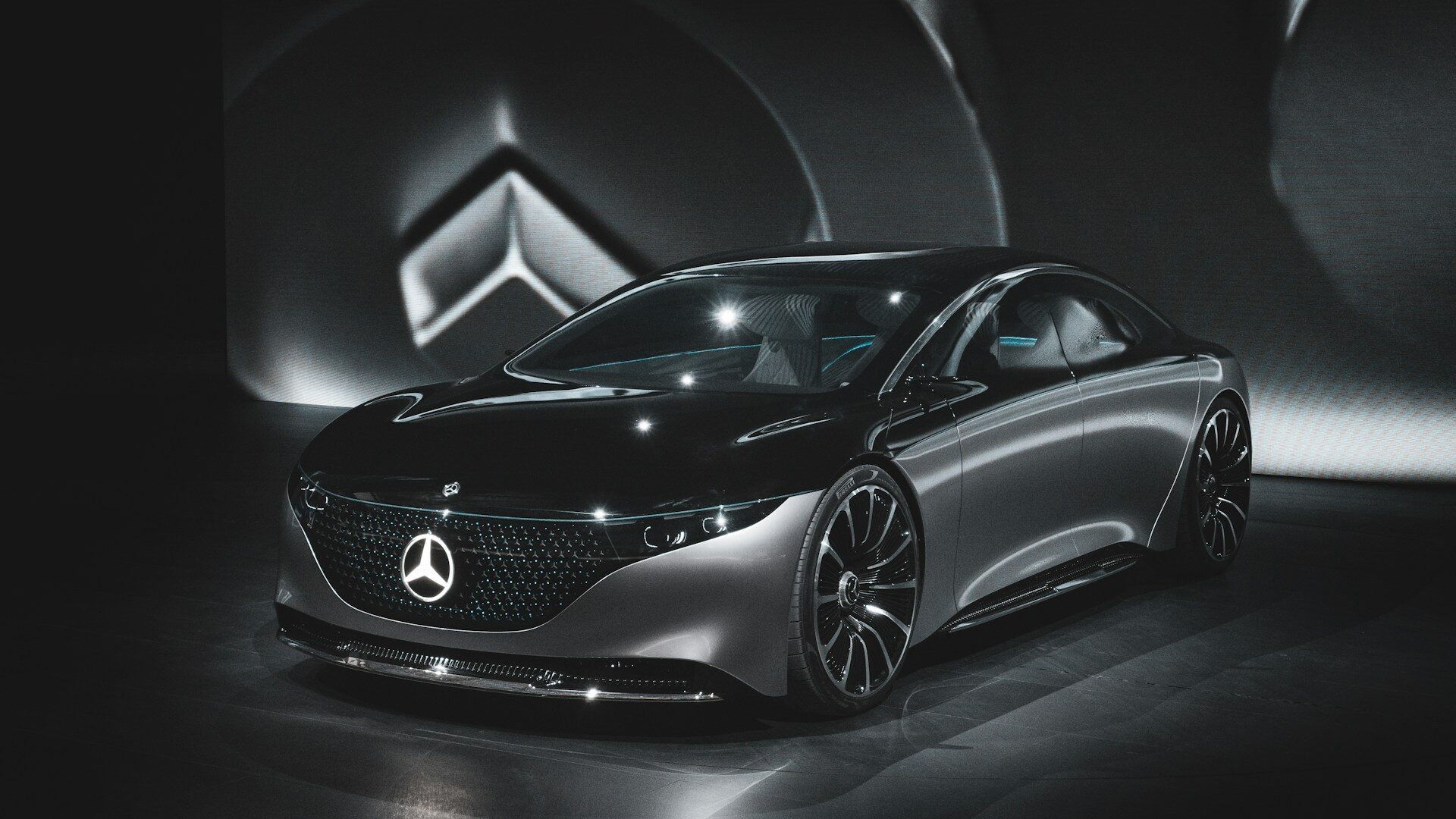
For twelve years, the “45” on the back of a Mercedes meant something specific: a hand-built turbocharged four-cylinder engine that AMG’s engineers kept squeezing for more power until it became, officially, the most potent production four-cylinder ever built. That engine, the M139, is dead. Its replacement isn’t a bigger engine, or even a smaller one. It’s three electric motors and zero cylinders. Mercedes-AMG unveiled the new CLA 45 4MATIC+ this week with 680 horsepower and not a single spark plug, and somehow that isn’t even the strangest part of the story.
Garage-worthy EDC gear, on sale this week.
Start with what actually changed. The new CLA 45 4MATIC+ arrives as a sedan and a Shooting Brake, both built on the same platform as the standard Mercedes-Benz CLA. Under the floor sits a 94-kWh battery on an 800-volt electrical architecture, feeding three axial flux motors, two on the rear axle and one up front, for a combined 500 kW (680 hp) peak and 450 kW (612 hp) continuous output, with 1,759 Nm (1,298 lb-ft) of torque split across AMG’s 4MATIC+ all-wheel-drive system. AMG quotes 2.7 seconds to 62 mph using the industry’s rollout method, a 168-mph top speed with the optional package, and a WLTP range over 416 miles. DC fast charging peaks at 330 kW, enough to add roughly 168 miles in ten minutes.
Here’s the detail worth pausing on. Axial flux motors are not a common production technology. In a conventional “radial flux” motor, the kind in nearly every EV on sale, the magnetic field runs perpendicular to the drive shaft. In an axial flux motor, it runs parallel to it, which lets engineers build something shaped more like a hockey puck than a soup can. That’s how AMG packages a motor producing up to 360 hp into a housing roughly 3.5 inches wide. Outside of Formula E and a handful of boutique hypercars, this layout has mostly stayed in prototype labs and low-volume specialty shops, because the flat, disc-shaped stator is harder to cool and more expensive to manufacture than a conventional design. AMG borrowed the layout from the GT 4-Door Coupe’s electric drive units, which means the compact CLA is now running motor technology that debuted on a car costing twice as much.
There’s a second engineering wrinkle buried in the spec sheet that matters more to owners than horsepower does. The front motor includes what AMG calls a Disconnect Unit, a mechanism that physically decouples the front motor from the wheels in a fraction of a second whenever the car doesn’t need all-wheel drive, cutting drag and saving range. It’s the electric equivalent of the disconnecting front differentials Detroit and Tokyo have used for decades on part-time four-wheel-drive trucks, and those systems have a well-documented history of clunks, actuator failures, and expensive dealer-only repairs once they age out of warranty. AMG is now betting that a mechanism which has never had to survive 1,298 lb-ft of torque can do exactly that, quietly, for the life of the car.
The battery itself tells its own story about how AMG actually functions inside the Mercedes empire in 2026. Its silicon-oxide-blended graphite anode cells, which AMG says boost gravimetric energy density by up to 20 percent, were developed first for the new Mercedes-Benz GLC, a family SUV. The flagship performance brand isn’t handing down its own halo technology to lesser Mercedes models anymore. It’s borrowing the SUV’s battery chemistry and putting a spoiler on it. That’s not a knock on the engineering. It’s simply how the economics of battery development work now: the cost of developing a new cell chemistry is too high to justify building one exclusively for a low-volume performance model, so it gets amortized across the whole lineup instead. Compare that with Porsche’s decision this month to shut down its in-house Cellforce battery operation rather than keep funding a bespoke cell program of its own, two neighboring German brands reaching opposite conclusions about whether owning your own battery chemistry is worth the money.
Then there’s AMGFORCE S+, the drive mode built to make an electric car feel like it isn’t one. AMG’s sound engineers strapped a real, combustion-powered A 45 S to a chassis dynamometer, mounted 13 microphones around it, and recorded more than 1,600 individual measurements of its turbocharged four-cylinder howling at full throttle. That recording library now gets mixed in real time and piped into the CLA 45’s cabin, complete with simulated gearshifts and a seat that shakes on cue. Mercedes-AMG spent a genuine engineering effort digitizing the exact engine note it just discontinued. The combustion CLA 45 S got its send-off as a Final Edition only last year. Now the company is paying a sound team to keep its ghost employed.
It’s also worth noting what’s missing. Since the early 1990s, every hand-assembled AMG engine has carried a small plaque bearing the signature of the single technician who built it, “One Man, One Engine,” the closest thing the brand has to a religious relic. AMG’s materials on the new HP.EDU electric drive units make no mention of any equivalent. That’s not a criticism so much as an honest acknowledgment: there isn’t really a way to sign a box of power electronics the same way, and AMG doesn’t seem to be pretending otherwise.
Widen the lens and the CLA 45’s identity crisis looks less like an isolated decision and more like where German performance brands are colliding right now. Porsche’s CEO spent part of this month reassuring 911 buyers that the car will never go fully electric, even as the company guts its own battery ambitions and writes down a chunk of its stake in Rimac and Bugatti. Mercedes-AMG is making the opposite bet with its own compact halo car, going all-in on electrons while keeping just enough combustion theater piped through the speakers to soften the transition. Neither company is wrong, exactly. They’re just running two different experiments on two different clocks, and the answer to which bet pays off won’t be obvious for years. Shelby found this out the hard way when it quietly rolled out its first EV to a muted reception a few years back, heritage badges do not automatically transfer their meaning onto a different kind of powertrain, no matter how the marketing department frames it.
None of this makes the new CLA 45 a bad car. Early numbers suggest it will be a genuinely quick one. But the lesson here isn’t about horsepower, it’s about what a badge is actually allowed to mean anymore. For three decades, “45” told you exactly what was bolted to the firewall. Today it just tells you AMG’s target lap time and how much its sound department billed by the hour. The engine used to define the badge. Now the badge just tells you how good the impression is.