
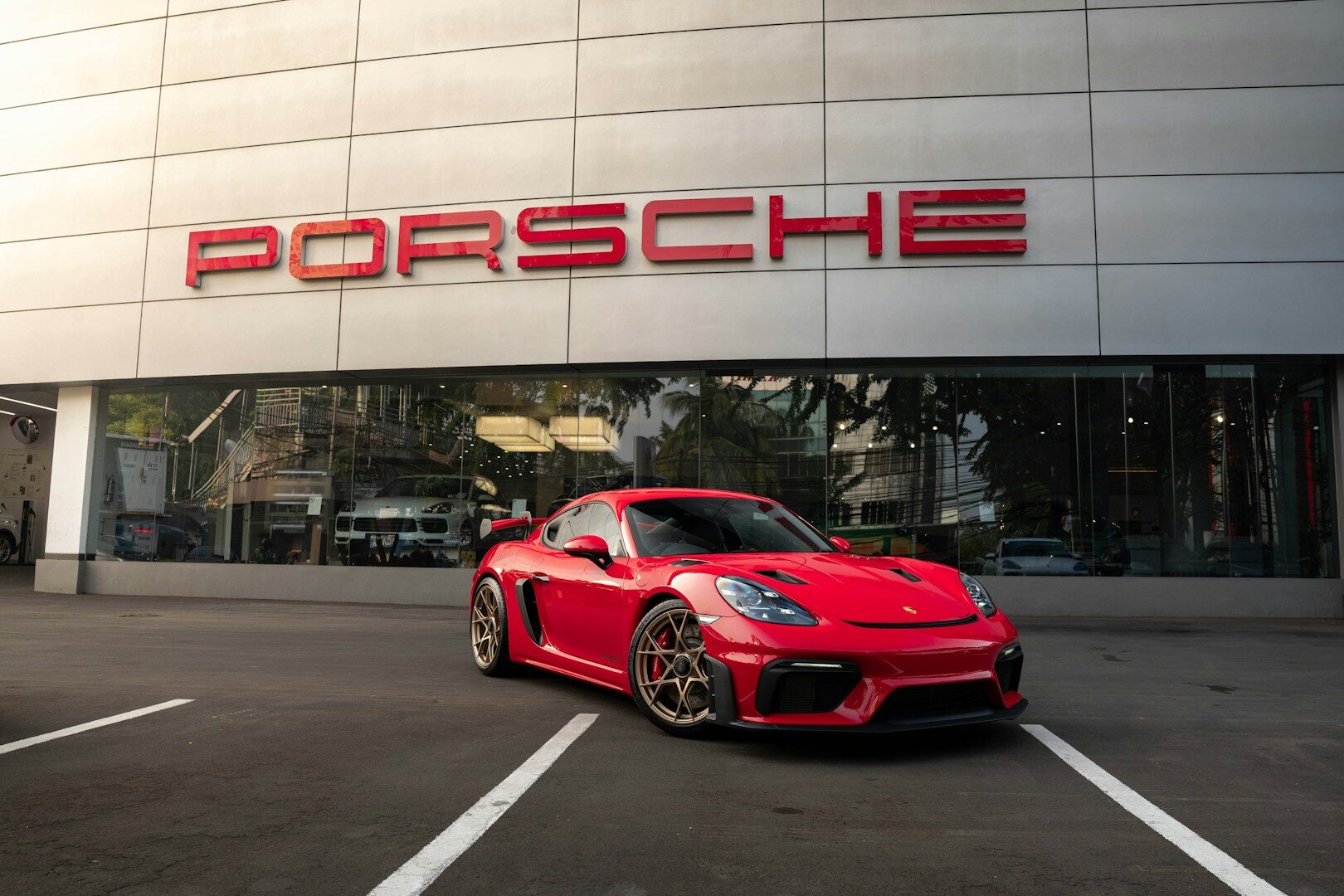
Porsche delivered 122,306 cars worldwide in the first half of 2026, a 16 percent drop from the same period last year. China fell 32 percent. North America fell 13 percent. Those numbers are real, and they’re the reason this week’s headlines are calling it a crisis. But the delivery count isn’t the story. The story is what Porsche has spent the last twelve months quietly burying to make that number survivable at all: an entire battery factory, an e-bike company, a software subsidiary, and its own stake in Bugatti.
Start with the plain numbers, because they set the stage. Porsche’s first-half report shows the 911 as the lone bright spot, up 19 percent on strong demand for GTS and Turbo derivatives, even as the company rules out a fully electric version of the car. Everything else slid: Cayenne deliveries down 9 percent, Macan down 22 percent, Panamera down 38 percent, the outgoing 718 down 73 percent as production wound down, and the all-electric Taycan down 25 percent. Layer on the first-quarter financial figures, revenue down 5.2 percent to 8.40 billion euros and operating profit down 21.9 percent to 595 million euros, and you get a company that’s smaller, thinner-margined, and still shrinking. None of that is new. The Auto Wire has already covered Porsche’s profit margin collapsing to 1.1 percent and the layoffs and EV strategy reversal that followed it.
What hasn’t gotten nearly enough attention is the graveyard. In a single press release on May 8, Porsche announced it’s shutting down three subsidiaries outright: Cellforce Group, the in-house battery cell developer it built from scratch in Kirchentellinsfurt; Porsche eBike Performance, the joint venture that made high-end e-bike drive units in Ottobrunn and Zagreb; and Cetitec, a Pforzheim-based software shop that wrote data-communication code for Porsche and the wider Volkswagen Group. More than 500 jobs go with them. Two weeks earlier, Porsche had already agreed to sell off its 45 percent stake in the Bugatti Rimac joint venture and its 20.6 percent stake in Rimac Group itself, handing both to a New York-led investment consortium.
Cellforce is the one worth sitting with, because it’s a genuine surprise even to people who follow this industry closely. Porsche broke ground on that factory back in 2021, aiming to build its own high-performance battery cells in-house rather than buy them from a supplier, the same logic that pushed rivals toward their own gigafactories. As recently as last August, Porsche was still defending the project while quietly shrinking Cellforce down to a research-only unit and trimming its workforce. Now, less than five years after the groundbreaking, the whole operation is being wound down. The lesson underneath the failure applies well beyond Porsche: battery cells are fundamentally a commodity business that only turns a profit at enormous scale, and a company building a few hundred thousand vehicles a year across a dozen different drivetrains can’t generate anywhere near the volume needed to make its own cell factory cheaper than simply buying from someone who already has one.
The other two closures tell a related story about discipline, not disaster. Porsche eBike Performance and Cetitec were both born in the same expansive, cash-flush era after Porsche’s 2022 IPO, when the company had public-market money to spend and every reason to bet on adjacent technology businesses. An e-bike drivetrain unit made sense when Porsche believed premium electrification would extend into every category its wealthy customers touched. A dedicated software subsidiary for in-car data communication made sense when every automaker was racing to insource digital capability rather than depend on suppliers. Neither bet was crazy in isolation. Closed in the same week as Cellforce, they reveal a company that spent several years diversifying outward and is now spending several years pulling it all back in. New CEO Michael Leiters put the mission as plainly as a public company ever does: “We must refocus on our core business.”
The Bugatti Rimac sale fits the same pattern, even though it involves a far more glamorous name. Porsche and Rimac Group set up the Bugatti Rimac joint venture in 2021, with Porsche holding a 45 percent stake and Rimac Group the rest, plus a separate 20.6 percent stake Porsche held directly in Rimac Group. That arrangement put Porsche engineering into the current Bugatti Tourbillon and gave it a front-row seat to Mate Rimac’s electric powertrain technology. Now both stakes are heading to a consortium led by HOF Capital, a New York investment firm, alongside BlueFive Capital. Mate Rimac keeps running the show and picks up new, deep-pocketed backers. Porsche gets cash and one fewer distraction. Nobody at Weissach is losing sleep over Bugatti volumes, but the sale is one more data point showing that anything outside the core sports car business is now expendable.
Here’s the detail that should surprise anyone who assumed Porsche’s electric transition was simply running late rather than running backward. In the 2025 financial year, the company’s battery-electric share of deliveries climbed to 22.2 percent, up from 12.7 percent the year before, a number Porsche cited as proof its EV strategy was ahead of schedule. In the first quarter of 2026, that same figure fell to 19.8 percent, down from 25.9 percent in the same quarter a year earlier. Porsche isn’t just slowing its electric ramp. It’s currently selling a smaller share of electric cars than it was selling a year ago, even with a new electric Cayenne in showrooms. The company still expects the full-year 2026 figure to land between 24 and 26 percent once Cayenne Electric volume builds, but the quarter-to-quarter reversal is the clearest sign yet that customer demand, not supply, has been the real constraint all along.
The combustion Macan is the clearest proof of that constraint. Porsche once planned for the Macan to go fully electric in Europe years ago. Instead, the gas-powered version is still in production in most markets outside the EU, will keep being built through the end of July 2026, and outsold the electric Macan by more than 4,000 units in the first half of this year alone. Keeping two completely different platforms alive under one nameplate is expensive: separate supply chains, separate crash certification, separate dealer training, separate parts inventories for a car buyer who might cross-shop either one. Porsche is paying that tax specifically because customers, especially in North America, kept showing up for gearheads and gasoline rather than electrons, and the expiration of the federal EV tax credit this past fall only reinforced the point.
Even Porsche’s factory footprint is being second-guessed. The company is reportedly weighing whether to pull Cayenne production out of Slovakia and consolidate it back home in Germany, the kind of reshoring decision that can trim logistics costs but raises new questions about labor rates and plant utilization at a moment when volumes are already shrinking.
China deserves its own mention, because a 32 percent drop sounds like collapse and isn’t quite that simple. Porsche has explicitly chosen not to chase Chinese volume with discounts, sticking to a value-over-volume approach even as domestic luxury EV makers undercut it on price and outspec it on software. That’s a defensible strategy for protecting resale value and brand equity. It also means a shrinking China business isn’t a bug in Porsche’s current plan, it’s the plan, and anyone betting on a near-term China rebound is likely to be disappointed.
There’s a fittingly ironic detail buried in all of this. The executive now dismantling Porsche’s most expansive era, Dr. Michael Leiters, spent thirteen years at Porsche earlier in his career with direct responsibility for the Macan and Cayenne programs, the same two model lines now caught in the middle of the combustion-versus-electric tug-of-war. He left for Ferrari, then ran McLaren Automotive, and returned as Porsche AG’s sole CEO on January 1, 2026, replacing Oliver Blume, who had spent a decade running Porsche AG and Volkswagen Group simultaneously before stepping back to focus on VW alone. Leiters isn’t an outside consultant parachuting in with a spreadsheet. He’s cleaning up a strategy partly built on the foundation he laid himself before he ever left.
It’s worth pausing on how much all of this restructuring cost, because the number is almost absurd for a company with Porsche’s reputation. Extraordinary charges tied to the realignment, the battery write-down, and US tariffs totaled roughly 3.9 billion euros in 2025 alone, dragging Porsche’s operating margin down to 1.1 percent from 14.1 percent the year before. For context, 1.1 percent is closer to the margin of a grocery chain than a company that built its entire brand on being the auto industry’s profit machine. Porsche isn’t alone in absorbing this kind of hit, either; the same week Volkswagen announced sweeping job cuts and Honda stumbled through its own guidance cut, a sign that this reckoning is spreading well beyond one address in Stuttgart. Porsche has already warned that 2026 will carry its own one-off charges, meaning the bill isn’t fully paid yet.
None of this means Porsche is in the kind of trouble a struggling mass-market brand would be in. The balance sheet is still healthy, net liquidity is still strong, and the 911 is still selling briskly to people who don’t much care what a spreadsheet says. But the framing matters. A 16 percent drop in deliveries is a market problem, the kind that better products and a stronger economy eventually fix. Shutting down a battery factory, an e-bike brand, a software subsidiary, and your stake in the world’s most famous hypercar maker within the same few months is not a market problem. It’s a company admitting, subsidiary by subsidiary, that it spent its most confident years building things it never actually needed.
That’s the detail worth remembering long after the delivery figures fade from the headlines: Porsche isn’t reporting a sales crisis. It’s reporting the bill for a five-year party it threw for itself, back when everyone in the industry was certain the future would be electric, in-house, and profitable immediately. The 911 will outlive all of it. Whether the rest of Porsche’s grand ambitions do is still very much in question.