
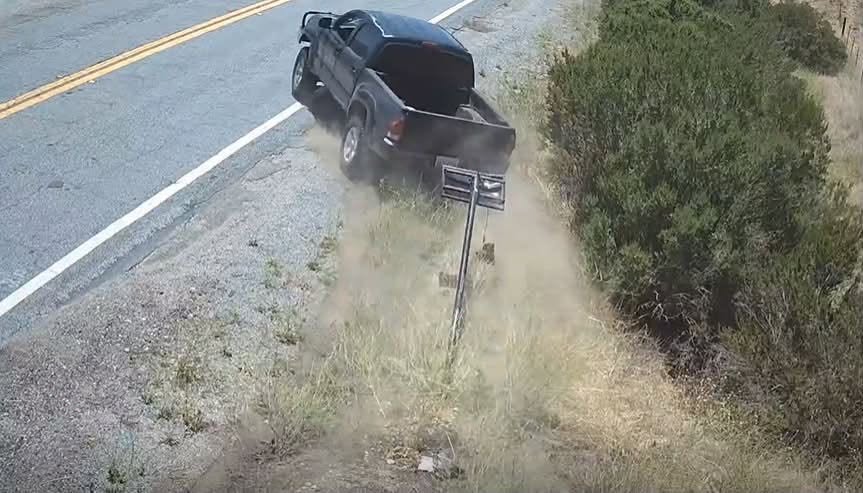
Marcus Bee allegedly drove roughly 150 miles from his home in Pismo Beach to a remote stretch of agricultural backroad in Monterey County, steered his pickup truck into a roadside ditch, and ran over a pole holding a solar-powered camera. Then, according to investigators, he did it two more times, at two more locations.
The Monterey County Sheriff’s Office says the equipment Bee destroyed belonged to the Flock Safety camera network, and that his own vandalism was captured by other surveillance cameras nearby, ones he apparently never noticed. Detectives used that footage, along with other investigative leads, to identify him. He was booked on a felony vandalism charge, bail set at $30,000.
That is the story county officials want told: a man broke the law and got caught by the very technology he tried to destroy. It is true, and it is tidy. It is also not the interesting part.
The interesting part is what Bee actually destroyed, and how little it cost the company that owns it.
Flock doesn’t sell cameras to police departments and walk away. It sells access to a network, billed as a subscription. Its license plate readers are solar-powered, connect over LTE, and by the company’s own account install in hours, with no wiring, no permits, and no IT department required. Installation, maintenance, and replacement are bundled into one plan. The hardware is designed to be cheap, quick to deploy, and quick to swap. It is closer to a sprinkler head than a bridge.
There’s also a road-safety wrinkle nobody has flagged. The sheriff’s own photos show Bee’s truck leaving the roadway and driving through a ditch to reach the poles. Standard signs and light poles near public roads are engineered to break away on impact specifically to limit injury and vehicle damage during an unintended road departure. Whether Flock’s off-the-shelf poles are held to that same standard isn’t something the company publishes, and it is worth asking, especially as this hardware keeps spreading from parking lots and intersections onto rural highway shoulders.
That design is also why Bee’s rampage barely registers. Flock says its network now spans more than 5,000 law enforcement agencies, 6,000 communities, and 1,000 businesses, generating billions of plate reads every month, by its own description the largest fixed license-plate-reader network in the country. Three poles in rural Monterey County are a rounding error. Marcus Bee didn’t break a surveillance network. He generated a maintenance ticket.
Here’s the detail nobody covering this story has mentioned: whatever bill Bee ultimately owes for “thousands of dollars” in damage almost certainly isn’t going through an insurance company. Standard auto policies exclude intentional acts. Comprehensive coverage pays out when a deer wrecks your bumper, not when you deliberately drive your own truck into a ditch to destroy government property. If he’s convicted, restitution typically gets ordered against the defendant personally, on top of a fine, on top of a felony record. The criminal charge may end up being the cheaper problem.
There’s a second detail, buried in the sheriff’s own press release, that says more than anything about Bee. Unprompted, the department stated that its cameras “are not used for civil immigration enforcement or federal immigration investigations.” Nobody asked. That is the kind of sentence a department includes only when it already knows what the next public-records request is going to be about.
California law already restricts sharing automated license-plate data with out-of-state or federal agencies. That hasn’t stopped it from happening anyway: a 2020 state audit of four California law enforcement agencies found access and retention practices that fell outside their own written policies. The Auto Wire has covered this exact tension before, including Flock’s own public pledge not to share data with federal agencies, and the fallout in DeKalb County, Georgia, where a $19 million, decade-long, no-bid Flock contract produced its first felony case without ever facing competitive bidding.
None of this is new. The Auto Wire has been tracking camera vandalism across the country for months, and the pattern holds: cut wires, gunfire, bolt cutters, and now, in Monterey County, a truck. Every time, the contracts already anticipated it. What sets Bee’s case apart is the premeditation. A 150-mile round trip isn’t road rage; it looks more like a mission. The location matters too. Lockwood and Bradley aren’t dense urban corridors with an active civil-liberties debate already underway. They are unincorporated ranching communities off Highway 101, the kind of place where a plate reader shows up not because of a city council vote, but because a subscription got renewed.
That expansion keeps outrunning the legal ground underneath it. A recent Supreme Court ruling on cellphone location tracking has already handed Flock’s critics fresh ammunition in a pending Fourth Circuit case over whether warrantless, always-on plate tracking violates the Fourth Amendment. If that case breaks the wrong way for Flock, its cameras won’t need a truck to come down.
For now, the math favors the network. A 40-year-old man is facing a felony, a bail bond, personal restitution, and an insurer that already knows better than to help him. Flock will have a new pole bolted into the ground within days, charging in the sun, doing exactly what it did before. The cameras didn’t survive because they’re indestructible. They survived because destroying one was never actually a threat to the business.