
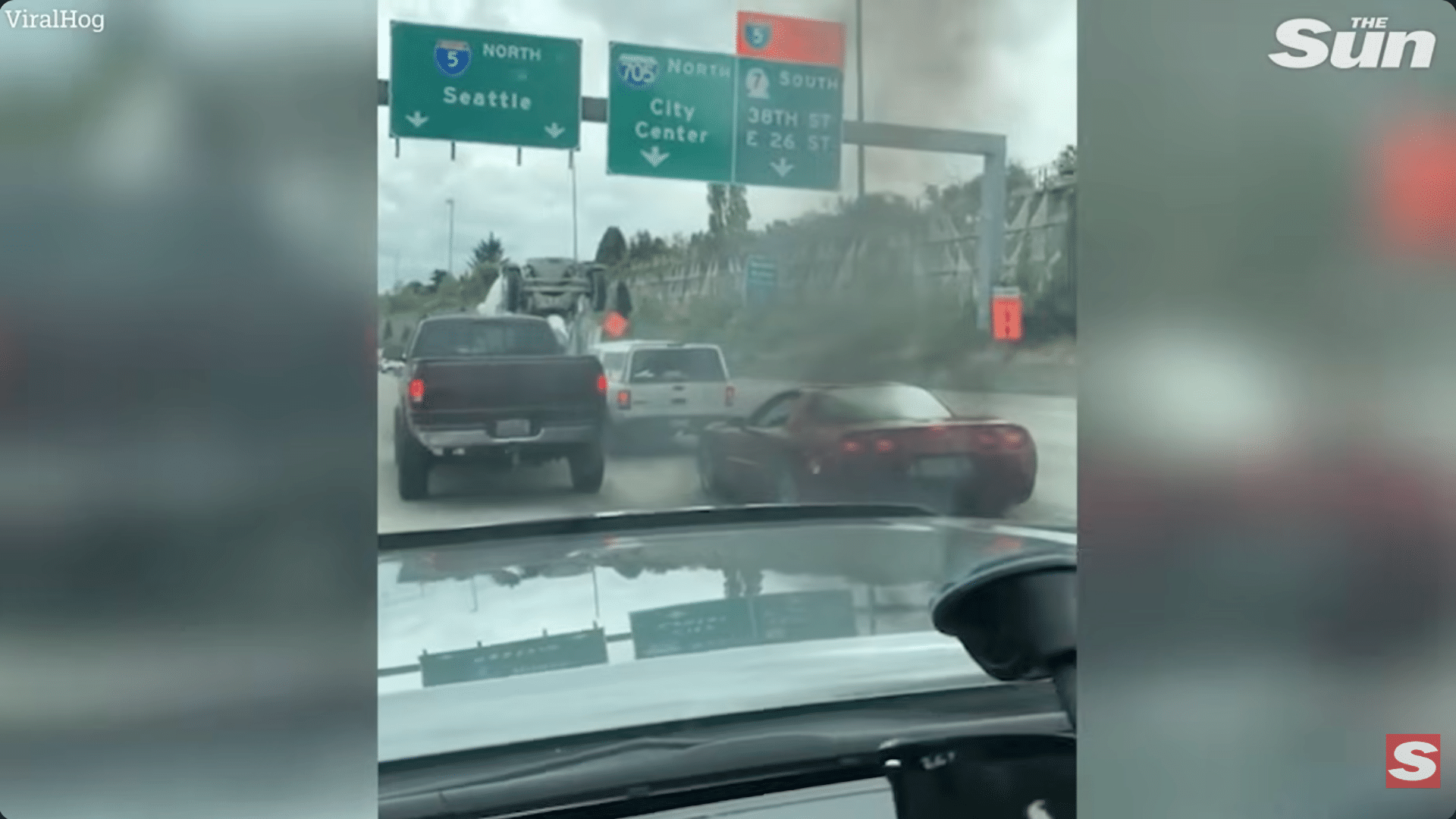
A modern diesel pickup’s particulate filter exists to catch soot, so a truck that can bury a Corvette in black smoke on demand has, in all likelihood, had that hardware altered. A short clip labeled as a 2018 merge dispute in Tacoma, Washington, shows the result: a dark pickup aims its exhaust at a red C4-generation Corvette that wouldn’t give way, and the car disappears into a cloud. I could not confirm the date, the location or the drivers, and the truck’s model year and what is under it are unknown, so treat the label as the uploader’s. What the footage does support is a view of where the legal exposure sits, and it isn’t with the driver who guarded the lane.
<iframe width="560" height="315" src="https://www.youtube.com/embed/82x-CLSAQoc?si=MW_JOaCg0g1j-q_0" title="YouTube video player" frameborder="0" allow="accelerometer; autoplay; clipboard-write; encrypted-media; gyroscope; picture-in-picture; web-share" referrerpolicy="strict-origin-when-cross-origin" allowfullscreen></iframe>What EPA Found When It Counted Deleted Pickups
In a report enclosed with a letter dated November 20, 2020, EPA’s Air Enforcement Division concluded that emissions controls had been removed from more than 550,000 Class 2b and 3 diesel pickups over the previous decade. The agency’s extrapolated estimate is about 557,000 trucks, covering deletions from 2009 through 2019, and it projects about 570,000 tons of excess nitrogen oxides and about 5,000 tons of excess particulate matter over those trucks’ remaining lifetimes. EPA put the air-quality effect at more than 9 million additional compliant trucks.
The filter is the part that holds soot back, and EPA’s enforcement alert on tampering lists diesel particulate filters and their sensors among the parts that may not be removed or disabled. The same alert says investigators found hundreds of thousands of pickups with controls completely removed, mostly under “competition only” claims.
Why Competition Only Doesn’t Cover a Freeway Merge
EPA’s longstanding practice, as that alert describes it, is not to take enforcement action against owners who remove controls from certified vehicles that are used solely for competition and no longer driven on public roads. A pickup in merge traffic fails the second half of that test. The money mostly flows toward sellers and installers instead. Civil penalties reach $4,819 per defeat device manufactured, sold or installed, or per vehicle tampered, as of January 13, 2020, and Performance Diesel paid $1.1 million after selling at least 5,549 products that enabled removal of filters and catalysts. EPA’s national enforcement initiative on aftermarket defeat devices closed 172 civil cases for $55.5 million in civil penalties from fiscal 2020 through 2023, plus 17 criminal cases.
Owners meet the problem at other counters. The alert says states may prohibit operating or registering tampered vehicles and that tampering can void warranties and may affect insurance coverage. Diesel warranty fights are already reaching court, as a lawsuit over GM Duramax engines shows, and a deleted truck hands a manufacturer a simpler reason to deny a claim. On the registration side, emissions-test holds on registration renewals show how much leverage a state has over a vehicle that can’t pass.
What Washington’s Smoke Rule Says
Washington’s RCW 46.37.390 never uses the phrase rolling coal. Subsection 2 says that below 3,000 feet, a vehicle first sold and registered as new on or after January 1, 1971, may not discharge an air contaminant for more than ten seconds that is as dark as Ringelmann No. 1 or that obscures an observer’s view to an equal or greater degree. Tacoma sits well below that elevation. The second test is the one that matters at a merge, because it measures how much road the driver behind can still see, and nobody needs a Ringelmann chart to judge that.

EPA’s alert ties particulate matter to premature death in people with heart or lung disease, nonfatal heart attacks, aggravated asthma and decreased lung function. Those risks fall on whoever is in the cloud, including a cyclist or a child at a bus stop, not only the person in the Corvette.
The Merge Math Behind the Fight
The argument that started it is the cheaper one to settle. The Minnesota Department of Transportation’s late-merge guidance tells drivers in slow, congested traffic to use both lanes and take turns at the merge point, and in light traffic at highway speed to merge early. It says the zipper shortens the overall backup by up to 50 percent, with about 40 percent common. It also reports no measurable effect on an individual motorist’s travel time through the work zone. On those numbers, the Corvette driver wasn’t saving anyone a minute by guarding the lane, and the truck driver wasn’t costing anyone one by running it to the end. The figures come from work zones and the clip doesn’t show traffic speed, so I can’t say which rule applied. Neither answer comes close to justifying a cloud.
The part that outlasts the clip is on the used market. A deleted Class 2b or 3 pickup can carry EPA’s list of consequences, including a state refusal to register it, a voided warranty and a coverage question, to whoever owns it next, long after the shop that sold the tune has been paid. Ask for emissions records before the price conversation starts.
If one driver provably started it with a rude gesture, should that cut the penalty for answering with a smoke screen, or should the smoke be treated the same no matter what came first?