
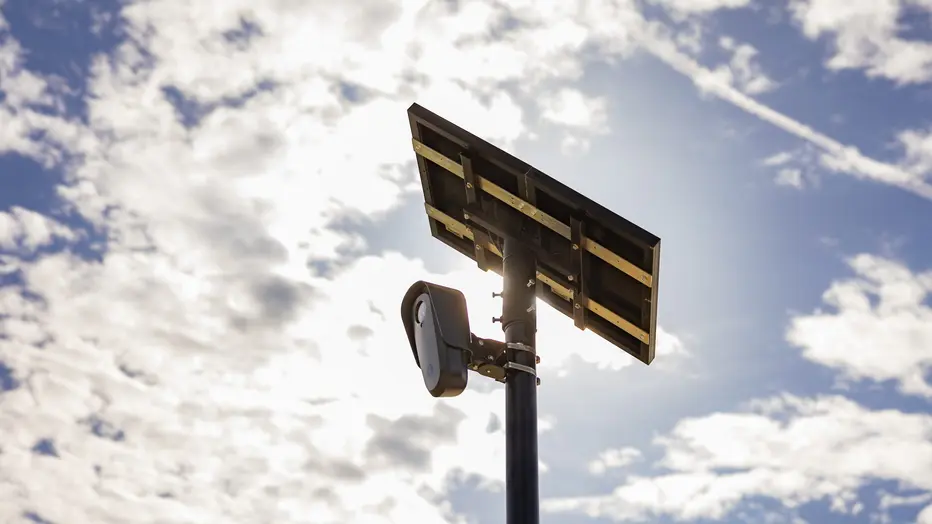
Every driver who passes through DeKalb County, Georgia gets photographed, logged, and run against a rapidly growing vehicle database, courtesy of a camera network the county just committed to for the next ten years. A sheriff’s sergeant with seventeen years on the job allegedly used that same database to look up things that had nothing to do with police work. That’s the headline. It shouldn’t be. The real story is what prosecutors had to charge him with once they caught him, because it has nothing to do with the license plate law at all.
On September 23, 2025, DeKalb’s Board of Commissioners approved Change Order No. 1 to Contract No. 2000081 in a single sitting: a ten-year, sole-source master services agreement with Flock Group Inc., not to exceed $18,969,939. County records describe it as funding additional license plate reader cameras, AI-enabled drone first responders, mobile security trailers, more surveillance cameras, and a service called Flock 911, all feeding a new Real-Time Crime Center. County CEO Lorraine Cochran Johnson unveiled the program, branded Digital Shield, on October 1 as a defining moment for public safety in the county.
Less than ten months later, on July 17, DeKalb County Sheriff’s Sergeant Kabiru Salawu, a member of the department since August 2009, was fired and arrested. An internal review found he had run queries through the county’s Flock system for reasons unrelated to his job. He’s charged with a felony count of violation of oath of office and a misdemeanor count of misusing license plate data, and he’s being held without bond. Sheriff Melody Maddox said the conduct amounted to “a serious breach of the public’s trust.” Investigators haven’t said what Salawu allegedly searched for or how they caught him, and the case remains open.
Here’s the detail that got buried under the arrest itself: Salawu isn’t just the latest Georgia officer caught misusing Flock’s network. He’s the first one charged under a statute that has nothing to do with license plates. Every other documented case this year, the Albany officers, the Fayetteville officers, the Conyers supervisor who spent four months checking her partner’s location, was handled under Georgia’s plate-data misuse law, a misdemeanor, or simply ended in termination. Prosecutors reached past that statute for Salawu and picked violation of oath of office instead, a felony that carries one to five years in prison. That’s not a paperwork distinction. It’s an admission that the penalty built into the surveillance law itself wasn’t considered enough.
Worth understanding, if you’ve never looked closely at what one of these cameras actually records: Flock’s pitch to law enforcement was never just about plates. Each camera builds what the company calls a vehicle fingerprint, cataloging make, color, body damage, roof racks, bumper stickers, and even temporary tags, all timestamped and geotagged, then shared across a network Flock says spans more than 6,000 communities and roughly 5,000 law enforcement agencies. A driver who swaps plates or covers one doesn’t disappear from that system. A distinctive paint job, a roof rack, or a faded parking sticker can be enough to reconstruct a route. For car enthusiasts, that’s the detail worth sitting with: the more memorable your car looks, the easier it is to track, plate or no plate.
Then there’s the money, and how DeKalb spent it. Sole-source procurement, awarding a contract to one vendor without opening it to competing bids, is standard practice once a county already runs a proprietary platform like Flock’s, because switching vendors would mean scrapping years of camera hardware, integrations, and training. But standard practice is exactly the problem here. Nobody ever got the chance to underbid a contract approaching $19 million, and DeKalb locked itself into this vendor’s pricing, terms, and data-sharing rules for a full decade before a single incident tested whether any of it held up.
That lock-in is the actual business model, and it survives bad headlines better than you’d expect. When Denver and Douglas County, Colorado dropped Flock earlier this year, both signed with a competing plate-reader vendor within days, because by then the surveillance infrastructure, the drones, the crime center dashboards, the officer training, wasn’t really optional anymore. Even the departments now backing away from Flock specifically, including LAPD and a handful of small Connecticut towns, are discovering that the harder question isn’t which vendor runs the cameras. It’s whether any city that has built a Real-Time Crime Center around this kind of data can meaningfully unplug it at all.
The same audit trail DeKalb points to as proof of accountability is also getting harder for outsiders to check. Flock’s newer Audit Assistance tool is what actually caught Salawu’s pattern, an AI layer that flags searches falling outside a department’s stated policy instead of leaving supervisors to comb through logs by hand. But this year, the company also began stripping officer names from cross-agency audit logs and dropping license plate numbers from records released through open records requests, after roughly 200 law enforcement leaders complained that activists were using that public data to identify undercover officers. Georgia alone has produced more than a dozen documented Flock misuse cases in about six weeks. The pattern is detailed case by case in our running record of reported misuse, and it’s worth reading in full before assuming Salawu is an outlier.
None of this happens in a legal vacuum. A pending Fourth Circuit case, reshaped by a recent Supreme Court ruling on cellphone location tracking, could eventually decide whether an officer needs a warrant to run a plate through a network like this one at all. Meanwhile, frustration with these camera poles has started showing up in more direct ways: several jurisdictions have seen Flock hardware vandalized or torn down entirely, an approach that solves nothing about the underlying contract but says plenty about how residents feel when they can’t opt out of being logged. For a full accounting of what these cameras get wrong even when nobody’s abusing them, our case-by-case record of reported Flock errors is a good place to start.
DeKalb’s own announcement promised residents transparency, accountability, and ethical data use, built in from day one. Nine months later, the system delivered exactly one arrest, and it took a felony statute borrowed from outside the surveillance law to make it stick. That’s not proof the safeguards failed. It’s proof of what a ten-year, sole-source contract actually buys a county: not protection against misuse, just a better paper trail for whenever it happens anyway. DeKalb didn’t buy a camera system. It bought a decade-long subscription, and subscriptions renew whether or not anyone ever checks how the last year went.