
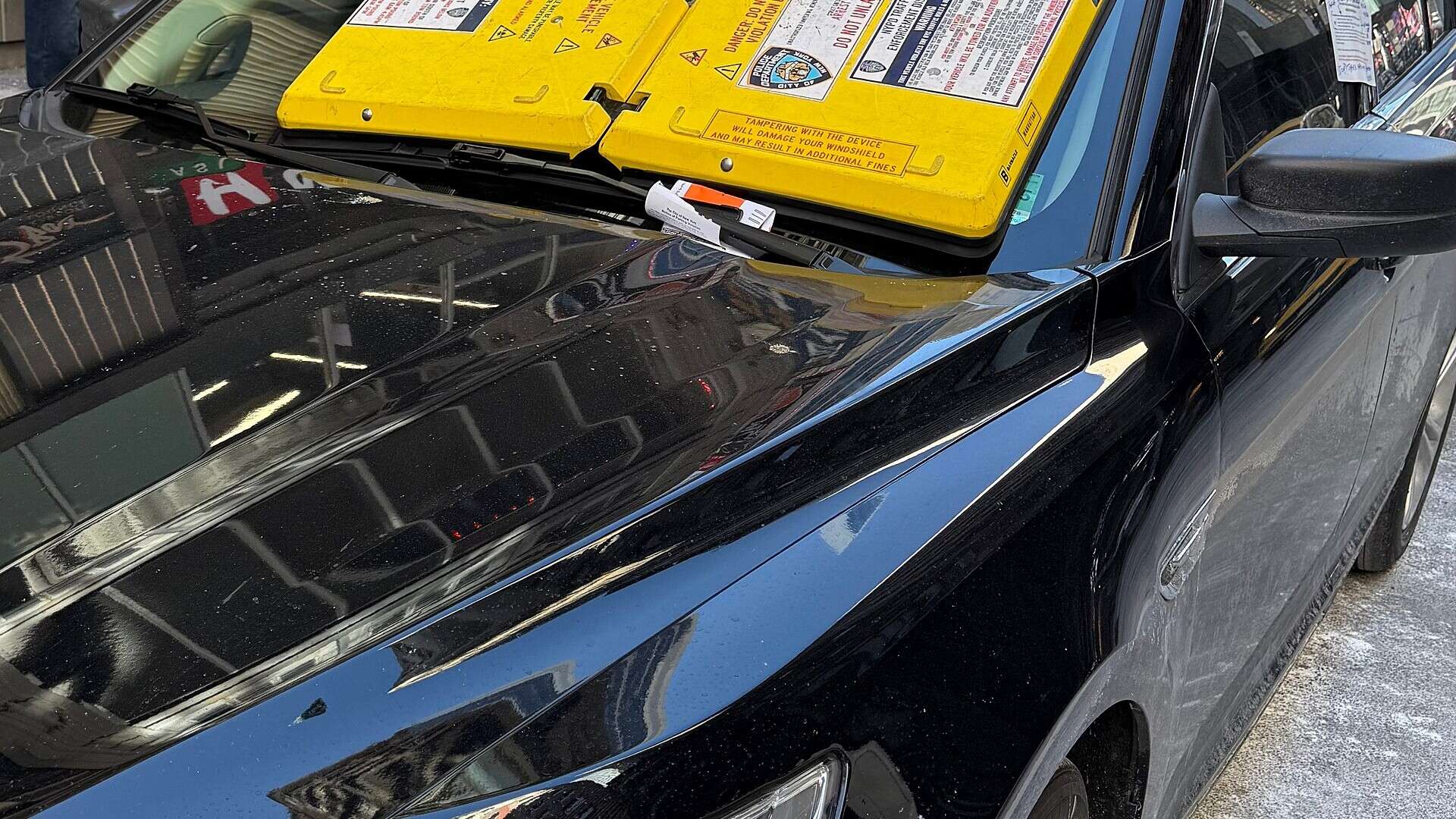
San Diego State University will put a yellow Barnacle across your windshield if your car has five or more unpaid parking violations more than 21 days past due. Getting it off, according to the university’s transportation office, costs a $150 immobilization fee, a $300 refundable deposit and every outstanding fine, all due within 48 hours of the device going on or the car may be towed.
The campus is within its rights. California’s Vehicle Code gives that power to police and public parking enforcers on public land, then denies it to everyone else in a single sentence. An apartment manager, a condo association or a private lot operator in California who sticks the same device on a car is doing something the statute reserves for government enforcers, and the state Attorney General’s office concluded in 2004 that a private security firm booting a car in a private lot was tampering with it, a misdemeanor.
What a Barnacle costs a driver at San Diego State
The Barnacle is a folding panel that grips the glass with suction cups. Its maker, Barnacle Parking, says the cups hold with 1,000 pounds of force, that an alarm sounds if the device is tampered with or the car is moved, and that GPS tracks every unit. The driver calls the number on the device or visits the website, pays, and gets a release code.
SDSU’s rules add a clock. The driver has to drop the unit in one of four campus drop boxes within 12 hours of removing it or lose the $300 deposit. Moving an immobilized car, including driving it off campus, brings an immediate tow at the owner’s expense. When windshield damage keeps a Barnacle from sticking, the university uses a conventional wheel boot instead.
The university cites Vehicle Code Section 22651(i)(1) as its authority. That subsection covers vehicles found on a highway or public land with five or more parking notices the owner ignored for 21 calendar days after the citation, or for 14 days after a delinquency notice was mailed. SDSU’s five-ticket, 21-day trigger is the statute’s trigger.
The Vehicle Code sentence that shuts out private lots
Immobilization in California is governed by Section 22651.7. Subdivision (a) lets a peace officer, or a regularly employed and salaried employee who enforces parking laws for the jurisdiction, immobilize a vehicle on a highway or public lands when it carries five or more delinquent tickets. That power comes with conditions. Parking tickets must warn that repeat violations can lead to impound or immobilization, and the driver can demand to be taken before a magistrate or a parking hearing examiner in the county instead of paying on the spot.
Subdivision (b) is one line: “A person, other than a person authorized under subdivision (a), shall not immobilize a vehicle.”
The ban turns on the word immobilize. Nothing in the text depends on whether a device clamps a wheel or suctions to the glass. Barnacle Parking pitches the product to HOAs and property managers as a friendlier alternative to towing, but its job is to keep a car from being driven until someone pays, which is what the statute forbids private parties to do.
The state’s top lawyer has already applied this reasoning to private enforcers. In Opinion No. 03-1204, issued Aug. 12, 2004, at the request of then-Ventura County District Attorney Gregory D. Totten, the Attorney General’s office concluded: “A private security firm, acting pursuant to a contract with a property owner, may not immobilize a vehicle that is impermissibly parked in a private parking lot by affixing a ‘boot’ device to the vehicle.”
The opinion rested on Section 10852, which bars anyone from willfully injuring or tampering with a vehicle without the owner’s consent. The office found that placing a boot to immobilize a car is tampering, and Section 40000.9 makes a 10852 violation a misdemeanor rather than an infraction. Attorney General opinions don’t bind courts, but California courts give them considerable weight.
That opinion addressed boots. In January, Karyn A. Larko of the California community-association law firm Epsten, APC advised associations that the same reasoning reaches the Barnacle, because it serves the same purpose even though it attaches differently, and that towing remains their lawful enforcement tool.
California caps private towing charges but not private Barnacle fees
California does give private property owners a way to deal with cars parked where they shouldn’t be. Section 22658 lets an owner, explicitly including a common-interest development association, have a vehicle towed if the property has the required signs. That law spells out in detail what the driver can be charged. A tow or storage charge is excessive if it exceeds the greater of what the local police agency’s contract tower would charge or the rate the California Highway Patrol approved for that operator. If the owner returns after the car is hooked up but before it leaves the property, the tow company can charge no more than half its regular towing fee.
The penalties are written in, too. A tow company that overcharges a driver is civilly liable for four times the amount charged. Doing it knowingly is a misdemeanor punishable by a fine of up to $2,500, up to three months in county jail, or both.
None of that applies to a Barnacle applied by a private operator. The towing rules cover towing, and because Section 22651.7(b) bars private immobilization outright, the code sets no price for a release it never allows and no four-times penalty for overcharging on one. A driver who finds a Barnacle on a car in a California apartment lot faces whatever release fee, deposit and return deadline the operator chose.
Barnacle Parking’s FAQ lists each device at $300 a month. An operator paying that has to recover it somewhere, and the release fee is the obvious place.
Why driving away with it is also a violation
Section 26708(a)(1) says a person shall not drive a motor vehicle “with any object or material placed, displayed, installed, affixed, or applied upon the windshield or side or rear windows.” A separate paragraph, (a)(2), covers objects that block the driver’s view. Paragraph (a)(1) covers anything attached to the glass, whether it blocks the view or not. SDSU cites the same section on its Barnacle page.
So a California driver can be cited for driving with a Barnacle attached even when the device had no lawful business being there. Prying it off has its own risks: the maker says it holds with 1,000 pounds of force, it carries an alarm and GPS, and it remains someone else’s property whether or not it was lawfully applied.
Philadelphia is writing rules for the same device
Other cities are still working out where the device fits. In Philadelphia, Councilmember Cindy Bass introduced legislation that would class barnacles with other immobilization devices and require a police-issued ticket before one could be used, WPVI-TV reported in March. California’s answer is already in statute; the current text of Section 22651.7 dates to a 2006 amendment.
Public enforcer or private lot: what the California rules give a driver
The first fact that matters is who applied the device and where. On a street, a campus or other public land, a Barnacle from a government enforcer comes with Section 22651.7’s process, including the right to demand a hearing before a magistrate or hearing examiner rather than paying first, and at SDSU a deposit that comes back when the unit is returned on time.
On private property in California, the statute says no one but a public enforcer may immobilize a car, and the 2004 opinion treats a private immobilizer as committing a misdemeanor, which puts enforcement in the hands of local police and prosecutors. What the code does not provide is a refund formula. The towing law spells out four-times damages for an overcharge; a driver trying to recover a private Barnacle fee paid under protest would have to bring a civil claim without that statutory multiplier.
Barnacle Parking is selling to associations and property managers, and California’s ban has not changed. The thing to watch is whether a California lot operator, or the company, asks Sacramento to open a private lane for the device with fee limits like towing’s, or whether a district attorney tests Section 10852 against a Barnacle first.
Should California let private lots and HOAs use Barnacles under the same price caps it puts on tow trucks, or keep immobilizing cars a power reserved for police and public parking enforcers?
Top photo: A Barnacle immobilization device on a windshield in Manhattan, February 2025. Photo: Z22 via Wikimedia Commons, CC BY-SA 4.0.
