
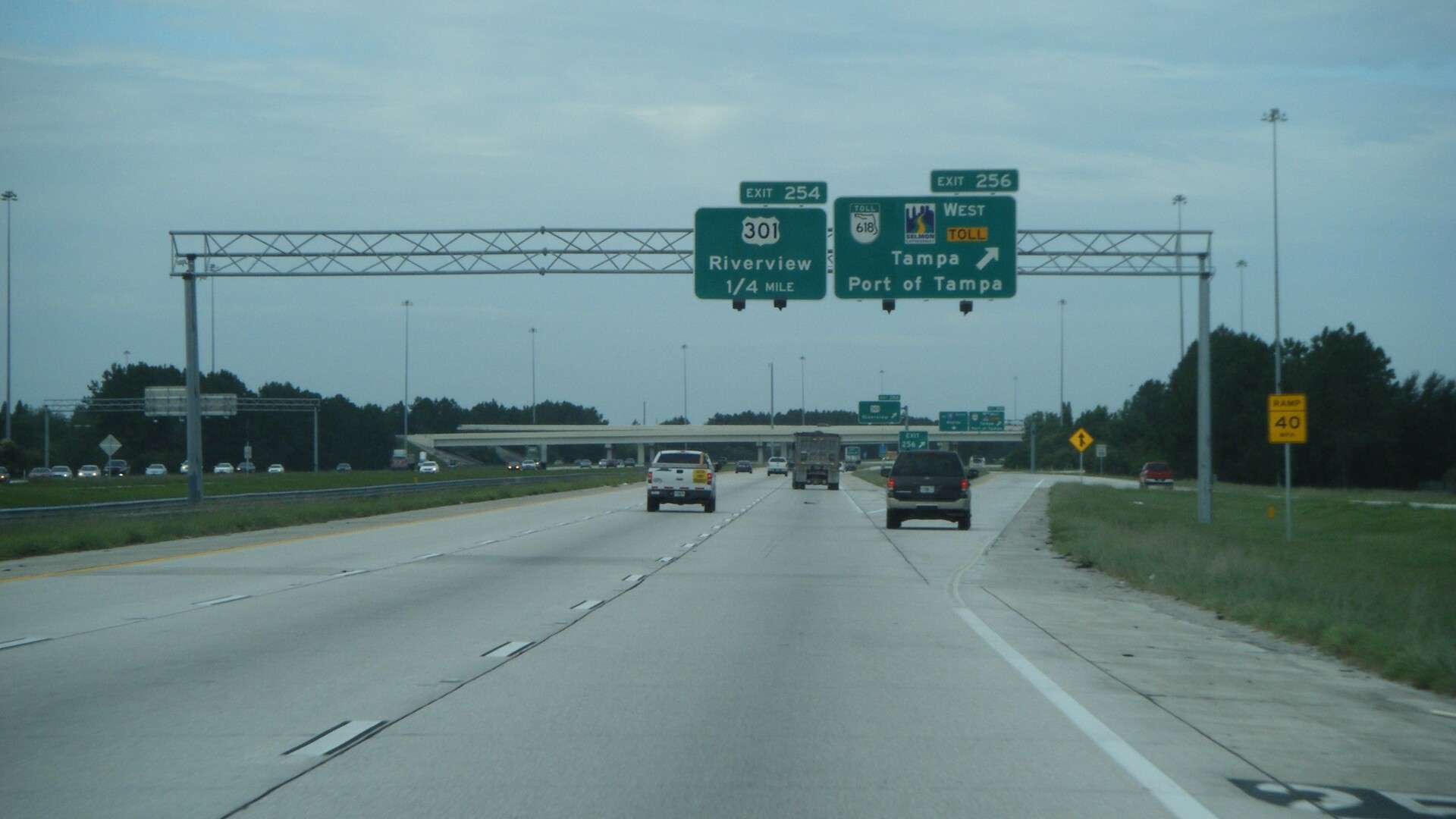
Lead photo: Southbound Interstate 75 in Brandon, Hillsborough County, Florida. Photo by Dough4872 via Wikimedia Commons, public domain.
Hillsborough County sheriff’s deputies stopped Darius Ford, 28, on northbound Interstate 75 near East Fowler Avenue in Tampa, Florida, at 12:41 p.m. on Monday, Sept. 28, by dropping a Grappler net from the front of a patrol car and letting it wind around his rear tire, the sheriff’s office said in a Facebook post that included the video. The agency called Ford a wanted felony suspect. He was booked on 16 felony charges, and according to the full charge list reported by Tampa station WTSP, not one of them is fleeing or eluding.
The Grappler is sold as a way to end police chases. On I-75 on Sept. 28, the sheriff’s office used it on a car whose driver, by the agency’s own account and charge list, has not been accused of fleeing. Most of what he is charged with comes from Florida’s sex offender registration law, which treats a registrant’s cars and driver license the way it treats a home address, and two of the counts involve vehicles he owned.
What the sheriff’s I-75 video shows
The clip the Hillsborough County Sheriff’s Office posted runs about a minute. It opens with footage from the agency’s aircraft over the interstate, then cuts to a patrol car’s dashcam directly behind a dark sedan that, on video, looks like an older Dodge Charger. Traffic ahead of the sedan is slowing. The patrol car closes to a few feet off its rear bumper, and moments later white smoke pours off the sedan’s right rear tire as the tether wraps it. The car rolls to a stop on the shoulder.
The sheriff’s office described the sequence this way: “Deputies worked to slow him down, then deployed the Grappler, which wrapped around his rear tire and brought his vehicle to a stop on the shoulder.” The agency said Ford followed deputies’ commands, stepped out with his hands visible and was arrested. WTSP reported that he can be heard on the video asking deputies why he is being detained.
Sixteen felony counts, most under Florida’s registry law
The sheriff’s post listed two charges by name, possession of a controlled substance and 10 counts of sexual offender providing false information after registration, and said there were 16 felonies in all. WTSP’s list fills in the rest: possession of drug paraphernalia; failure to report for driver license or ID card renewal; failure to report within 48 hours of vacating a residence; and two counts of failure to report within 48 hours of a change in vehicles owned.
These are accusations. Ford has not been convicted of any of them, and the sheriff’s statement does not say what information he is accused of falsifying, which vehicles are involved, or whether he has a lawyer.
The charges track Section 943.0435 of the Florida Statutes, and the car rules in it are stricter than most drivers would guess. When a person first registers, the sheriff’s office takes down the make, model, color, VIN and license tag number of every vehicle the registrant owns. After that, the statute requires a registrant to report “within 48 hours after any change in vehicles owned,” online or in person at the sheriff’s office. A registrant also has to appear in person at a driver license office every time the license or ID card comes up for renewal, and Florida prints “943.0435, F.S.” on the front of that card under Section 322.141. Any officer handed that license at a traffic stop sees it.
Missing one of those deadlines is a third-degree felony, which in Florida carries up to five years in prison and a $5,000 fine under Section 775.082 and Section 775.083. The count totals come from one sentence in subsection (9)(a): “Each instance of a failure to register or report changes to the required information specified in this paragraph constitutes a separate offense.” That is how a single arrest becomes 10 false-information counts. If a judge doesn’t impose prison time, the same section requires community control with electronic monitoring, a minimum of six months for a first offense, one year for a second and two years for a third.
For a registrant, buying a $2,000 used car or selling an old truck starts a 48-hour clock, the same as moving does, and two of Ford’s 16 counts rest on it.
No fleeing charge, and the penalties that come with one
Florida’s fleeing law, Section 316.1935, makes it a third-degree felony to refuse to stop for an officer or to run from a marked patrol car with its lights and siren on. Doing it at high speed, or in a way that shows “a wanton disregard for the safety of persons or property,” raises it to a second-degree felony. The driver-specific consequences are what set it apart from most felonies. A conviction brings a driver license revocation of one to five years, judges are barred from withholding adjudication, and the statute says the vehicle “is deemed to be contraband,” subject to seizure and forfeiture.
None of that appears in Ford’s charges, and the sheriff’s office’s own earlier Grappler case shows what a fleeing case looks like on paper. In a March 4 press release, the agency said that on Dec. 17, 2025, a driver fled a traffic stop at high speed while the sheriff’s aviation unit tracked the car, and deputies used a patrol-mounted Grappler to stop it on Nebraska Avenue near Bearss Avenue in heavier traffic. That driver, Ramiya Franklin, 25, was charged with two counts of felony fleeing to elude, along with drug, cannabis and probation counts.
The December stop ended a pursuit. In the September stop, as the agency describes it, deputies slowed the car and caught the tire on I-75 with no pursuit and no fleeing charge. From a public-safety standpoint, that is a reasonable use of the tool, since a wanted man who bolts at interstate speed near the Fowler Avenue interchange is the scenario every chase policy is written to avoid. It is also a wider use than the one the device was pitched for, and the device has failure modes. Officers in Tempe, Arizona, once deployed one on an uninvolved motorist, and in another case a Grappler tore the rear axle off a fleeing car.
Fifty Hillsborough patrol cars now carry a Grappler
The sheriff’s office said in March that it had installed the device on 50 patrol vehicles. “This system gives our deputies the ability to quickly and precisely disable a vehicle in a controlled manner,” Sheriff Chad Chronister said in that release. The manufacturer, Grappler Police Bumper, says on its website that the system is in use with more than 165 agencies in 34 states and has made more than 1,500 captures, and that deputies can reload a net in about five minutes. Those are the company’s figures.
Each deployment uses a net that has to be replaced. The Auto Wire has covered what a Grappler costs and why most departments don’t have one, and a Colorado case in which a single net ran $399.
What comes next for Ford and for Hillsborough drivers
Ford’s case moves to Hillsborough County’s 13th Judicial Circuit, where prosecutors will decide which of the 16 counts to formally file. The sheriff’s statement did not list a court date. Because the vehicle and license counts are separate offenses under the statute, each can be resolved, dropped or reduced on its own.
For everyone else on I-75, the practical change is in what a patrol car riding close behind you on the interstate may be carrying. In Hillsborough County, 50 of them can now end a stop with a net around a tire. The fleeing statute is still the law that turns a traffic stop into a revoked license and a forfeited car, and on Sept. 28 deputies made the arrest without anyone being charged under it.
Should deputies be allowed to deploy a Grappler at interstate speed on a wanted driver before any chase starts, or should the device be reserved for drivers who are already running from police?
Top photo: Interstate 75 in Hillsborough County, Florida. Photo: Dough4872 via Wikimedia Commons (public domain)