
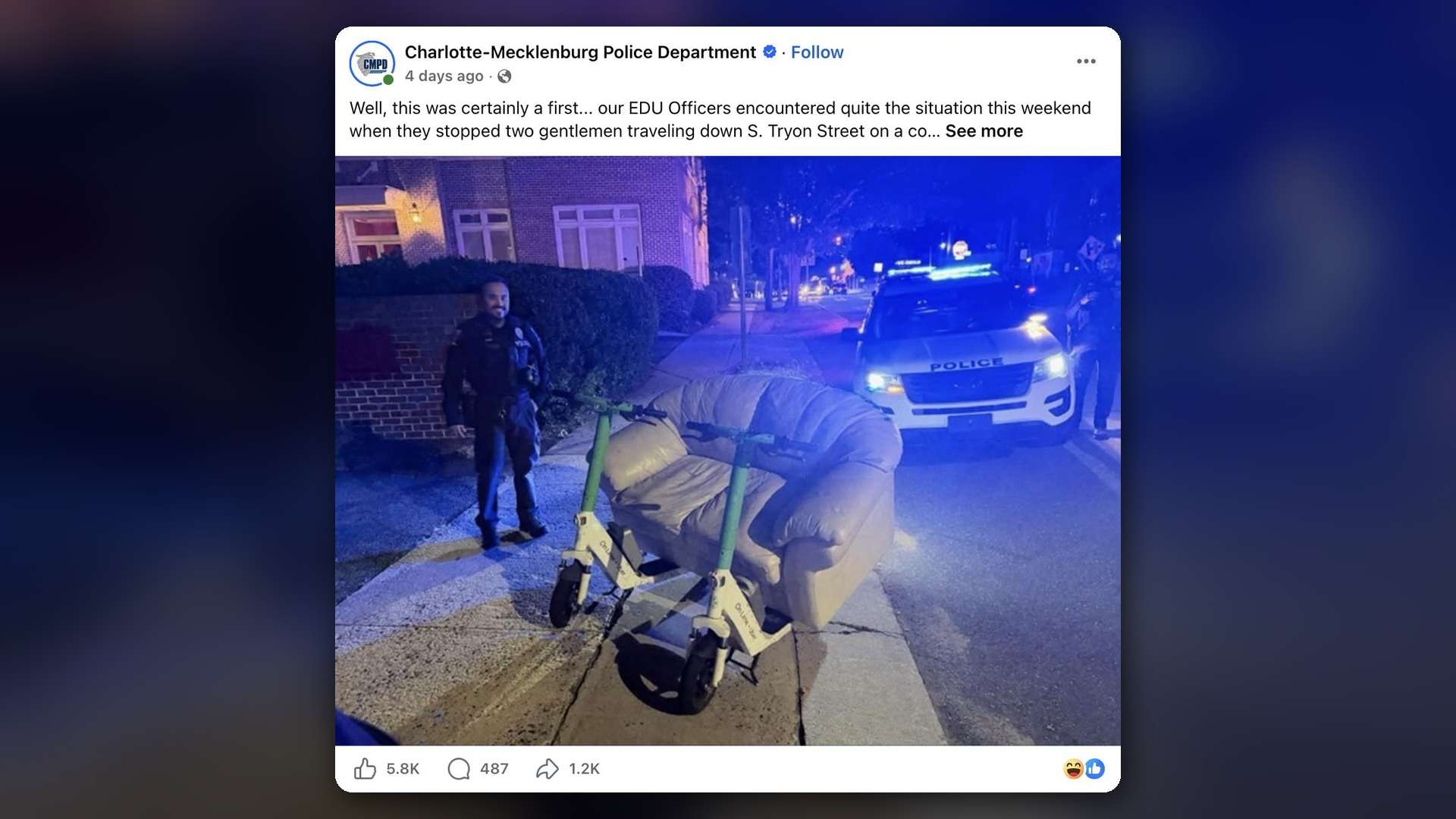
Officers with the Charlotte-Mecklenburg Police Department stopped two men on South Tryon Street in Charlotte, North Carolina, on the last weekend of September because the men were riding a couch. The couch was the vehicle: a light-colored, two-seat leather sofa sitting on the decks of two green-and-white Lime rental scooters, with both sets of handlebars sticking up in front of the cushions, according to the photo the department posted to X on Oct. 1.
CMPD said the stop was made by its EDU officers, the Entertainment District Unit the department set up in its Central Division to work bars, clubs, and venues on busy nights. “Yes, an actual couch,” the department wrote. “We had questions too.” CMPD did not name the men, and WBTV reported that police did not say whether either one was cited.
What the department published instead of a charge was a distraction warning. “Ask yourself: Should this be on a road… with actual cars… will the sheer shock of seeing this on the road cause other drivers to lose focus and drive unsafely?” the post read, before advising riders to “leave the mobile furniture displays to IKEA.”
A warning and a joke is about as far as North Carolina’s written law makes it easy for an officer to go with a powered sofa. The rulebook this build broke most clearly belongs to Lime, and that contract is where the real money is: the scooter company’s user agreement turns off its rider insurance the moment someone breaks its terms, which leaves whoever unlocked those two scooters personally responsible for anything the couch hit.
Charlotte’s scooter rules assume the rider is standing up
Charlotte’s traffic code, in Chapter 14 amendments the City Council adopted on Nov. 13, 2023, counts electric standup scooters as vehicles but leaves them out of its definition of a motor vehicle. The same chapter lets them ride on sidewalks everywhere except the slice of uptown bounded by Church Street, Brooklyn Village Avenue, College Street, and Seventh Street. The city’s permit requirements for rental operators, dated Dec. 24, 2024, describe an e-scooter as a device designed to be stood upon by the user while riding, with a top speed of 15 mph.
Nobody on that couch was standing. Once a scooter stops being a standup scooter, the city’s carve-out stops helping, and the state’s definitions take over. G.S. 20-4.01 still has no definition for electric standup scooters. Its definition of a vehicle covers any device that carries a person on a highway and isn’t moved by human power. Its one exemption for small electric devices, the “electric personal assistive mobility device,” requires a self-balancing machine with side-by-side wheels designed to carry one person. That’s a Segway. A sofa on two tandem-wheel scooters with two riders misses on every count.
That gap has been on paper since rental scooters arrived. In 2018, Shea Denning of the UNC School of Government concluded that ordinary e-scooters appear to meet North Carolina’s definition of a self-propelled motor vehicle, which would mean they have to be registered under G.S. 20-50(a) and their riders need a driver’s license under G.S. 20-7(a). Her analysis was about a person standing on one scooter. A motorized couch fits the motor-vehicle definition at least as well. Building an unregistered-vehicle case around living-room furniture would have been possible on paper; CMPD, at least publicly, went with a photo and a punchline instead.
Lime’s user agreement covers the couch line by line
The contract every rider accepts in the app is far more specific than the statute book. Lime’s U.S. user agreement, last updated July 15, 2025, says riders will not carry items “unless properly and safely secured in a vehicle basket, where available.” The two scooters in CMPD’s photo have no baskets. The agreement also caps the total load on a scooter, rider and everything being carried, at 220 pounds. Spread across two scooters, that gives two adult men and a leather couch 440 pounds to share.
The costs are spelled out too. A rider who damages a vehicle is responsible for the associated costs, and Lime puts the replacement cost of one of its vehicles at up to $1,500. If both scooters came out of the ride bent, that’s up to $3,000 before anyone talks about the street.

The street is where the insurance clause matters. Lime says that in certain locations it may provide personal accident or rider liability coverage, but only if the rider was in full compliance with its terms at the time of the incident. The agreement says that coverage “does not cover damage that occurs while you are in breach of the Terms,” and that in that case the rider is responsible for the full cost of the damage. It also requires a police report on any collision before Lime’s liability coverage applies, and says that where riders must carry their own motor vehicle insurance, that policy goes first.
Put those clauses together and the two men’s real exposure on South Tryon had little to do with a ticket. If the couch had swerved into a car door or a pedestrian, the rider whose account unlocked the scooters would have been left facing the bill without Lime’s coverage, because a couch riding on the decks breaks the cargo rule and very likely the weight limit, and a breach is what switches that coverage off. Whether a personal auto policy would respond to a claim involving a sofa on rental scooters is a question I would not want to put to an adjuster. Charlotte’s shared mobility program page notes that every operator in the city requires riders to be at least 18 and hold a valid driver’s license, so the person on the account has a name the company can bill.
Federal injury counts for e-scooters
CMPD’s worry was the drivers around the couch, and the federal crash numbers give it weight. Staff at the U.S. Consumer Product Safety Commission estimated in an April 2026 report that e-scooters were associated with about 380,000 emergency-room visits from 2017 through 2024, including an estimated 79,300 in 2024 alone. The agency said its staff knew of 206 deaths tied to e-scooters over the same period. Those are estimates built from a hospital sample and reported deaths, and they cover ordinary riders on ordinary scooters.
States have been answering those numbers with paperwork. California lawmakers pushed license plates for e-bikes after crashes surged there. Police elsewhere have shown less patience with odd builds than Charlotte did: in Louisiana, officers measured a squatted pickup at 13 inches nose-up and towed it after its second ticket in three days, because Louisiana has a statute written for that modification. North Carolina’s statutes don’t define scooters, let alone scooter furniture, which makes a stop like the one on South Tryon much harder to turn into a court date.
What comes next for the couch and its riders
As of CMPD’s post and the local reports that followed, there is no public charge and no court date. The men were not identified. The open bill, if there is one, would come from Lime, which under its agreement can hold a rider responsible for damage to its vehicles. Nothing public says whether the scooters were damaged or whether Lime has done anything about the ride.
For everyone else riding rental scooters in Charlotte, the written rules are short: 15 mph, sidewalks allowed outside the uptown blocks the city lists, one rider per scooter, and a weight limit that includes whatever you’re carrying. Break the company’s terms and the insurance coverage in the app goes with them. That holds whether the extra cargo is a couch or a backpack too heavy for the deck.
Should police write tickets for stunts like a couch riding on rental scooters down a busy street, or is a warning and a public joke the right call when nobody gets hurt?
Top photo: Screenshot of the Charlotte-Mecklenburg Police Department’s Facebook post about the South Tryon Street stop. Source: CMPD on Facebook.