
Jordan Eugene Brown, 35, was supposed to spend Thursday, Sept. 24, inside Palmetto General Hospital in Hialeah, Florida, where the Miami-Dade Sheriff’s Office had brought him that morning under a Baker Act order for an involuntary mental health exam. According to police reports obtained by NBC6, he left the hospital shirtless, in green scrubs, and went to a black Nissan Sentra waiting in line to exit the parking lot. Police say he grabbed the woman driving it, threw her to the ground and drove off in her car.
The police reports describe her injuries as minor, with bruises, and WSVN reported that officers photographed injuries to her left arm. NBC6, which describes her as elderly, reported that she was still receiving medical treatment days later and told the station she feels fortunate to be alive.
An 85 MPH chase from Hialeah into northwest Miami-Dade
Officers spotted the Sentra just before 1 p.m., WSVN reported, and the police reports place it near Northwest 22nd Avenue and Northwest 62nd Street. From there, the reports say, the driver circled the area “in an erratic and reckless manner,” ran stop signs, cut off civilian and police vehicles, reached about 85 mph in a 35 mph zone and crashed into two Miami-Dade Schools Police cars. Sheriff’s deputies, Miami police, school police and Florida Highway Patrol troopers all joined in. One driver whose car was struck told CBS Miami the fleeing car hit him, hit a sign and kept going.
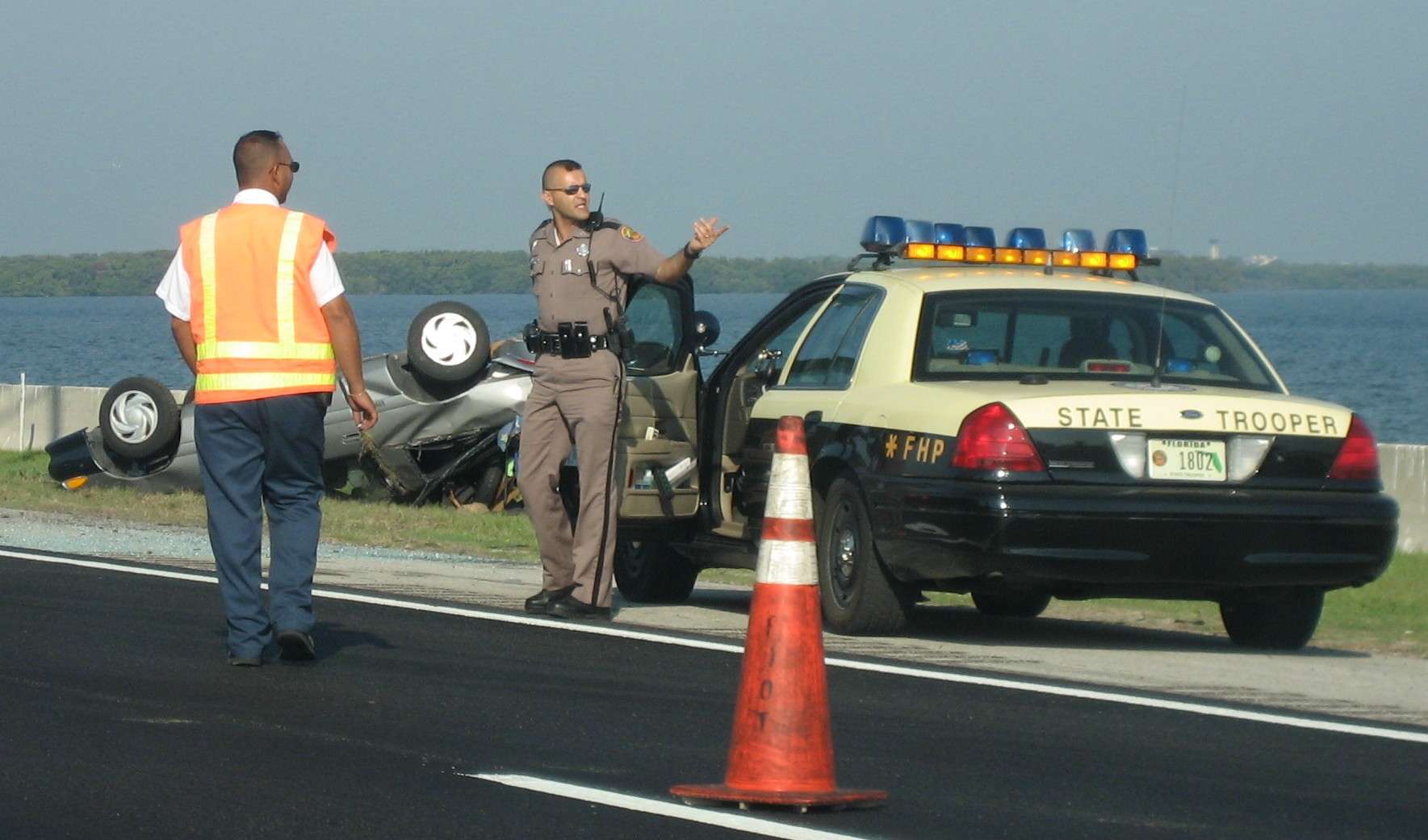
Troopers used the precision immobilization technique, the push on a rear quarter panel that spins a fleeing car sideways, more than once before it worked. The police reports describe four attempts, with the fourth stopping the Sentra on Northwest 17th Avenue. WSVN, which had its helicopter overhead, counted the one that ended the chase as the fifth. The station also obtained trooper dashcam video of the arrest near Northwest 79th Street and 17th Avenue and reported that troopers pointed their weapons at Brown in the driver’s seat while others climbed onto car hoods to help pull him out. He was still in his hospital scrubs.
How a car becomes a burglary scene under Florida law
Brown faces at least nine counts, according to NBC6, including robbery-carjacking, burglary with assault or battery, battery, fleeing and eluding, aggravated fleeing and eluding, reckless driving, aggravated assault on an officer and resisting an officer without violence. The carjacking count is not the most serious one.
Florida’s carjacking statute makes taking a car by force without a weapon a first-degree felony, and the state’s sentencing law caps that at 30 years. The burglary count goes further. Florida’s burglary law covers entering a dwelling, a structure or a “conveyance” with intent to commit a crime inside, and the definitions section lists “any motor vehicle” as a conveyance. If the person “makes an assault or battery upon any person” along the way, the burglary becomes a first-degree felony punishable by up to life in prison. Reaching into a car and dragging out the driver can satisfy both laws at once, which is how a parking-lot carjacking ends up with a life-felony count attached.
That count is also why Brown has no bond. Article I, Section 14 of the Florida Constitution guarantees pretrial release on reasonable conditions to nearly everyone charged with a crime. The exceptions are people charged with a capital offense or an offense punishable by life, when the proof of guilt is evident or the presumption is great. NBC6 reported on Sept. 28 that a judge ordered Brown held without bond on the burglary-with-battery charge, the one that carries life.
A judge, a public defender and the Baker Act
At his first appearance on Friday, Sept. 25, less than 24 hours after the chase, Miami-Dade Circuit Judge Mindy S. Glazer read from the arrest report: “He grabbed her out of her car and threw her to the ground.” Brown’s public defender argued against raising his bond. “I don’t think it’s appropriate this time to increase Mr. Brown’s bond when he’s undergoing a mental health crisis and not receiving the treatment he needed,” she said, according to WSVN. Glazer replied, “So you’re saying it’s the hospital’s fault he stole a car?”
The judge’s question puts bond on the act. The defense’s point is about the hours before it: a sheriff’s office delivered a man in crisis to a hospital that morning, and before 1 p.m. police were chasing him in a car they say he took from the parking lot. Florida’s Baker Act lets police, judges and certain clinicians send someone for an involuntary exam when there is reason to believe mental illness makes the person likely to seriously hurt himself or others in the near future, or likely to suffer harm from neglect. The exam can last up to 72 hours, starting when the patient arrives at the receiving facility, and the statute spells out what the facility must do before that clock runs out. It does not address what happens when a patient walks out before then. None of the coverage or records I reviewed included an account from Palmetto General of how Brown left.
His mental state can still matter later, through a competency evaluation or an insanity defense. At the bond stage it didn’t. Under the constitution, a life count with strong proof is enough to hold someone, whatever brought him to that parking lot.
Who pays for the cars damaged in the chase
The chase left the Sentra wrecked, two school police cruisers hit, at least one civilian car struck, and damage to parked vehicles that WSVN’s helicopter recorded. Florida law makes it hard to send those bills to the police.
Under section 768.28(9)(d) of Florida’s sovereign immunity law, a law enforcement agency is not liable for injury, death or property damage caused by someone fleeing in a vehicle if three conditions hold: the officer reasonably believed when the pursuit began that the driver had committed a forcible felony, the pursuit followed a written policy the agency adopted, and the officer’s own conduct was not so reckless that it showed disregard for human life, safety or the property of others. The Florida Highway Patrol’s pursuit policy, Policy 17.05, lists carjacking, robbery and burglary among forcible felonies. It allows troopers to chase only for a felony, reckless driving or DUI, and states, “ALL OTHER PURSUITS ARE PROHIBITED.” It also bars troopers from using the PIT without the patrol’s training on it, calls for a supervisor’s approval first whenever practicable, and requires a supervisory report every time a PIT is executed.
The carjacking had been reported before officers spotted the Sentra, which puts the forcible-felony condition in place from the start of the pursuit. That pushes the costs back onto owners and their insurers. Florida requires drivers to carry personal injury protection and only $10,000 in property damage liability, and that liability coverage pays for damage the policyholder causes to someone else’s property. It does nothing for the policyholder’s own car after a stranger takes it and police wreck it to end a chase. That repair falls to optional comprehensive or collision coverage, if the owner bought it, minus the deductible. If Brown is convicted, Florida’s restitution statute directs the court to order him to pay for damage or loss caused directly or indirectly by the offense, an order that is only collectible if he has money.
This was not the only Miami-Dade chase to end with an FHP PIT in recent weeks. The Auto Wire covered a stolen Honda flagged by a plate-reading camera whose chase ended with the car on its roof. The maneuver draws the hardest questions when the fleeing driver turns out not to be a felony suspect at all, as in the Arkansas case of a parent rushing a sick child to the hospital. Brown’s case sits at the other end, with a reported violent felony behind the chase from its first minute.
Where Brown’s case goes from here
Brown remains jailed in Miami-Dade without bond on the burglary count, according to the most recent court coverage, and no trial date has been reported. Every charge against him is an accusation. If he is convicted of aggravated fleeing alone, the fleeing statute makes it a second-degree felony and requires the court to revoke his driver’s license for at least a year and up to five. The woman whose Sentra he is accused of taking was still being treated for her injuries late last month, according to NBC6, and her car came out of the chase severely damaged.
When a Baker Act patient walks out of a hospital and is accused of a violent carjacking shortly afterward, should a judge weigh the hospital’s failure to keep him when setting bond, or look only at the charge in front of the court?
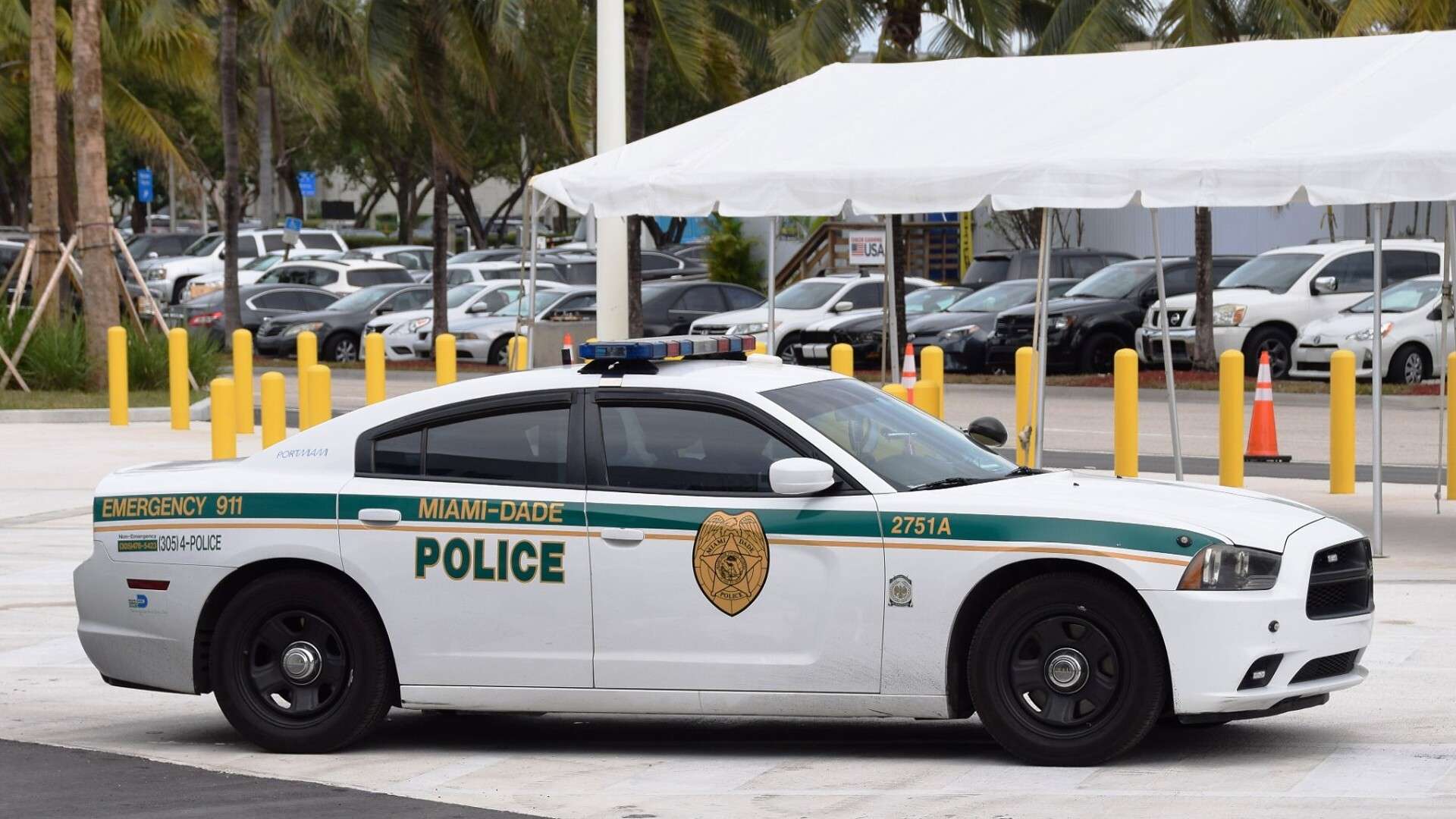
Top photo: A Miami-Dade police Dodge Charger, photographed in 2018. Patrol duties have since moved to the Miami-Dade Sheriff’s Office. This is not a vehicle involved in the case. Photo: Dickelbers / Wikimedia Commons (CC BY-SA 4.0)