
Dale Schultz, 66, of Salt Lake City, was in a Tesla at the charging stalls beside the Twin Falls Visitor Center in Twin Falls, Idaho, on Aug. 1 when a gunman shot him, police said. Schultz died. His passenger was wounded, and so was a person in another Tesla at the same stalls, according to the account police gave when they released video of the attack on Aug. 7, as reported by Fox News and CBS News.
On the evening of Oct. 1, Tesla’s official charging account on X posted a short video and a single line of text: “Emergency Drive Away lets you shift into Drive while still plugged into a Supercharger.” The posts don’t mention Twin Falls. They do put a price on the escape. In a reply, Tesla wrote that the feature will damage both the car and the Supercharger and that “Deliberate misuse will invoke additional penalties.” Asked what damage a driver should expect, the account answered: “Depends on the Supercharger, but electrical & civil cost can be up to $25k.”
Giving drivers a way out of a locked charging stall is the right call. The way Tesla built it is the problem. The escape is a deliberate act of destruction that Tesla says can cost up to $25,000, the driver decides in seconds whether the moment qualifies, and Tesla decides afterward whether it agrees. Gas stations handle the same drive-off problem with a part the fire code requires. Tesla’s own Supercharger rules ban that part.
Emergency Drive Away lets you shift into Drive while still plugged into a Supercharger pic.twitter.com/40GSzyP4lG
— Tesla Charging (@TeslaCharging) October 1, 2026
The shooting at the Twin Falls Visitor Center chargers
Police said the attack began at the In-N-Out drive-thru, where the gunman killed Ashley Garibay, 23, of Stockton, California, at the payment window and Christopher Claunch, 59, of Hagerman, Idaho, in his vehicle, CBS News reported. In the video breakdown released by Police Chief Matthew Hicks and the FBI, the gunman then moved to the Tesla chargers, where an armed bystander, Jordan Salinas, engaged him, KIVI reported. CBS News reported the gunman was Chad Williams, 24, and police said he died of a self-inflicted gunshot wound. The Twin Falls City Council’s statement put the toll at three dead and seven injured.
Tesla’s own locator lists an eight-stall Supercharger at the Twin Falls Visitor Center, 2015 Neilsen Point Place. The Associated Press, in its report on the video’s release, placed the shootings at a car charging station in the visitor center lot.
None of the police accounts I found say whether either Tesla was plugged in, and nothing on the record says a charging cable kept anyone from leaving. Twin Falls showed what a charging stall looks like when someone with a gun walks toward it. It did not show that the cable cost anyone their life, and Tesla hasn’t claimed that it did.

What tears when a Tesla drives off a Supercharger
A Tesla normally refuses to shift into Drive while a charging connector is latched in its port. That interlock exists so nobody drags a live high-voltage cable across a parking lot. Emergency Drive Away overrides it, and the car pulls the connector out by force.
What spills is coolant. Tesla’s Supercharger Emergency Response Guide (Revision 8, February 2026), written for firefighters, lists a 50/50 mix of ethylene glycol and water in the equipment: roughly 0.5 to 1 liter in a V3 charge post and 3 to 5 liters in a V4 post, with more in the cabinets behind them. Replying to another user, Tesla wrote: “Glycol, which Tesla will clean up as part of the mandatory service visit to the Supercharger after the damage is incurred.” On the car side, Tesla said a service visit for the chargeport is mandatory.
The feature comes with conditions. Tesla said it requires software version 2026.38.3, doesn’t support Model S and Model X cars built before 2021, and works only at U.S. Superchargers for now. In other replies, the account said it covers V2, V3 and V4 stalls and Supercharger for Business sites, and works only at Superchargers, not home Wall Connectors. Because the override lives in the Tesla’s own software, Tesla’s posts don’t cover the Fords, GMs and other non-Tesla EVs that now plug into the same stalls.
Tesla gave the $25,000 as an upper limit for “electrical & civil cost” that depends on the site. The cable is the same hardware that turns up in vandalism cases: The Auto Wire reported this week that someone cut 28 Supercharger cables in Ballarat, Australia.
The fire code requires a breakaway at the gas pump; Tesla’s rules forbid one at the charger
Drive away from a gas pump with the nozzle still in the tank and the hose is built to separate. The International Fire Code’s chapter on fuel-dispensing facilities, as Seattle adopted it in 2021, says in Section 2306.7.5.1 that hoses for Class I and II liquids “shall be equipped with a listed emergency breakaway device designed to retain liquid on both sides of a breakaway point.” Gasoline and diesel fall in those classes. The same chapter has a matching rule for propane hoses. It has no section on EV charging.
At a Supercharger, Tesla’s Good Conduct Policy rules out the equivalent: “We prohibit any unapproved devices that plugs in between a vehicle and the charging cable such as third-party adapters, extension cords, and breakaway devices.” The same policy says, “Damaging equipment, vehicles, or other property is prohibited.”
Tesla has a fair reason to keep aftermarket couplers off its cables. The response guide describes roughly 900 volts on the V3 cabinet’s DC bus, and an unlisted gadget at that voltage is a hazard. The result, though, is that the only approved way to leave a stall in a hurry is the one Tesla’s own rules otherwise call vandalism. A frightened driver is asked to break the equipment on purpose and trust Tesla to sort out later which category the damage falls in.
Tesla decides what counts as an emergency, and it has cut off Supercharger access before
Tesla hasn’t published what separates an emergency from “deliberate misuse,” what the “additional penalties” are, or whether a driver who uses the feature in a real emergency gets the repair bill. Its posts don’t say whether the chargeport repair on the car is covered by warranty. Tesla’s written terms lean its way. The Vehicle Charging Policy says that, except where the law says otherwise, Tesla “will not be liable for any damage or loss suffered as a result of your use of a charging station.” The Payment Terms say Tesla “may limit or block your vehicle’s ability to use the related services” when an owner doesn’t pay past-due, unchallenged amounts.
Tesla has used that switch before. In Shenkman v. Tesla, filed in Alameda County Superior Court, a California owner disputed idle fees and Tesla shut off his Supercharger access. The settlement The Auto Wire covered in August requires Tesla to stop disabling access for class members and restore what it took away. That protection covers that class, not every owner. Tesla has also locked cars out of the network for other reasons, as an Illinois man learned when his used Model 3 arrived with a Supercharger ban.
A driver billed after a real emergency would point to a police report. Tesla would weigh it under rules it hasn’t written down, holding the power to cut off the car’s fast charging. The Payment Terms tie that power to amounts that are past due and “unchallenged,” so on its face the clause doesn’t reach a bill the owner disputes.
What Tesla owners should know before they need it
The feature exists only on cars running 2026.38.3 or later, so an owner who hasn’t updated doesn’t have it. Tesla says it damages the car as well as the stall, and that a chargeport service visit is mandatory afterward. The cost to the owner, if any, is undefined. Tesla’s announcement came as a product post with no written policy attached, and the answers to who pays and what counts as misuse will come from the first owners who use it and then get an invoice.
Watch for Tesla to publish those rules in its terms or owner’s manual, and for whether the first emergency drive-offs end in a waived bill or a blocked Supercharger account. If a driver flees a real threat and rips a cable out of a Tesla charger, should the driver pay for the damage, or should Tesla absorb it as the cost of building chargers that lock cars in place?
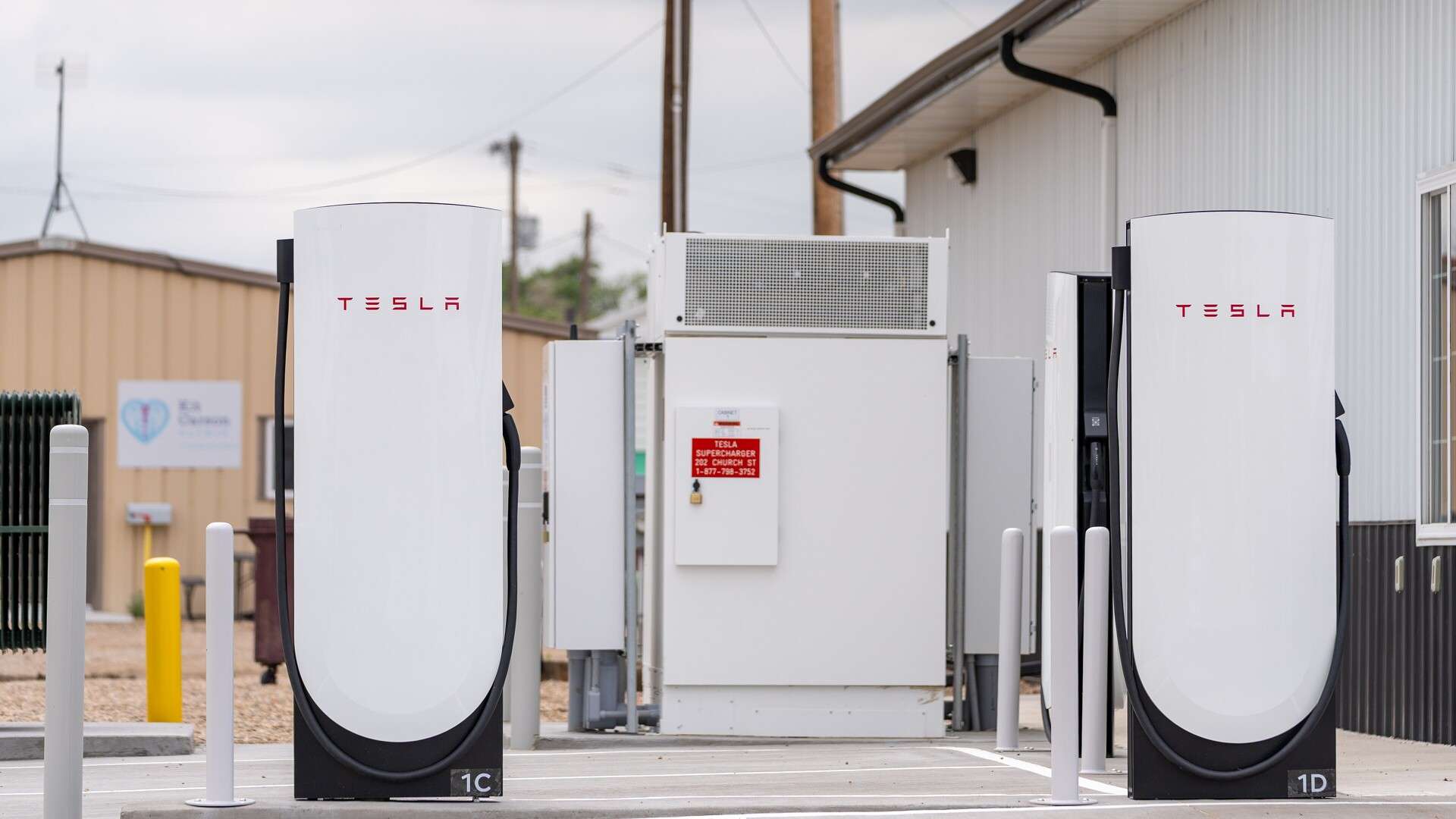
Top photo: Tesla Supercharger stalls in Kit Carson, Colorado. Photo: Tony Webster / Wikimedia Commons (CC BY 4.0)