
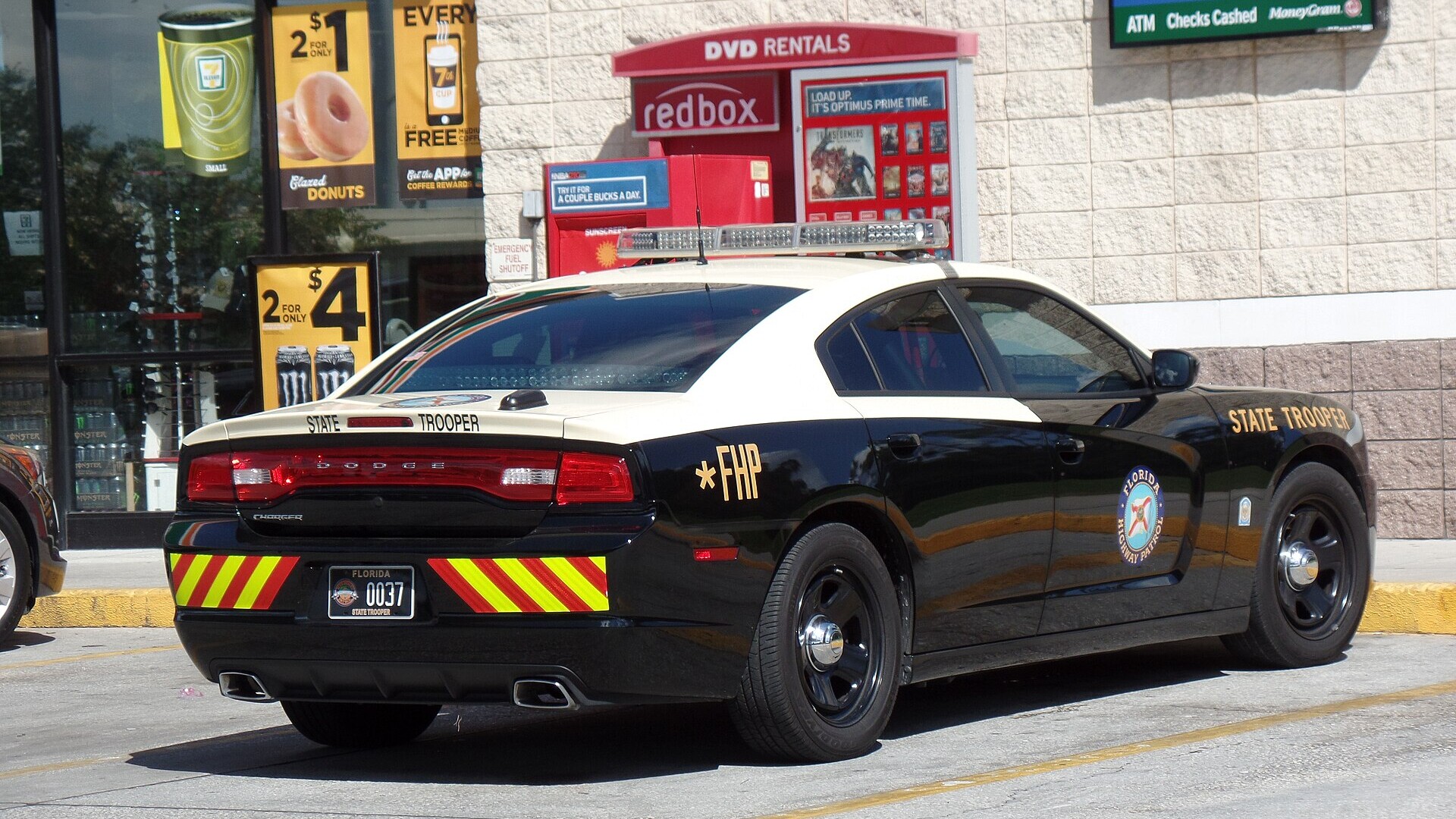
On Aug. 23, a roadside camera in Miami-Dade did something that used to take a patrol officer a lucky glance, a memorized plate number and a radio call. It read the tag on a Honda sedan, matched it against a stolen-vehicle list and told the Florida Highway Patrol where to look.
What happened next took a lot longer. It ended with the Honda on its roof.
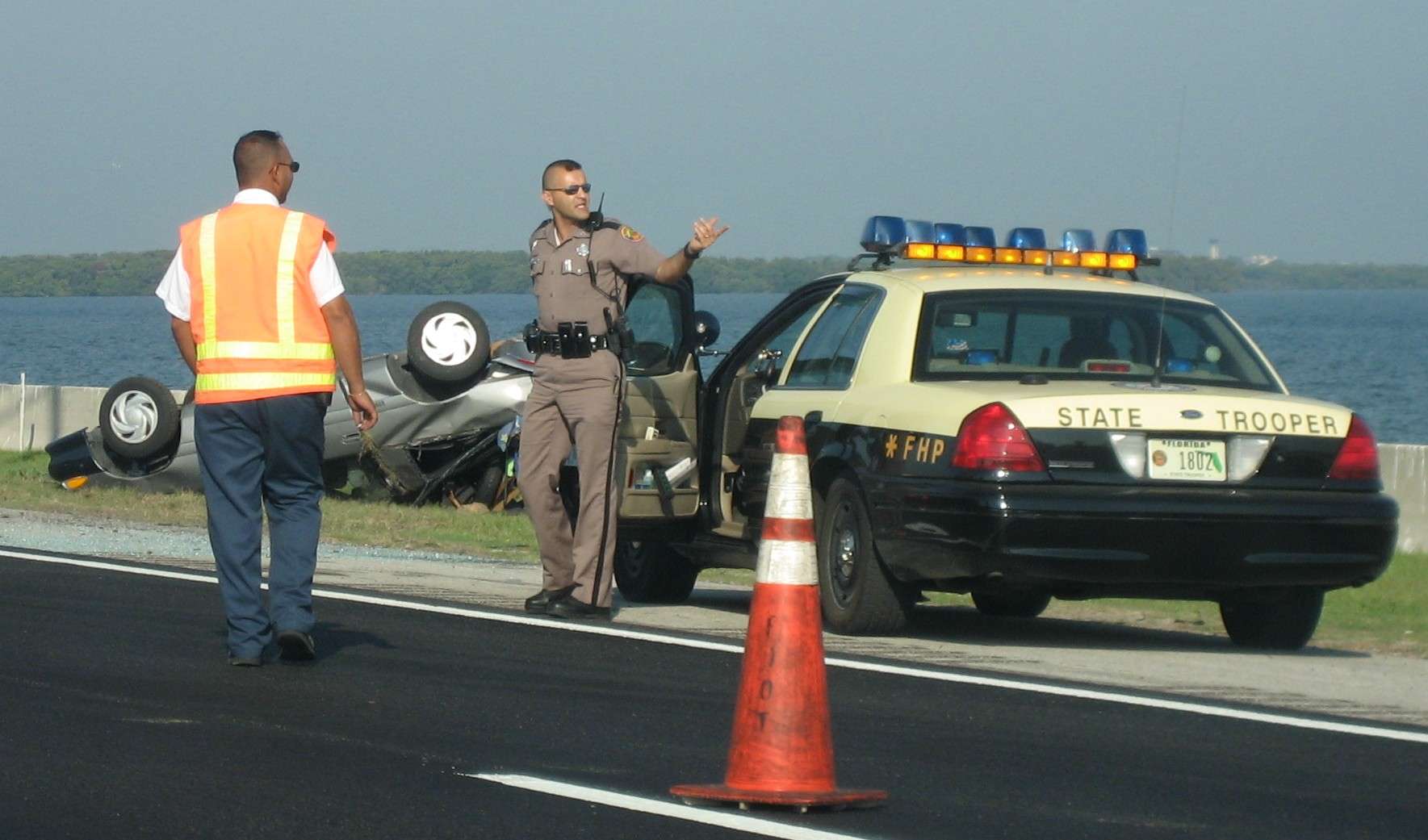
Dashcam footage of the chase, obtained and aired last week by NBC 6 South Florida, is already circulating as another Florida pursuit clip. According to FHP officials, troopers were sent to the area of Interstate 95 and Northwest 79th Street after a Flock license plate camera flagged a stolen vehicle. They found the Honda, tried to pull it over, and the driver ran. The video shows the car weaving through traffic, running red lights and plowing through an orange traffic barrel. One trooper’s PIT maneuver fails to stop it. A second, on Northwest 7th Avenue near Little River Drive, sends the sedan sideways and then completely over. FHP said the driver and a passenger were both taken into custody.
As a crash video, it’s one more Florida chase, and in Florida that’s a crowded genre. What’s interesting is the gap between how it began and how it ended.
The camera did more than find the car
The Florida Highway Patrol does not let its troopers chase just anybody. Its own Emergency Response and Pursuits policy (17.05) limits pursuits to drivers reasonably believed to have committed a felony, reckless driving or DUI. Everything else, in the policy’s own capital letters, is prohibited.
Florida’s theft statute matters too. Under Section 812.014, stealing a motor vehicle is at least third-degree grand theft, a felony, no matter how little the car is worth. A 20-year-old Civic qualifies just like a new Accord.
Together, those two rules change the camera’s role. A stolen-plate alert does not just point a trooper at a car. It hands the trooper a felony, which is the legal ticket into a pursuit, before anyone has seen who is driving. The moment the driver refuses to stop, fleeing a marked patrol car with its lights and siren on becomes a second felony of its own.
The same policy has another catch. Among the factors troopers must weigh before chasing, FHP lists “other available means of apprehension, such as obtaining a warrant for identified violators.” That is the textbook alternative to a pursuit: let the car go, find the person later. A plate hit can’t supply it. The camera identifies property, not people. It knows which car was stolen, but it has no idea who is behind the wheel, so the only way to learn that is to stop the car.
That’s why the explosion of plate-reading cameras deserves more attention from drivers than it gets. Flock says its network operates in 49 states and sends users instant alerts when a passing vehicle matches a customer or NCIC hot list. We have written about the fight over where those cameras are allowed to stand and about the Florida county that couldn’t say where its cameras came from. The less-discussed consequence is operational. Every hot-list alert is a potential traffic stop, and every stop of a stolen car is a potential chase.
Agencies can add cameras by the hundreds. They can’t add safe ways to stop a car at anything like that pace.
A PIT is built to spin a car, not flip it
The Precision Immobilization Technique looks crude on video. The physics behind it are fairly elegant. The trooper matches the fleeing car’s speed, puts the front corner of the cruiser against the other car’s rear quarter panel just behind its rear axle, and steers into it. That sideways push acts on a long lever arm around the car’s center of mass. The rear tires get more lateral load than they can hold, the back end steps out, and the car rotates until it is sliding broadside, scrubbing off speed as it goes. Done right, the result is a spun car pointed the wrong way with its engine stalled.
A rollover is not part of the design. And a Honda sedan is one of the least likely vehicles on the road to roll on its own. In a federal NHTSA rollover-mitigation report, passenger cars rolled over in 1.7% of crashes, compared with 5.5% for SUVs.
The same report explains how low cars still end up on their roofs. About 95% of rollovers in single-vehicle crashes are “tripped.” Tires sliding sideways on pavement rarely flip a car by themselves. What flips a car is something catching the side of it partway through the slide: a curb, soft soil, a guardrail, a pothole, or a wheel rim that digs into the asphalt after a tire gives out. A PIT turns a car sideways on purpose. On a city street full of curbs and medians, that sideways car has plenty to catch on.
FHP’s policy accounts for this. It tells troopers to pick PIT locations away from abutments, grades, blind curves and roadside obstacles, and to perform the move “at speeds consistent with training.” It also tells troopers to avoid a PIT on large vehicles, vehicles with a high center of gravity, or cars running on a flat tire “unless the use of deadly force is justified.”
The agency’s own rulebook puts a PIT on a tall vehicle in the same category as deadly force. The reason is rollover risk, and that distinction depends on the vehicle, not the driver. As more of what people drive becomes crossovers and pickups, a smaller share of fleeing vehicles fits the profile the technique was designed around.
The Miami video also shows something the highlight clips tend to leave out: the first PIT didn’t work. Every attempt is deliberate contact between two cars moving through traffic, and the chase continues after each miss. The policy bans all other intentional contact during a pursuit. It makes an exception only for this one move, because it is supposed to be controlled. The flip shows how narrow that control really is.
The person nobody mentions: the owner
Somewhere in South Florida, someone got their Honda back. It was upside down.
Hondas remain staples of the theft trade. The National Insurance Crime Bureau ranked the Accord as the fourth most stolen vehicle in America in 2024, with 18,539 thefts, even as total U.S. vehicle thefts fell 17% to 850,708. That was the steepest one-year drop in four decades, the group said.
For the owner, the recovery is where the ownership-cost story begins. A sedan that has rolled usually has roof, pillar and glass damage, the kind of structural repair that can push an older car into total-loss territory. Whether that becomes a check or a headache depends on the policy. Theft and damage done during a theft are generally comprehensive-coverage claims. An owner carrying liability-only coverage has nothing on the policy that pays for their own car.
There is a legal twist too. Under Florida’s fleeing statute, any motor vehicle involved in fleeing or eluding “is deemed to be contraband” and subject to forfeiture. Read literally, the victim’s car has become contraband. What protects the owner is the state’s forfeiture act, which bars forfeiture unless the agency proves the owner knew, or should have known, that the car would be used in a crime. A theft victim should clear that easily. Still, it’s an odd spot for the law to put a car whose owner was the first victim.
The national picture is older than the cameras
The most detailed federal accounting of police pursuits, a Bureau of Justice Statistics study, estimated about 68,000 pursuits by state and local agencies in 2012. Pursuit-related crashes killed an average of 355 people a year from 1996 through 2015. State police and highway patrols ran about 17 pursuits per 100 officers, roughly double the rate of local departments. Those numbers come from before plate readers were everywhere, when most chases still started the old way. In a BJS database of 115 agencies, about 69% began with a traffic violation.
FHP’s felony-only rule sits on the restrictive side of that landscape. BJS found only 53% of state agencies used restrictive pursuit criteria, and FHP’s rule bars chases over a burned-out taillight. What it can’t do is anticipate a world where machines generate felony-grade leads around the clock, on every major road. The policy was written to stop troopers from chasing for trivial reasons. Plate cameras don’t generate trivial reasons to chase. They generate more of the legitimate ones.
Better hardware doesn’t close that gap. We recently looked at Michigan State Police testing of every patrol car sold in America, and how dashcam footage can build a case even when a stop fails. Faster cruisers and better cameras improve the chase and the evidence. Neither changes what happens at the end of a pursuit, which is still a bumper, a tire and whatever curb is closest.
The number to watch
Agencies will judge plate-reader networks by recovered cars and arrests, and on those terms the Aug. 23 alert worked. A stolen car was found and two people were arrested. But the number drivers should watch is a different one: how many of those alerts end with a patrol car’s push bar on somebody’s quarter panel on a crowded street.
The camera spent a fraction of a second on its part of the job. The rest was handled with a technique that goes back decades, on a Miami street with red lights, traffic barrels and bystanders. Everyone else on that street shared the risk, and nobody asked them.
When a camera flags a stolen car, should troopers go after it right then, or is a stolen Honda not worth a PIT on a busy city street if they can track it and pick up the driver later? Let us know what you think.