
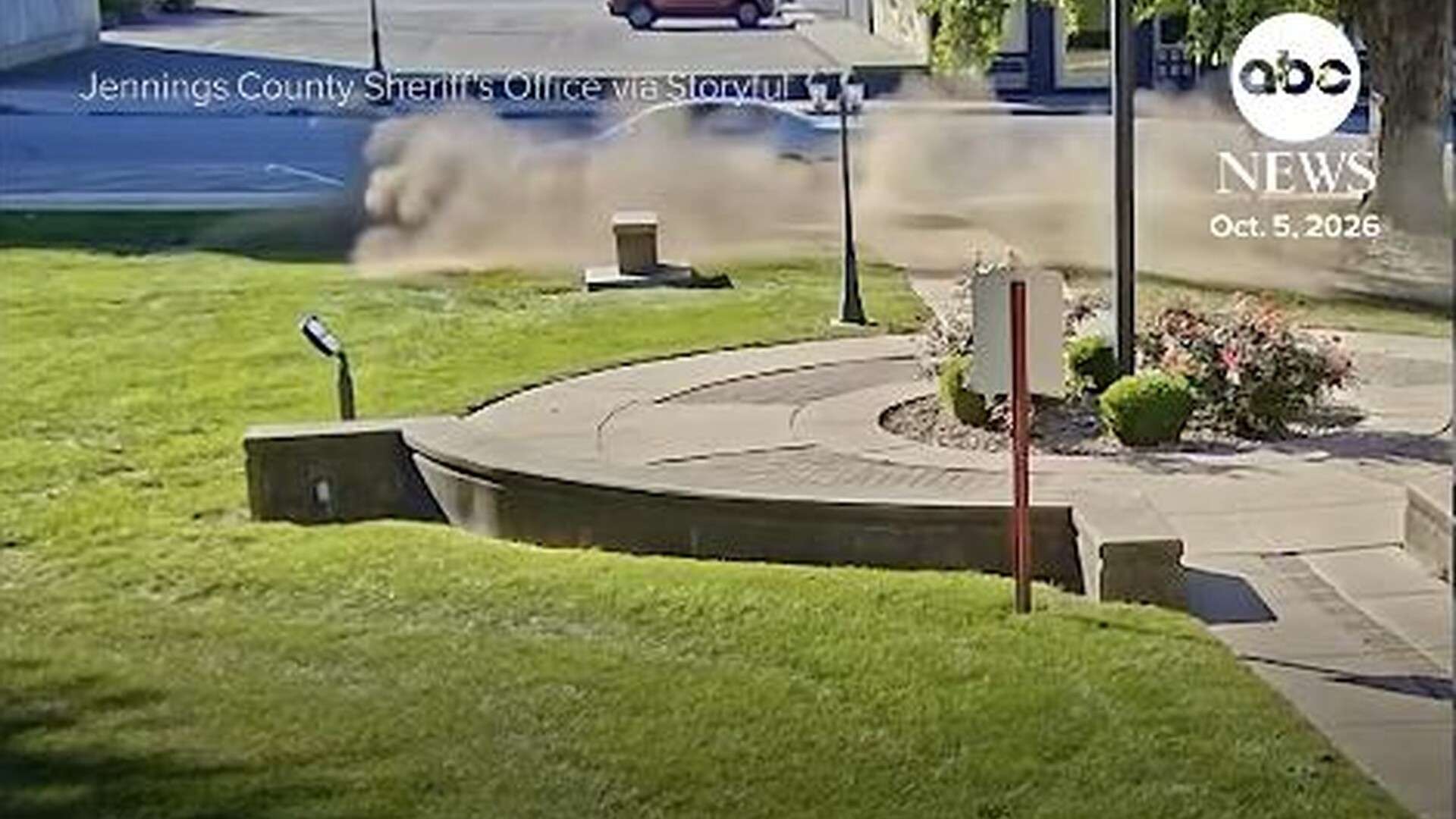
A woman in her late 60s drove a sedan in circles across the lawn of the Jennings County Courthouse in Vernon, Indiana, on Monday, Oct. 5, and the sheriff’s office had a surveillance camera pointed at the whole thing. The sheriff’s office said she was arrested for operating a vehicle while intoxicated and what it described as numerous other charges, which the reports I found did not itemize.
The footage, which ABC News posted with a credit to the Jennings County Sheriff’s Office via Storyful, shows a plume of dust drifting across the grass beside the courthouse walkway. A police accusation is not a finding, and she has not been convicted of anything.
@abcnews A 67-year-old woman was arrested in Vernon, Indiana, after allegedly doing doughnuts in her car on a courthouse lawn while under the influence, according to local news reports. #indiana #news #abcnews ♬ original sound – ABC News
Video: Jennings County Sheriff’s Office via Storyful, as posted by ABC News on TikTok.
The sheriff’s office paired the video with a Facebook post that 812NOW and FOX 6 both quoted: “If you’ve had a few too many margaritas with dinner, please don’t get behind the wheel, and definitely don’t do donuts on the courthouse lawn.” FOX 6 reported no injuries.
How Indiana Grades an OWI Charge
Indiana does not grade drunk driving by how dramatic it looks on camera. Under Indiana Code 9-30-5-2, operating a vehicle while intoxicated is a Class C misdemeanor, and it becomes a Class A misdemeanor if the driver operates “in a manner that endangers a person.” A separate section, 9-30-5-1, ties the grade to a number: an alcohol concentration of at least 0.08 but under 0.15 is a Class C misdemeanor, and 0.15 or higher is a Class A.
The grade matters because the ceilings are far apart. A Class C misdemeanor carries up to 60 days in jail and a fine of up to $500 under 35-50-3-4. A Class A misdemeanor carries up to one year and up to $5,000 under 35-50-3-2. That is 305 more days of possible jail time and $4,500 more in maximum fine, and the dividing line is either a test result or a finding that someone was put in danger.
Where a Courthouse Lawn Fits in the Statute
The reports I found do not say what her test result was, which counts beyond OWI were filed, or whether the county is treating the grass as damaged property. Without a 0.15 reading, the Class A grade depends on whether prosecutors can show the driving endangered a person, and the statute’s word is “person,” not “property.” A car spinning across an open lawn with no injuries reported is a harder fit for that language than a drunk driver on a street with traffic, though the charging documents will say how the state sees it. I did not find a court docket entry or a statement from a defense attorney as of Wednesday, Oct. 7.
The case sits in a county seat where the courthouse that will eventually hear it is also the scene. For a sense of how far drunk-driving cases can escalate once a record builds up, The Auto Wire covered a Waukegan driver arrested for DUI a ninth time, and what California’s new DUI laws actually change.
Next comes the formal charging paperwork in Jennings County court, where the specific counts, any test result, and a plea will become public record. Until then, the sheriff’s description is the only account of what she is accused of.
Should a drunk-driving charge carry the same weight when the car never left a lawn and no injuries were reported, or does getting behind the wheel intoxicated at all deserve the full penalty the law allows?
Top photo: Credit: Jennings County Sheriff’s Office via Storyful, as posted by ABC News on TikTok.