
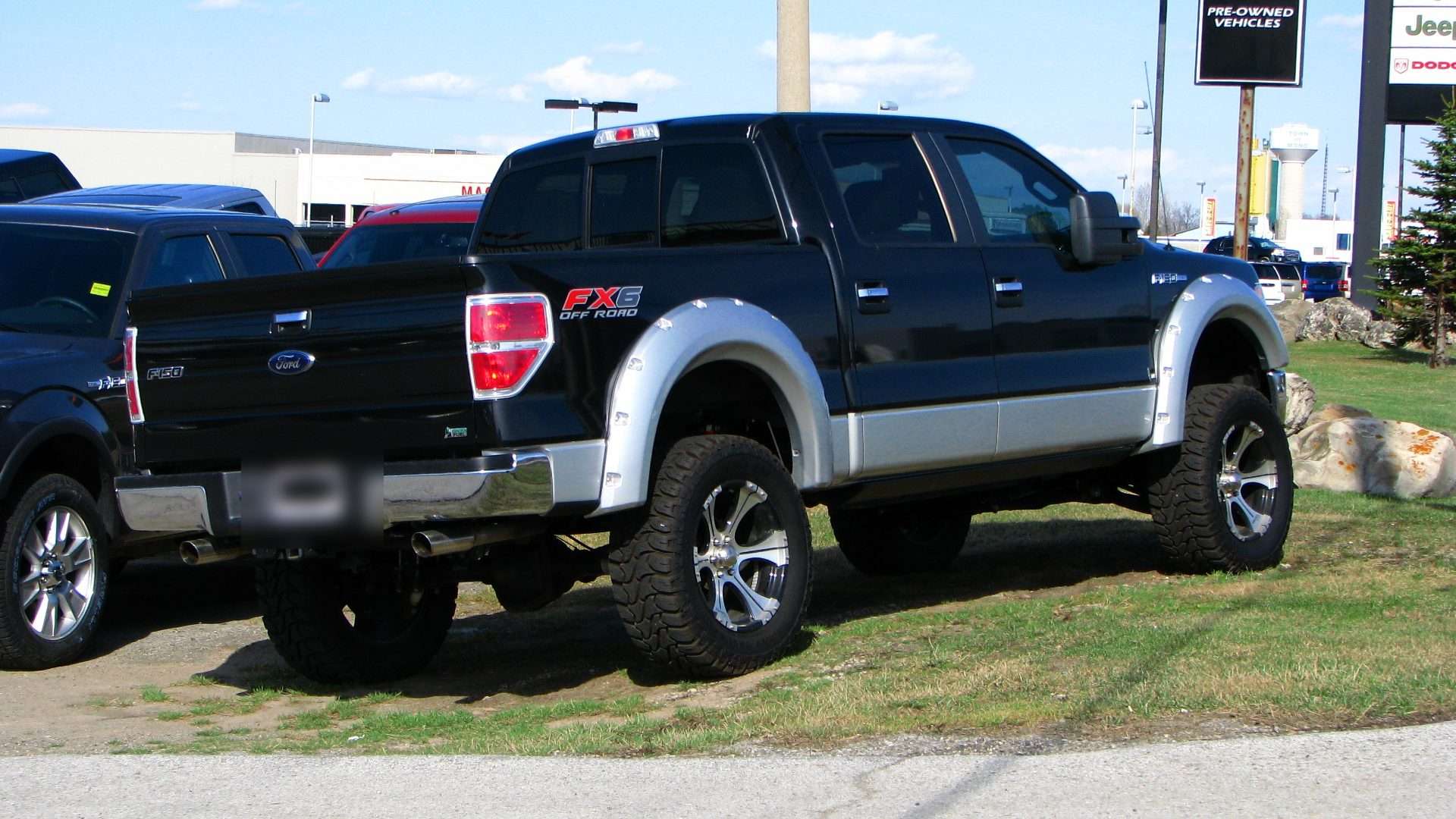
Charles Holloway Jr., 63, of Cartersville, Georgia, was driving his Toyota Tundra west on Browns Bridge Road near Lake Lanier in Hall County at about 10 a.m. on Jan. 8 when an eastbound Ford F-150 crossed the centerline and hit him head-on, according to the Hall County Sheriff’s Office account reported by Atlanta News First and The Daily Tribune News. He died at the scene.
His wife, Lolita Holloway, has now filed a wrongful-death suit in the State Court of Gwinnett County. It names the F-150’s driver, but it also reaches past him to the dealership that sold the truck, the shop that installed its suspension lift and the companies behind the lift kit. The suit’s theory is that the lift made the crash deadly: it alleges the raised F-150 rode over the Tundra’s front crash structure and into the cab instead of meeting it bumper to bumper.
That claim lands in a state that, since July 1, 2024, has exempted nearly every pickup built in the past 15 years from its suspension-height limits. If lifted trucks are going to be held to any safety line in Georgia, it will be drawn by juries in cases like this one, one wreck at a time.
The Hall County charges against the F-150’s driver
Deputies charged the F-150’s driver, Scott Douglas Kneiss, 61, with second-degree vehicular homicide, failure to maintain a lane and driving with an expired tag, according to those reports. He was hospitalized, then posted a $16,960 bond and was released. The charges are accusations, and The Auto Wire could not confirm their current status.
Second-degree vehicular homicide is the charge Georgia uses when an ordinary traffic violation, rather than DUI, reckless driving or fleeing police, causes a death the driver did not intend. O.C.G.A. § 40-6-393(c) punishes it under the state’s general misdemeanor statute, which tops out at 12 months in jail and a $1,000 fine.
Why the suit targets the lift kit, the installer and the dealer
The defendants include Courtesy Ford, North Georgia lift shop GRJ Offroad, suspension maker Sport Truck USA, its parent Fox Factory, and accessory company RealTruck. The suit claims the lift defeated the crash compatibility built into both trucks and that the companies failed to warn buyers, installers and other drivers about it.
Sport Truck USA is a Fox Factory subsidiary. Fox bought its assets in March 2014 for about $44 million at closing, plus up to $29.3 million more tied to performance targets, according to the announcement Fox filed with the SEC. The filing describes two lines: BDS Suspension, sold as complete premium lift kits through four-wheel-drive shops, and Zone Offroad, its entry-level kits. Which kit was on the Hall County truck is not public in the records I reviewed.
The engineering argument rests on a fix automakers agreed to more than 20 years ago. Federal bumper rules define a zone 16 to 20 inches off the ground where car bumpers sit. In December 2003, nearly every automaker selling in the U.S. agreed, in a voluntary effort facilitated by the Insurance Institute for Highway Safety, to line up the main front crash structure of their pickups and SUVs with that zone by Sept. 1, 2009. A truck had to overlap at least half of it, or carry a secondary crossmember no higher than the bottom of the zone that could take at least 100 kilonewtons of load.
The automakers’ April 16, 2009 final report to NHTSA says all of the participants’ covered vehicles met the criteria by September 2009, and it cites an IIHS estimate that lower front structures cut the fatality risk to belted car drivers in front-to-front crashes with light trucks by 19%.
A suspension lift undoes that geometry after the truck leaves the factory. The frame rails, and the bumper and crush structures bolted to them, rise by roughly the height of the lift. The 2003 pledge covers trucks as their makers build them. It says nothing about what a shop does afterward, and no federal safety standard caps the ride height of a modified pickup.
Federal law does reach shops in one way. Under 49 U.S.C. § 30122(b), a dealer or repair business may not knowingly make inoperative any equipment installed to meet a federal motor vehicle safety standard. Crash-compatibility alignment is a voluntary pledge, not a standard, so raising the frame alone does not trigger that rule. The suit also alleges the lift degraded the F-150’s crash-avoidance and warning systems, and if a lift disables equipment that a standard requires, such as stability control, a shop that installed it has a federal problem as well as a civil one. That rule applies to businesses. An owner who lifts a truck in his own driveway is not covered by it.
Georgia’s 2024 lift law exempts trucks with stability control


Until mid-2024, Georgia had a blunt rule. The old Code Section 40-8-6 made it a misdemeanor to alter the suspension of any private passenger vehicle more than two inches above or below the factory recommendation. Trucks fell under a separate raised-chassis section, 40-8-6.1, which capped frame height at 27, 30 or 31 inches depending on gross vehicle weight rating. Neither section had an exemption for newer vehicles.
Then lawmakers passed Senate Bill 352. It cleared the Senate 41-9 in January 2024 and the House 136-33 in March, Gov. Brian Kemp signed it on May 6 as Act 611, and it took effect July 1, 2024. The bill dropped the two-inch rule, applied the 27-, 30- and 31-inch frame-height caps to all motor vehicles, and added a new limit aimed at “squatted” trucks: for vehicles rated 4,000 to 7,000 pounds, the front of the frame may not sit more than four inches above or below the rear. Sen. Sam Watson, one of the bill’s Senate sponsors, told WALB it was driven by concern that drivers of squatted vehicles can’t see the road.
The bill also added an exemption. Subsection (f) of the current law says the entire Code section does not apply to any vehicle with an electronic stability control system that complies with federal standard 126. That standard, 49 CFR 571.126, has required stability control on every car, SUV, pickup and van with a gross vehicle weight rating of 10,000 pounds or less built on or after Sept. 1, 2011.
Read as written, Georgia’s height caps and its squat limit now apply mainly to light vehicles old enough to predate that mandate. A late-model F-150 with a big lift is outside the statute entirely. Georgia is not alone in going after squatted trucks; police in Louisiana recently measured one at 13 inches nose-up and towed it. But Georgia wrote its squat rule and its stability-control exemption into the same section.
Why the old two-inch rule may still matter in the Holloway case
Descriptions of the complaint indicate it invokes the two-inch rule. That language was gone 18 months before the crash. Whether it still helps the Holloway family depends on a fact no public record I found answers: when the F-150 was lifted.
Georgia lets injured people use a broken safety statute as evidence of negligence under O.C.G.A. § 51-1-6. If the lift went on before July 1, 2024, the plaintiffs can argue the installation broke the law in force that day, assuming a pickup counts as a “private passenger motor vehicle” under the old wording. If it went on later, the statute offers them nothing, and the case comes down to ordinary product-liability and negligence questions: was the kit defectively designed, did anyone warn about crash compatibility, and did the lift make Holloway’s injuries worse than they would have been in a head-on hit from a stock truck.
No answer from any defendant was publicly available to The Auto Wire as of Oct. 6.
What comes next in Gwinnett County court
Under Georgia’s Civil Practice Act, defendants generally have 30 days after service to answer. Because the plaintiff, the driver and the installer are all in Georgia, the out-of-state companies would have a hard time moving the case to federal court on diversity grounds, so it is likely to stay in Gwinnett. The fatal-crash suits Tesla has settled on the eve of trial show that product cases like this one can end before a jury ever hears them.
For Georgia drivers, the 2024 law took the height question off the ticket book and put it in the courtroom. A lifted truck built after September 2011 falls outside Georgia’s suspension-height statute no matter how high it sits, and the Holloway suit tests whether the companies that sell and install the lift share responsibility when that truck hits a car. If a Gwinnett jury says yes, every lift shop and every dealer that sells lifted trucks off the lot in Georgia will be pricing that risk.
Should Georgia put hard height limits back on modern lifted pickups, or leave it to juries to decide when a lift goes too far?