
Ryan O’Donnell’s parking problem added up to about $524: two tickets for an expired meter and one for overstaying a time limit. Chicago’s answer was to tow his car, impound it, and sell it at scrap value, $273, to URT United Road Towing, the private company that tows for the city. According to the federal appeals court that upheld the arrangement, the city did not use any of that money to pay down his tickets.
On Monday, Oct. 19, the U.S. Supreme Court declined to take up his challenge, O’Donnell v. City of Chicago, No. 25-1098. The denial came with a statement from Justice Sonia Sotomayor, joined by Justice Neil Gorsuch, that reads less like a shrug and more like an instruction sheet for the next lawsuit.
“In Chicago, a driver who fails to pay as few as two parking tickets risks forfeiting his vehicle to the city,” the statement opens. It goes on to say that the police-power reasoning Chicago relies on “may be insufficient to avoid the requirement of just compensation” under the Fifth Amendment.
The other plaintiff never got a ticket
O’Donnell’s co-plaintiff, Michael Goree, had no ticket debt at all. Someone who co-signed on his car had about $560 in unpaid tickets, run up on a different vehicle. Because Chicago’s ordinance reaches every vehicle registered to a delinquent owner, the city towed and impounded Goree’s car anyway, then handed it over to the lienholder, according to the Sotomayor statement and the Seventh Circuit’s opinion.
Goree’s car was gone in 2018. O’Donnell’s went in 2021. “Neither petitioner received any compensation,” Sotomayor wrote.
How $524 becomes a missing car
The process lives in Section 9-100-120 of the Chicago Municipal Code, and the Seventh Circuit laid it out step by step. A ticket that goes unpaid and uncontested becomes a final determination of liability. Once an owner has three of those, or two that are more than a year old, every vehicle registered to that person becomes eligible for the boot.
The owner gets 21 days’ notice to pay or ask for a hearing. After the boot goes on, there are 24 hours to pay or get into a payment plan before the car can be towed. After the tow, there are 21 more days to pay up and reclaim it. Then the city may sell or dispose of it, and some cars go to URT at scrap value.
Getting a car back means paying a lot more than the tickets. The plaintiffs’ petition to the Supreme Court lists a $100 boot fee, a $250 tow fee and $50 a day in storage. It also says the owner has to clear the ticket debt on every vehicle registered in their name, not just the one in the lot. At $50 a day, three weeks of storage comes to $1,050 by itself, about twice what O’Donnell owed in tickets.
That is the strange part of the case. Someone who can’t pay $524 is handed a bill that grows by $50 every day. If they still can’t pay, the city sells the car for about half the ticket total, and the money doesn’t go toward the tickets.
Why two justices think this looks like debt collection
The Seventh Circuit (Judges Thomas Kirsch, Michael Scudder and Doris Pryor) ruled on Dec. 22, 2025 that the scheme is an exercise of the city’s police power to enforce its traffic code, which means it isn’t a taking that requires compensation. The court leaned on Bennis v. Michigan, the 1996 decision that let a state forfeit a car used in a crime. It also didn’t treat the money as a problem: “it’s a feature, not a bug,” Judge Kirsch wrote, that the ordinance “raises money and improves compliance with traffic laws.”
Sotomayor’s answer is that Chicago’s cars aren’t like the car in Bennis. The city “does not impound only those vehicles involved in violations of its municipal traffic code,” she wrote. It can take a car “regardless of whether the vehicle was involved in an infraction.” Goree’s car is the example. And it is nonpayment, not the parking violation, that sets off the forfeiture.
If the scheme is really about collecting money, she argued, the controlling case is Tyler v. Hennepin County. In that 2023 decision, a unanimous Supreme Court held that a Minnesota county couldn’t sell a woman’s condo over a tax debt and keep the surplus. The statement adopts the plaintiffs’ description of Chicago’s purpose: “to collect a debt, not enforce public safety laws.” It says the city’s habit of handing cars to lienholders or selling them for scrap, rather than at a fair auction, “amplifies” the constitutional problem. It also cites an estimate, from a 2018 ProPublica analysis, that Chicago took in $264 million from tickets in 2016, about 7 percent of its operating budget.
So why did they vote to turn it down?
There were two reasons, and both are about how the case was set up rather than what happened to the plaintiffs. First, lower courts disagree about when police-power actions are exempt from takings claims, and Sotomayor wrote that the question would “benefit from further percolation.” Second, O’Donnell and Goree brought a facial challenge, asking the courts to strike down the ordinance as a whole. Ruling for them, she wrote, “might require this Court to invalidate even those features of the law” that have nothing to do with keeping cars, such as the boot.
Read as a road map, the statement points the next challenger toward a narrower case built on their own car, something like a vehicle that was never ticketed, sold for less than it was worth, with nothing credited back. The statement closes by urging courts to make sure “due deference to state police powers does not eclipse constitutional rights.”
Chicago’s side
In its brief opposing review, filed with URT, the city said the plaintiffs “concede there is no conflict in the circuits.” It also argued that their facial challenge failed because simply passing the ordinance took no one’s property. The city described the options drivers have before their cars are taken: installment plans with payments as low as $25 a month, a hardship plan for low-income owners or people facing a financial emergency, a Fresh Start plan for eligible bankruptcy debtors, and no booting or towing while an owner keeps up with a plan. The city also said the record doesn’t support the claim that O’Donnell was unable to pay.
The Supreme Court’s order list leaves the Seventh Circuit’s ruling in place, so the ordinance stands. No justice noted a dissent.
What this means if you drive in Chicago, or anywhere with a boot list
Nothing changes on the street this week. Booting, towing and disposal under Section 9-100-120 continue as before. In Chicago, two old unpaid tickets are enough to put every car registered in your name on the boot list, so the payment-plan route the city describes is the practical way to keep a car out of the lot. Also note Goree’s case: under this ordinance, co-signing for a car, or letting someone co-sign yours, can tie that car to another person’s ticket debt.
Impounds tied to how a car is actually driven are a different matter, like the 30-day street-racing seizure CHP just made of a Nissan GT-R. The O’Donnell statement is aimed at the other kind, where the car is taken to cover a debt. This is general information, not legal advice.
Two justices have now said in writing that taking a car over parking-ticket debt may be debt collection, and that the Constitution may require paying for it. The ordinance hasn’t changed. Should a city be allowed to sell your car for less than you owe and still count the debt as unpaid?
Sources: Statement of Justice Sotomayor respecting denial of certiorari, O’Donnell v. City of Chicago, No. 25-1098 (Oct. 19, 2026); Supreme Court order list (Oct. 19, 2026); Seventh Circuit opinion, O’Donnell v. City of Chicago, No. 24-2946 (Dec. 22, 2025); Petition for certiorari; Brief in opposition of City of Chicago and URT.
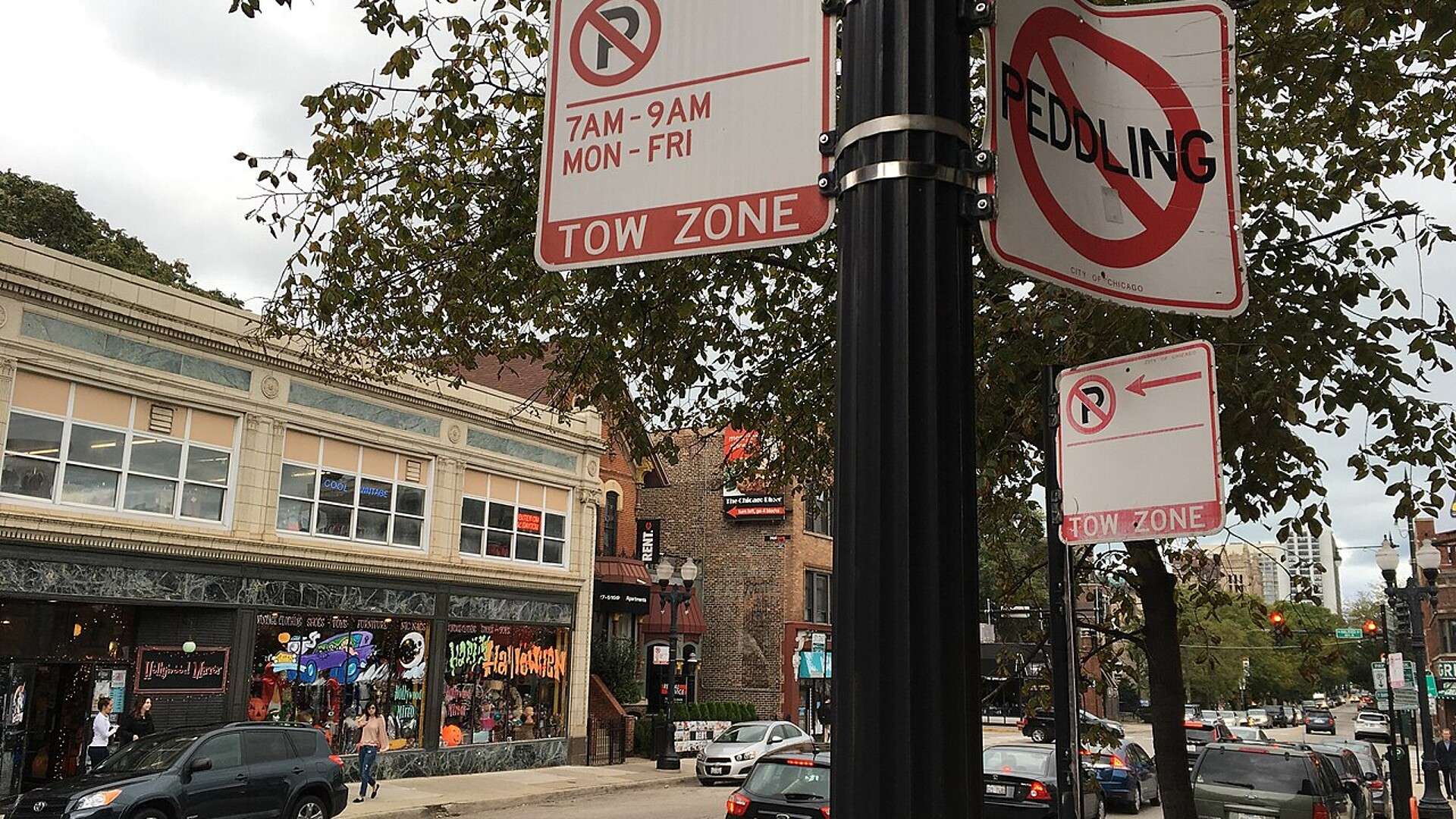
Lead image: Tow-zone signs on a Chicago street, photographed by Eric Fischer, via Wikimedia Commons, licensed under CC BY 2.0.