
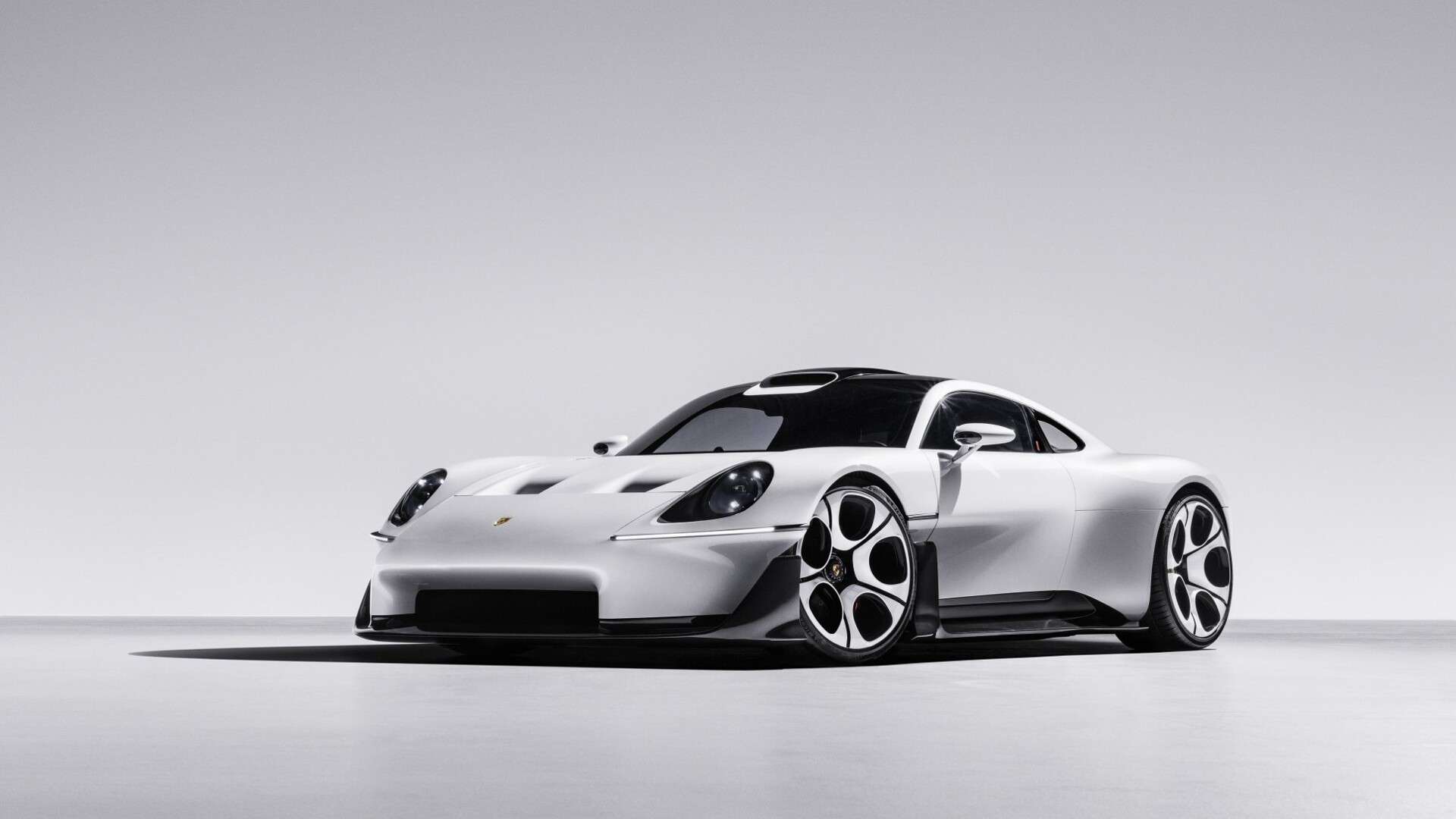
Porsche says its next flagship will sit above the 911 for good, not as a numbered special that sells out before it is built. If the show car is any guide, the screen in the middle of that flagship’s dashboard will be whatever phone you walked in with.
That is the plain reading of the Mission S, a vision model Porsche unveiled on Oct. 15. In its own press release, the company says it “deliberately” left out a permanently integrated center display and a fixed passenger display. In their place is a retractable smartphone holder that works with MagSafe. Your phone becomes the navigation or information screen “if desired,” and the My Porsche app handles the rest of the car’s functions.
This is the same company that offers an optional passenger-side touchscreen in the Taycan. For its most expensive permanent model, it is betting that buyers will happily supply the screen themselves.
What Porsche actually announced
Strip away the design talk and Porsche made one concrete product commitment. “The Mission S represents a mid-engined super sports car platform positioned above the 911,” CEO Michael Leiters said in the release, “not as a one-off hypercar, but as a permanent and versatile addition to our customer offering.”
That is a real change. Porsche’s previous cars above the 911, the Carrera GT and the 918 Spyder, were limited runs of 1,270 and 918 cars respectively. Porsche’s release says that this time it is planning, “for the first time, a permanently available super sports car offer” above the 911. The Mission S is presented as part of a strategy the company calls “Sportwagenschmiede ’35.”
The release calls the Mission S a “vision model,” and Tobias Sühlmann, Porsche’s vice president of style, says its direction will “soon” be translated into future products. Porsche did not say what the production car will be called, when it will be built, or what it will cost.
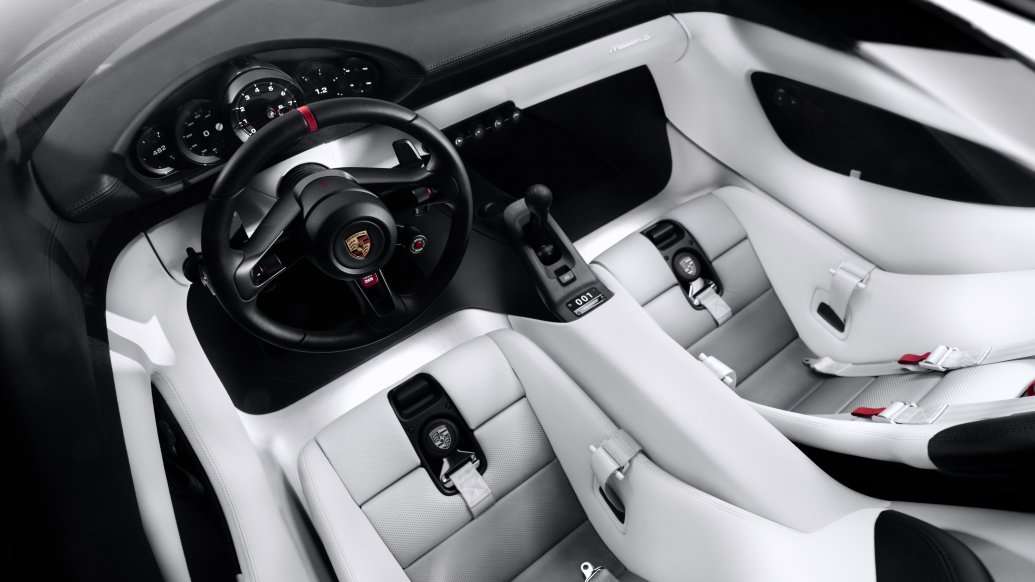
The cockpit, as shown
Porsche says there are five round instruments behind the steering wheel, with a central rev counter that uses an analog needle with a display behind it. Depending on the drive mode, the rev counter moves closer to the driver, and the gauge tubes rearrange themselves either side by side or one behind another.
The key holder sits to the left of the steering wheel, as Porsche tradition demands. There are push-pull controls on the dash for comfort and driving functions, and a reimagined Sport Chrono element. The seatbelt buckle is built into the center panel, and the seat adjustment controls have been moved. Through the app, owners can pick digitally rendered gauge designs inspired by older Porsches. So the screen you do not get in the dash is also where you choose what the analog-looking dials look like.
Porsche’s photos also show a tall, exposed lever on the center console and a row of round controls across the dash. The press release does not say what the lever does, and it does not mention a gear selector or shift paddles at all.
What we don’t know yet
The engine. Porsche’s release says only that the engine “is positioned centrally” to make room for the classic Porsche “flyline” roofline. It does not name the engine, its output or whether it is electrified. The closest thing to an answer came from Leiters in a separate interview with Automotive News: “There won’t be a BEV on that platform because there is no demand, in this segment, for an EV there.” That rules out a battery-electric version. It leaves pure combustion and hybrid power on the table.
The gearbox. Asked after the reveal whether the platform could get a manual, Leiters told Road & Track: “Customer demand will define what we build on this platform.” That is not a yes. It is not a no either.
The price. Porsche has not given one. Any number circulating right now is a guess, not a Porsche figure.
The timing. Porsche has not given a production date. The only time word in its release is “soon.”
Whether the phone holder survives. This is a show car. Porsche presents the screenless dash as a deliberate choice, but concept interiors often change on the way to production.
Why it was unveiled on a pier in Queens
Porsche chose a pier in Queens, with Manhattan across the water, for the reveal. According to the company, that is the same pier where the first photos of the mid-engined 550 Spyder were taken in 1953. Porsche calls the 550 Spyder its first super sports car and credits it with laying the groundwork for the brand’s success in the U.S.
Porsche’s design team also lists the old cars that shaped the new one: 911-style round headlights and fenders, G-model shut lines, a GT1-inspired flat front and a “car-in-car” rear, a 959-style roofline, wheels based on the 928’s “dial” design, and a cooling setup that recalls the 917’s radiator fan. The interior architecture, Porsche says, draws on the 550 Spyder and the 356.
Seventy-three years after the 550 Spyder posed on that pier, its successor showed up quoting nearly every Porsche ever built, minus the one thing almost every new car now has: a screen of its own.
Would you buy a car at this level if the only screen in the dash was the phone already in your pocket?
Top photo: The Porsche Mission S vision model. Photos: Porsche AG. Source: Porsche Newsroom