
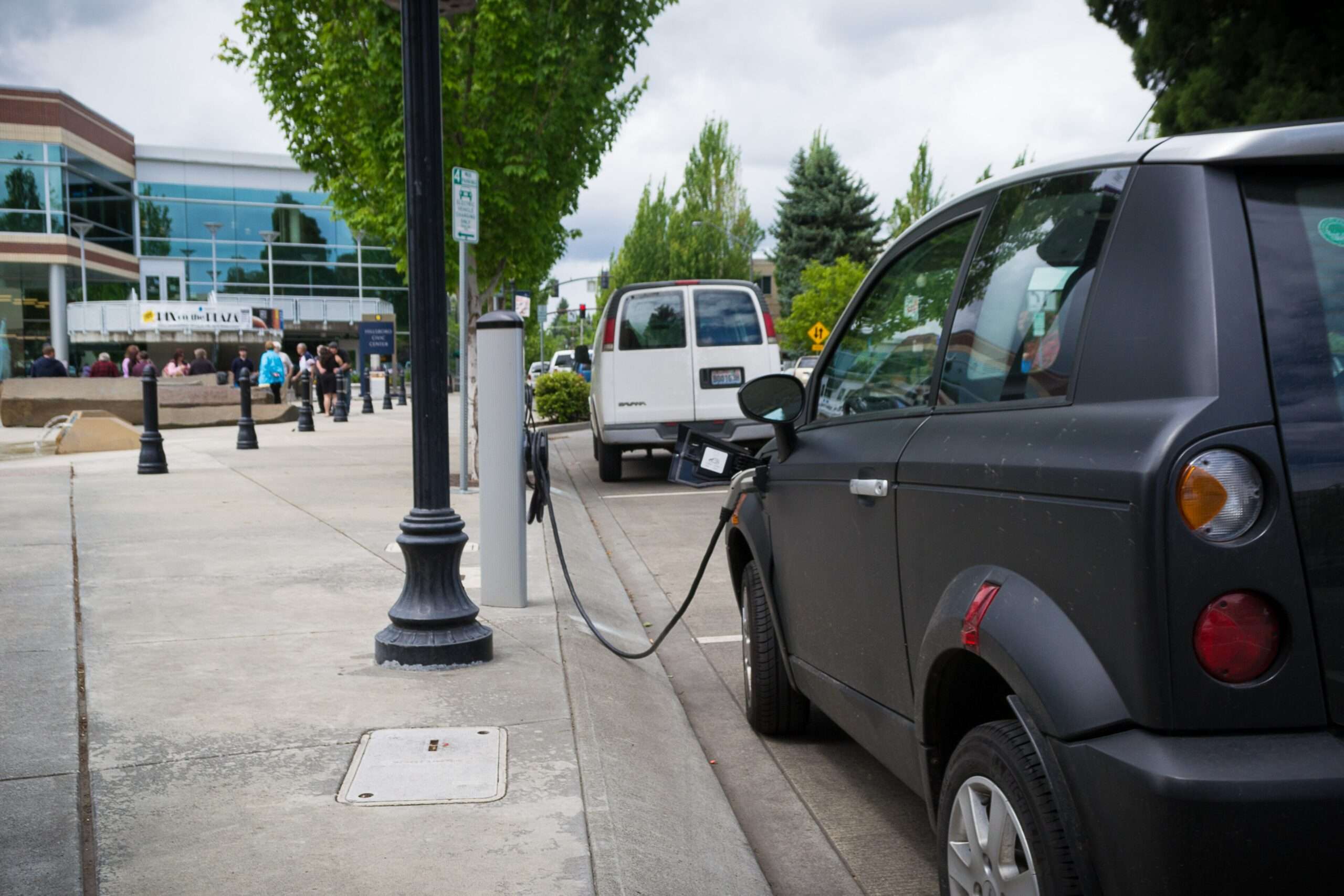
The House highway bill would charge electric-vehicle owners an annual EV registration fee of $130 and plug-in hybrid owners $35, and the Congressional Budget Office estimates the fees would raise a net $12 billion through fiscal 2036.
Through fiscal 2031, CBO’s table puts the net take at $2.774 billion. CBO’s June 2026 baseline has the Highway Trust Fund’s highway account $86.0 billion short by the end of 2031. Divide one by the other, The Auto Wire’s arithmetic and not CBO’s, and the fee covers about 3 percent. The fee changes who pays for roads. It does little about how much money is missing.
What Section 1129 would do
The fee sits in Section 1129, “Registration fee on motor vehicles,” of H.R. 8870, the BUILD America 250 Act, introduced May 19, 2026. The House Transportation and Infrastructure Committee’s section-by-section summary sets the fee at $130 a year for a covered electric vehicle and $35 for a covered plug-in hybrid. Starting in 2029, it says, both rise by $5 every two years, to caps of $150 and $50. On that schedule an EV owner reaches $150 in 2035 and a plug-in hybrid owner reaches $50 in 2033. I could read the committee’s description of the section but not the operative bill text, so the schedule rests on the summary, and amendments could change it.
States would do the collecting. The summary says each state collects the fee, and a state that does not has 125 percent of the amount owed withheld from its federal highway apportionment. CBO describes it the same way: states would be required to collect registration fees on electric and plug-in hybrid vehicles. For owners, that puts the charge at the registration counter, not at a pump. CBO assumes the revenue goes into the Highway Trust Fund, although it notes the bill does not require that.
The timeline is long. CBO’s table shows the first collections in fiscal 2028, which begins Oct. 1, 2027, at $152 million, growing to $2.421 billion in fiscal 2036, the last year the fees run. The committee approved the bill May 22 after a 14-hour markup, and its release said the bill had not yet reached the House floor; I could not confirm a floor vote since. Chairman Sam Graves’s office said in a Sept. 1 statement that H.R. 6500 would continue surface transportation programs through December 11, and that he wants a multi-year bill passed before the end of this Congress.
A flat fee against a per-gallon tax
The federal gasoline tax is 18.4 cents a gallon. CBO says it has stood at that rate since 1993 and is not adjusted for inflation. A $130 fee equals the gas tax on about 707 gallons, which a 25-mpg car burns in roughly 17,700 miles. The $35 plug-in hybrid fee equals about 190 gallons. Those conversions are The Auto Wire’s math.
That puts the break-even mileage in plain view. A 25-mpg gas car driven fewer than 17,700 miles a year pays less in federal gas tax than the EV fee would cost, and a car driven more pays more. The EV fee, as summarized, is the same whether the car covers 5,000 miles or 25,000. A plug-in hybrid owner would pay both: the pump tax on whatever gasoline the car burns, plus the $35. Hybrids have been taking a record share of sales as gas prices climb, which makes that second group larger than it was.
Why $17 billion becomes $12 billion
CBO puts gross fee collections at $17 billion over 2026 to 2036. It then subtracts about 25 percent of each year’s collections, which it attributes to reduced income and payroll tax receipts, leaving the $12 billion net. In CBO’s accounting, a dollar of fee is not a dollar of added federal revenue.
The shortfall it would be set against is larger and moving the other way. CBO’s June 2026 baseline projects a cumulative shortfall at the end of 2031 of $86.0 billion in the highway account and $45.2 billion in the transit account. CBO’s estimate under H.R. 8870, adjusted for permitting changes and historical spending rates, is $99.5 billion for highways and $48.2 billion for transit. The highway figure is $13.5 billion above the baseline, nearly five times the fee’s net revenue through 2031.
What to watch before any owner sees a bill
Four things will decide how much of this survives. The first is the schedule: the summary’s $5 every two years, and the $150 and $50 caps, need to match the text that finally passes. The second is whether Congress requires the money to go into the Highway Trust Fund instead of leaving CBO to assume it. The third is the calendar. The December 11 date comes first, and The Auto Wire has already reported that this Congress ends January 3, so a bill that misses the lame-duck window starts over. The fourth is the states, which would have to build the collection process into registration before the first dollar arrives in fiscal 2028.
Should EV and plug-in hybrid owners pay a flat annual fee at registration, or should every driver, gas or electric, pay by the mile?