
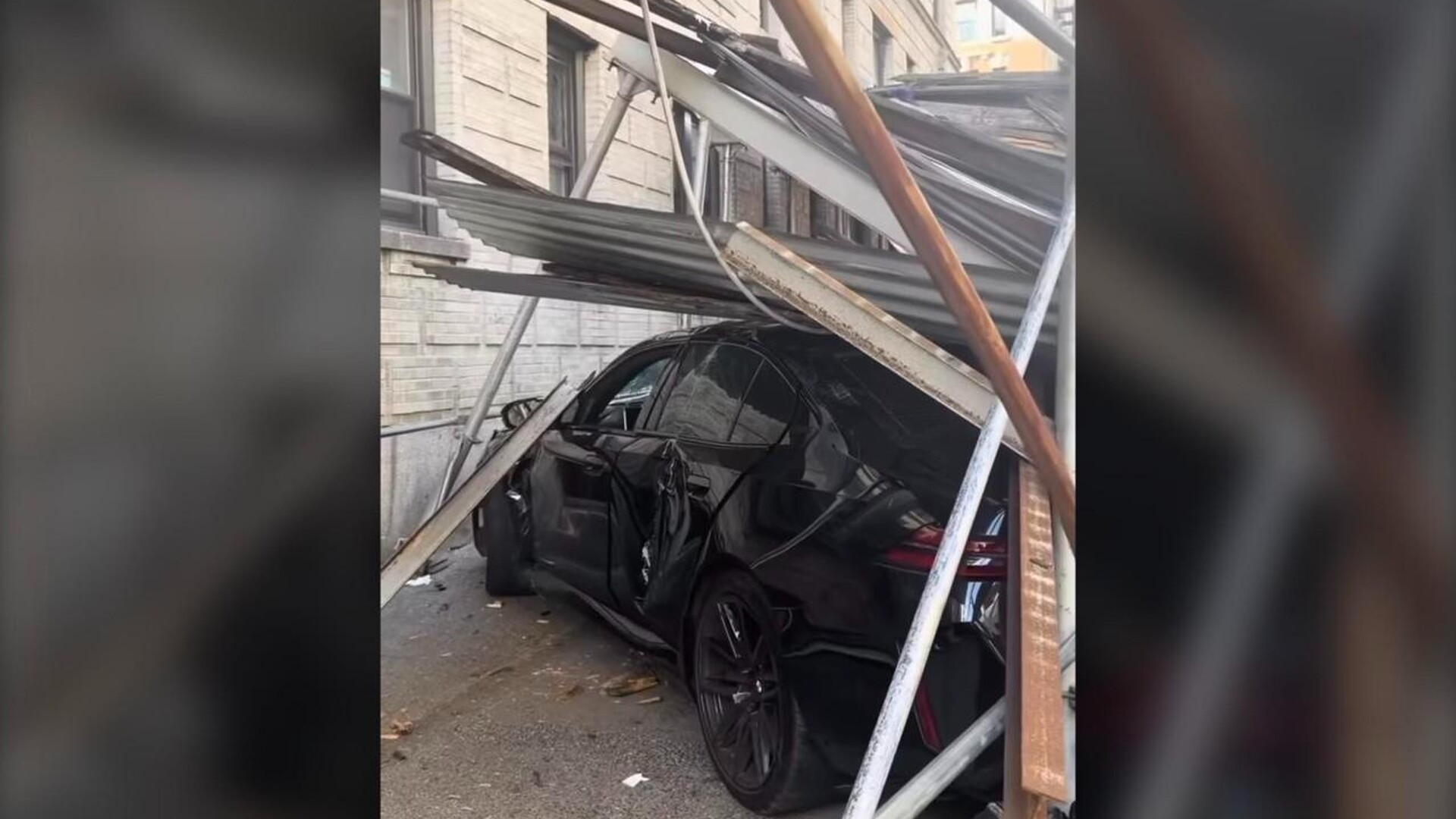
A black BMW M5 spent part of this weekend pinned under a collapsed sidewalk shed in Washington Heights, in Upper Manhattan, making it the latest New York car to end up where pedestrians walk. Video credited to Instagram user @fundedsalary and reposted Sunday by the @newyorkers account shows the sedan wedged between the shed’s toppled uprights and the wall of an apartment building, with a rusted steel pipe lying across its trunk lid and the shed’s decking folded down over the roof.
The @newyorkers caption says the M5 “ripped into scaffolding in Washington Heights this weekend.” That is the account’s description, not an official one. I checked for NYPD, FDNY and Department of Buildings statements and found none about this crash, so the address, the time, whether anyone was hurt and who was driving are all unconfirmed.
Whether the car drove into the shed or the shed fell onto the car decides who pays. New York courts have already drawn a clear line for the first case. The second puts the building owner and the shed contractor on the hook.
View this post on Instagram
Video: @fundedsalary, reposted by @newyorkers on Instagram
What the 14-second video shows
The clip opens on the street side of the wreck: the shed’s corrugated decking collapsed toward the curb, its pipe uprights splayed at angles, and yellow tape strung along the sidewalk. The camera then moves in on the rear of the car, where the M5 badge sits just below a pipe resting on the decklid. The last few seconds show the driver’s side. The rear door is pushed in, and the car sits tight against the building’s facade, under what is left of the shed, in the space a sidewalk shed exists to protect.
The taillights and badge match the current G90-generation M5 sedan. BMW’s June 25, 2024 U.S. launch release rates its plug-in hybrid V8 at 717 hp and 738 lb-ft and lists a base MSRP of $119,500 plus $1,175 destination. The video doesn’t show this car’s model year or options, so its actual price is unknown, but no version of it is cheap to fix.
New York courts on drivers who hit sidewalk sheds
In Rodriguez v Hernandez, a 2007 case in the Appellate Division’s Second Department, a driver lost control after a two-car collision and struck a sidewalk shed at a school construction project. The shed collapsed, and a pole stored on top of it came through his windshield and into his leg. The appeals court threw out his claims against the City and the School Construction Authority. Even if the shed had been put up improperly, the court said, his own loss of control was the proximate cause, and the shed “merely furnished the condition for the occurrence, not the cause.”
A Bronx Supreme Court justice relied on that reasoning in Scott v Ba (Index No. 25552/2018E), decided Feb. 15, 2024. According to the decision, on March 27, 2018, a delivery van went over the curb at 2383 Second Avenue and hit a sidewalk shed, and part of the shed fell on a pedestrian. Justice John A. Howard-Algarin dismissed all claims against Advanced Construction Equipment Corp., the company that had installed the shed in 2012. He found that the proximate cause of the injuries was the van driver losing control. Two code violations raised by another party didn’t change that, because no evidence tied them to the collapse.
Proximate cause is what both cases turn on. A shed owner can be careless and still not be liable when a car leaves the roadway and knocks the structure down. The crash is treated as the event that did the damage, and the shed is just where it happened. Both rulings involved injured people, but in my reading the same causation reasoning would apply to claims over damaged property. The outcome changes if a shed was already failing and would have come down without the impact. Courts decide these cases on their facts, and the rules differ in other states.
Who pays for the shed and the M5
If the M5 hit the shed, the building owner and the shed contractor can claim the cost of the collapsed section against the driver. That claim goes to the driver’s property-damage liability coverage. New York’s minimum for that coverage, according to the state Department of Financial Services, is $10,000 per accident. That has to cover the shed, the cleanup and anything else the collapse damaged. Any cost above the policy limit is the driver’s personal debt.
Liability coverage never pays to fix the driver’s own car. The M5’s repairs would come out of collision coverage, minus the deductible, and only if the owner bought it. A lender or leasing company on a car at this price would almost certainly have required it.
If the car was parked and the shed came down on its own, comprehensive coverage normally pays for damage from falling objects. The owner’s insurer can then go after the building owner or the contractor to recover what it paid. The facts nobody has published yet, whether the car was moving and whether anyone was in it, decide which path this claim takes.
New York’s 2025 sidewalk shed laws
The city has spent the past two years trying to shrink its shed count. Local Law 48 of 2025, which the Council passed on March 26, 2025 and the mayor approved on April 17, 2025, limits shed permits to 90 days. It charges owners who aren’t doing the repair work a shed is supposed to cover: $10 per linear foot per month for sheds up less than three years, $100 per foot from three to four years, and $200 per foot after that, capped at $6,000 a month. Under the Buildings Department’s implementing rule, the penalties apply starting with the second renewal of a permit issued after Jan. 12, 2026. A separate DOB proposal for standard shed designs took public comment through Sept. 24, 2026 and is not yet in effect.
The sections of that package I read cover how long sheds stay up, what they look like and how owners prove repairs are moving. They don’t address what happens when a vehicle hits a shed’s uprights, and crashes into sheds keep happening. On Nov. 18, 2024, a box truck knocked down a sidewalk shed on West 29th Street in Chelsea and injured three people, one critically, ABC7 New York reported; DOB officials told the station the owners had an active permit for that shed. In August 2021, a driver hit a shed in Bedford-Stuyvesant and drove off, and the city ordered the contractor to clear the debris and replace the shed, according to ABC7.
What happens after the Washington Heights crash
In past shed collapses, the Buildings Department has inspected the site and ordered the contractor to stabilize or replace the structure, and it typically does that whatever caused the collapse. A police crash report, if one was filed, would record whether the M5 was moving, who was driving and whether anyone was hurt. None of that is public yet.
Any driver who hits a shed, a parked car or a storefront in New York has a legal duty that starts before the insurance claim. Vehicle and Traffic Law Section 600 requires a driver whose vehicle damaged someone’s property to stop, show a license and insurance card, and give name, address, insurer and policy information to the person whose property was damaged. If that person isn’t there, the driver has to report the damage to the nearest police station as soon as physically able. Leaving without doing either is a traffic infraction carrying a fine of up to $250, up to 15 days in jail, or both, and it sits on top of whatever the building owner claims.
New Yorkers: how many years has the shed outside your building been up? Has anyone on your block clipped one yet?