
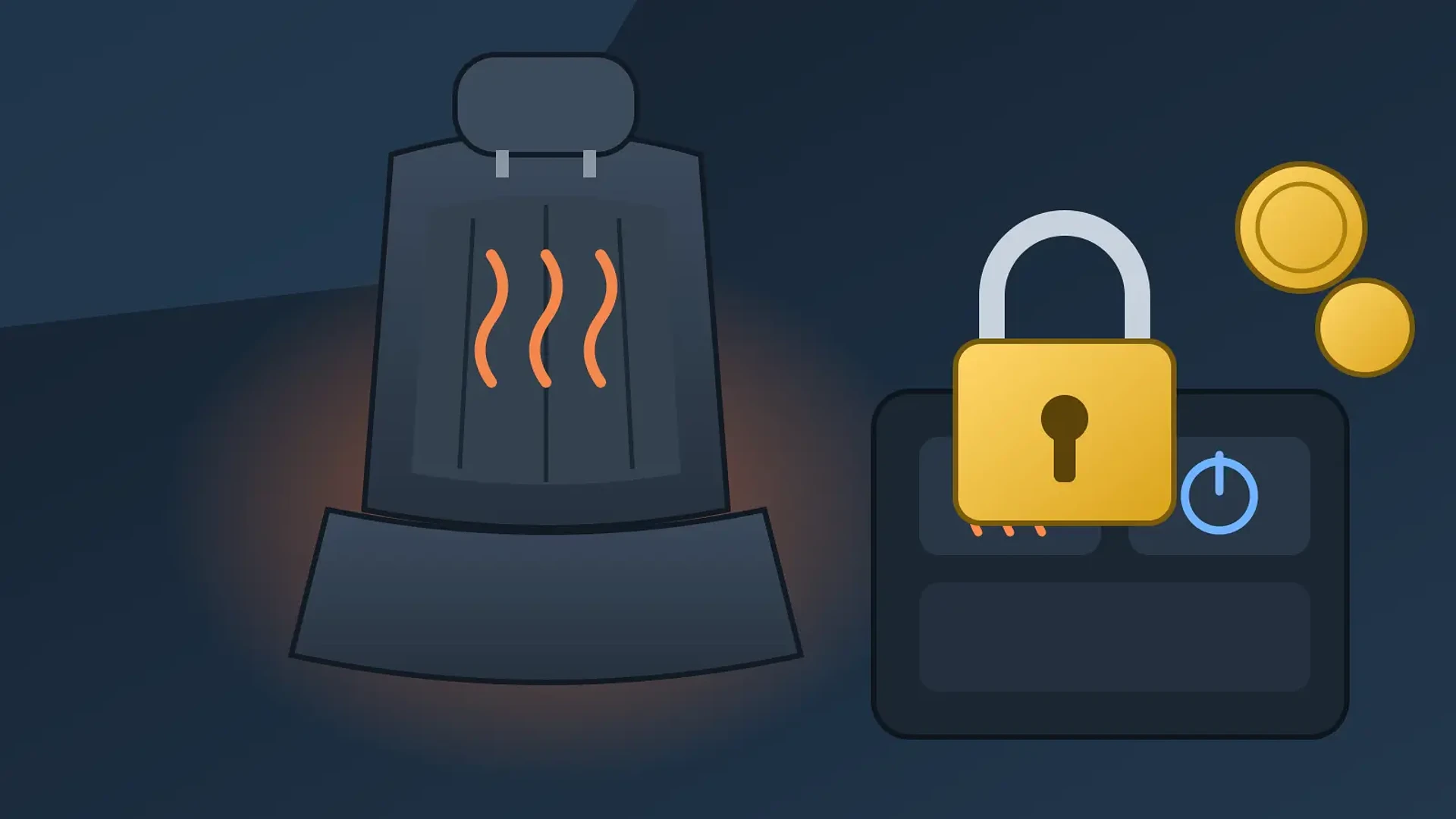
Gov. Kathy Hochul signed a law in Albany on Monday that bars automakers and dealers from charging New York drivers a recurring fee to switch on hardware already built into their cars, a measure lawmakers first sent her in 2025 and she vetoed on Dec. 5 of that year.
The new law is S.9348A/A.10411A, signed as Chapter 414 of the Laws of 2026, according to the Legislature’s bill record. It adds Section 198-d to the state’s General Business Law. I read it side by side with S5708, the bill she vetoed. The definitions, the ban, the list of exemptions and the $250 penalty match word for word. The one addition is subdivision (e), a single sentence letting the Department of State write rules to carry out and enforce the section.
When she rejected the first version, Hochul wrote that the bill “limits consumer choices and may increase the costs of new vehicles,” according to New York Focus, which compiled her 2025 veto messages. Nothing in the new text bears on either objection. Her office’s announcement on Monday framed the same words as a cost-of-living measure, with Hochul telling carmakers to keep their hands out of New Yorkers’ wallets.
What New York’s Section 198-d bans
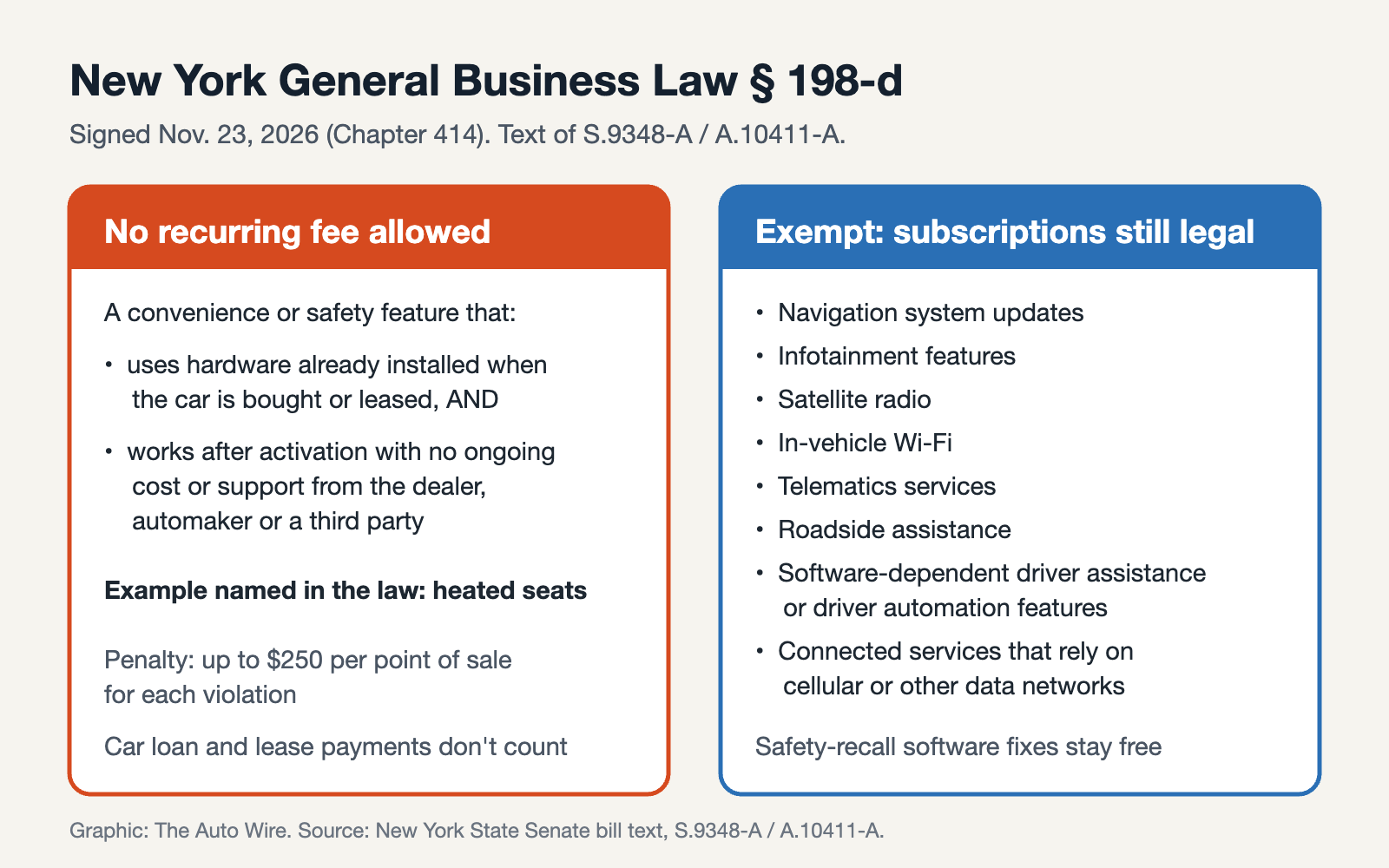
The statute covers a “motor vehicle feature,” defined as any convenience or safety function on the car, heated seats included, that is typically sold as an upgrade when the car is bought or leased. A manufacturer, dealer or their agent can’t offer a subscription for that feature when two conditions are both met: the hardware was already installed when the buyer took the car, and the feature would keep working after activation without ongoing cost or support from the dealer, the automaker or any outside provider.
A subscription, under the law, means a recurring weekly, monthly or annual payment. The definition carves out payments on a retail installment contract or a lease, so a dealer can still fold a feature’s price into the car loan at signing. The law is aimed at the separate bill that arrives after the sale.
A violation carries a civil penalty of up to $250 per point of sale for each violation. The text doesn’t say which office brings the case, and it gives buyers no right to sue on their own. For scale, a hypothetical $15-a-month heated-seat plan kept for three years would bring in $540 from one car, more than double the maximum fine.
Hands-free driving and navigation are exempt
The governor’s announcement says the law guards against fees to activate “heated seats, enhanced navigation, hands-free driving and entertainment options.” The statute’s exemption list, in subdivision (c), excludes navigation system updates, infotainment features, satellite radio, in-vehicle Wi-Fi, telematics services, roadside assistance, software-dependent driver assistance or driver automation features, and any connected service that relies on cellular or other data networks. Navigation updates, infotainment and hands-free driving software all appear on that list. Heated seats are the one example in her sentence the law clearly reaches.
Hands-free driving is among the most visible recurring charges in the industry. In an October 2024 announcement, Ford priced BlueCruise at $495 a year or $49.99 a month for owners of equipped vehicles. Skoufis’ sponsor memo cites BlueCruise’s earlier pricing as an example of the practice the bill was written to stop. As software-dependent driver assistance, it sits outside the ban.
The law can treat the same feature two ways depending on how it reaches the car. A remote start triggered from the key fob uses only hardware in the car and the fob, so a monthly fee for it would be covered. The same remote start sent from a phone app over a cellular connection is, on a plain reading of the text, a vehicle-connected service, and the exemption applies. Connected-service plans, including the kind at the center of a Chicago lawsuit over a lapsed Volkswagen Car-Net trial, stay legal.
One-time unlock fees aren’t in the text
The 2024 version of the bill, S8393, would have barred offering a subscription or charging a post-purchase fee for built-in features. The post-purchase language is gone from the law Hochul signed. Section 198-d(b) now prohibits offering a subscription service, and a subscription service requires a recurring payment. A one-time charge to unlock installed hardware after the sale doesn’t meet that definition.
The paperwork around the law still describes the broader version. The S9348A sponsor memo summarizes the bill as barring a subscription or a post-purchase fee, and the governor’s release says the same. A court would read the statute. Carmakers already sell performance upgrades through software, and any such unlock priced as a single payment would fall outside Section 198-d.
The sponsor’s own examples show how narrow the ban is
The sponsor memo’s leading example of a covered fee is BMW, which the memo says charged drivers in several countries $18 a month to turn on heated seats. Its other examples are Ford’s BlueCruise and General Motors, which the memo says told investors it aims to make a significant profit from subscription fees. Driver assistance and connected services, the bulk of GM’s subscription business, are on the exempt list.
That leaves New York with a rule that bans the heated-seat model before it takes hold in the state, which matters for a buyer who plans to keep a car for a decade and doesn’t want the comfort options turned into rent. It does less about the recurring charges drivers pay today, which run through software and data connections the law exempts. The broader fight over software paywalls and what they cost owners is playing out elsewhere.
A veto, a reintroduction and a signing
The first version passed the Senate 57-2 in June 2025 and cleared the Assembly five days later. After the veto, Sen. James Skoufis and Assemblymember William Magnarelli reintroduced it in March 2026. It passed the Assembly on May 19 and the Senate on June 4, 57-3, and was delivered to the governor on Nov. 13, according to the Senate’s records.
Skoufis, a Hudson Valley Democrat, has clashed publicly with Hochul, also a Democrat. When she vetoed seven of his other bills in one day in October 2025, he called it political retaliation, Spectrum News reported; her veto message on one of them cited the staff and money agencies would need to comply. Monday’s release quotes Skoufis thanking the governor and Magnarelli. Attorney General Letitia James also endorsed the law in the release, pointing to settlements her office has won over illegal fees in car sales.
When the law takes effect for New York car buyers
The bill takes effect on the 90th day after it became law. The governor’s office puts that date at Feb. 27, 2027. Counting 90 days from Monday’s signing lands on Feb. 21, so the state’s own date may be off by six days. The Department of State can start writing rules before either date.
The law protects consumers who buy or lease, not dealers buying for resale. For a New Yorker at the dealership, the question that decides coverage is how a paid feature works. If it runs on hardware already in the car and needs nothing from the automaker after it’s switched on, a recurring charge for it is barred once the law takes effect. If it depends on a data connection, a mapping service or driver-assist software, the subscription remains legal. Complaints about a covered fee can go to the state attorney general’s office or the Department of State, which now has rulemaking power over the section.
The Department of State’s rules will settle how “per point of sale for each violation” is counted and how broadly the exemptions for software-dependent and connected features are read. That second answer decides whether an automaker could move a heated seat’s switch into an app and argue the fee is for a connected service.
Have you ever been asked to pay monthly for something your car could already do? What was it, and did you pay?