
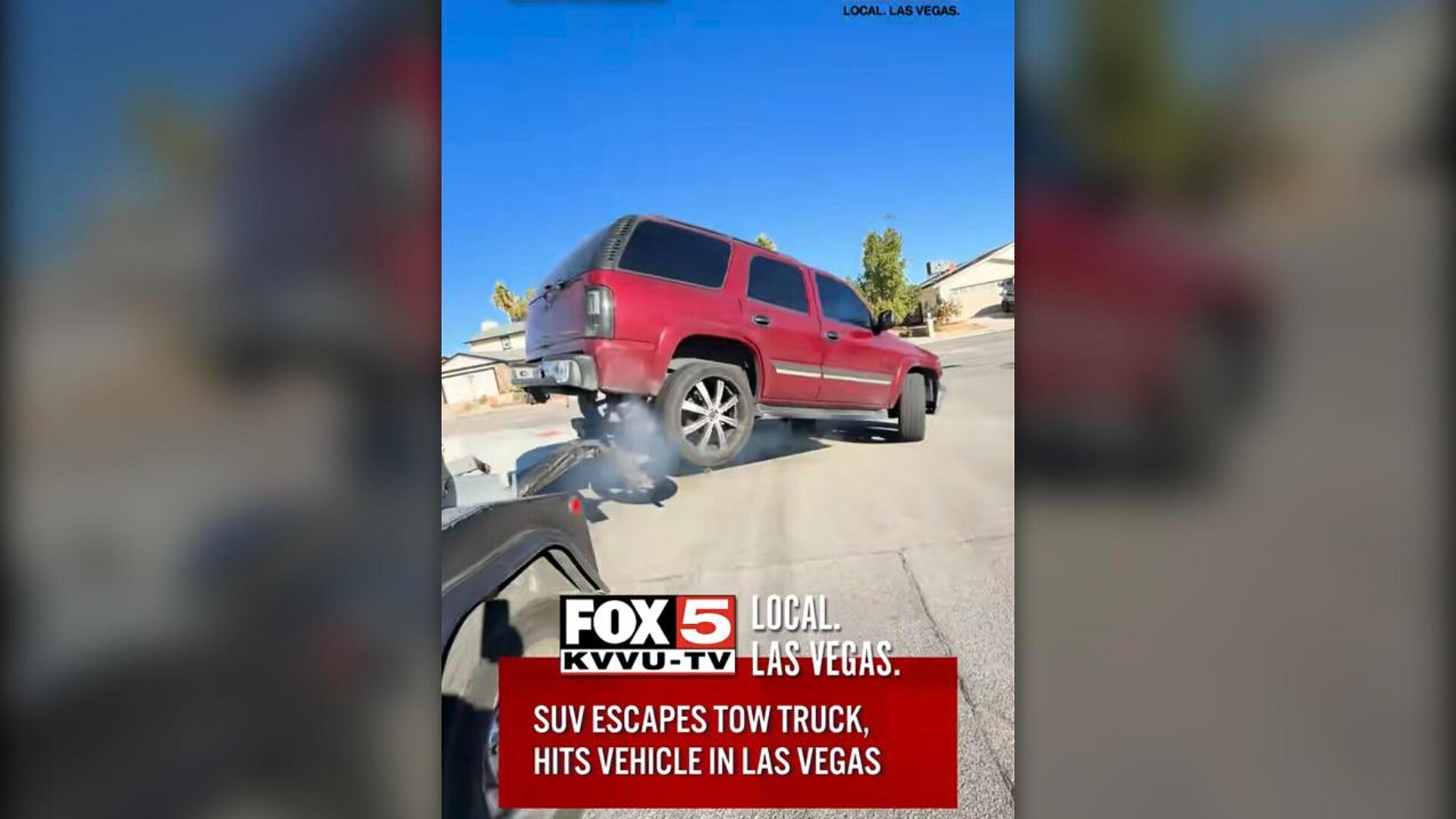
A red full-size SUV was already hooked to the back of a tow truck on the 7000 block of Carrondale Way in Las Vegas, Nevada, on Tuesday, Nov. 24, when someone got in, started it and drove it off the truck, according to the Las Vegas Metropolitan Police Department. Police told FOX5 Las Vegas the tow was a repossession, and that the SUV then struck another vehicle and left the scene.
The 20-second clip FOX5 posted, which credits the footage on screen to Joey I., was shot from beside the tow truck in the neighborhood near Washington Avenue and Tenaya Way. Tire smoke pours off the SUV as it lurches free of the truck, and it rolls away down the residential street while the camera swings back to the empty lift. As of FOX5’s Tuesday afternoon report, investigators were still looking for the SUV and no one had been arrested. Police have not publicly identified the driver, and nothing in the account police gave FOX5 says whether that person owns the SUV, owes money on it, or was hurt.
@fox5lasvegas An SUV drove off a tow truck, hit another vehicle and left the scene during a repossession in Las Vegas, police say. Watch on TikTok
Video: FOX5 Las Vegas (KVVU) via TikTok. The footage is credited on screen to Joey I.
Whoever drove that SUV off the truck took a loan default, which Nevada treats as a civil matter with a written procedure for getting a car back, and turned it into a police investigation. I read the Nevada statutes that govern each step. None of them gives anyone a right to take a car back off a repo truck at the curb, and the crash afterward carries criminal penalties no matter whose name is on the title.
Nevada lets a lender take the car without a judge, with one condition
Nevada adopted the Uniform Commercial Code’s repossession rule as NRS 104.9609. After a default, the secured party, usually the lender or the repo company it hires, may take the collateral without going to court “if it proceeds without breach of the peace.” The statute does not define breach of the peace, so where that line falls gets argued after the fact, in a civil lawsuit, not settled in the street.
The repo side carries its own paperwork. Under NRS 482.518, anyone who repossesses a vehicle without the registered owner’s knowledge has to report it immediately to the city police or county sheriff where it happened, and that agency forwards a copy to the Nevada DMV. Repossessors are licensed by the state’s Private Investigator’s Licensing Board under NRS Chapter 648. The system is built so a repossession lands on a police record, not just on a lender’s ledger.
Nevada also has a criminal statute aimed at people who move or hide financed property to keep it from the lender. NRS 205.345 makes it a gross misdemeanor for a person in possession of property subject to a security interest to remove or conceal it in a way that hinders, delays or defrauds the secured party. Under NRS 193.140, a gross misdemeanor carries up to 364 days in county jail, a fine of up to $2,000, or both. Police have announced no charges, and the public record does not yet say who the driver was or how that person is connected to the loan.
Hitting a vehicle and driving away is a separate crime
The debt question doesn’t change the crash question. If the vehicle the SUV hit had someone in it, NRS 484E.020 required the driver to stop immediately, and NRS 484E.030 required handing over a name, address and the vehicle’s registration number. If it was parked and empty, NRS 484E.040 required stopping and either finding the owner or leaving a written notice with names and addresses on the damaged vehicle. Police have not said which applies.
Each of those is a misdemeanor. NRS 193.150 sets the default misdemeanor penalty at up to six months in county jail, a fine of up to $1,000, or both. The stakes jump if someone is hurt: under NRS 484E.010, leaving a crash that injures or kills a person is a category B felony carrying 2 to 20 years in state prison and a fine of $2,000 to $5,000. FOX5’s report mentions no injuries.
Driving off also doesn’t erase a loan. A lender’s security interest follows the vehicle, and nothing in NRS 104.9609 limits a lender to one attempt at repossessing it.
Nevada’s legal route back to a repossessed car runs on a 10-day clock
Nevada gives borrowers a way to get a repossessed vehicle back, and it runs through paperwork. Under NRS 482.516, before the holder of the contract can resell or re-lease the vehicle, it must send at least 10 days’ written notice to everyone liable on the contract. That notice has to state the right to redeem, the total amount needed to redeem as of the notice date, where the vehicle will be returned, and who gets the payment. Reinstatement, meaning catching up on missed payments instead of paying off the whole balance, is available only if the lender chooses to offer it.
The same statute limits what the lender can collect afterward. A borrower is on the hook for a deficiency, the gap between what the vehicle sells for and what is still owed, only if the notice goes out within 60 days of the repossession and itemizes the balance along with any costs or fees for delinquency, collection or repossession. Those repo fees go on the borrower’s bill, which means every extra trip a tow truck has to make for the same SUV can raise the price of getting it back.
Fights over repossessions don’t always start with an unpaid bill. The Auto Wire has covered a Jacksonville owner whose 2019 Yukon was repossessed 19 days before his first payment was due and a Los Angeles teen who says a DMV clerk told him his Mercedes-AMG had no lien before a tow company said Carvana ordered it repossessed. Borrowers who believe a repo was wrongful have a remedy in the same article of the code: NRS 104.9625 covers remedies when a secured party fails to follow the rules. That claim gets filed in court, not settled by getting behind the wheel while the car is on the lift.
What comes next for the driver, the lender and the owner of the struck vehicle
LVMPD is still looking for the SUV. If investigators identify the driver, prosecutors will decide what, if anything, to charge, and the bystander video is the clearest public evidence of what happened at the truck. If the default behind Tuesday’s tow stands, the lender’s claim on the SUV hasn’t gone anywhere, and neither has its right to send another truck.
The owner of the vehicle that got hit is in the weakest spot of anyone involved. Until police identify who was driving, there is no other driver’s insurer to file against, and the repair bill lands on that owner’s own policy, if it covers collision, or on that owner’s wallet.
Should Nevada treat driving a car off a repo truck mid-tow as a crime on its own, or should a dispute over a car loan stay a civil matter between borrower and lender unless someone else’s car or body gets hit?