

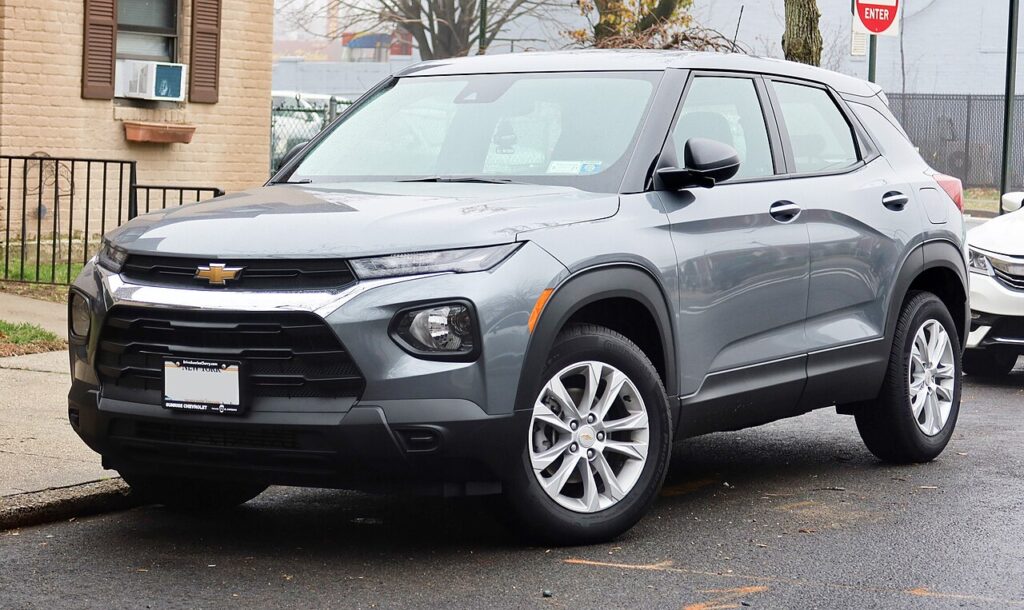
GM’s maintenance schedule for the 1.2-liter three-cylinder in the base Chevrolet Trailblazer calls for replacing its timing belt, along with a second belt that turns the oil pump, at 150,000 miles or 15 years, whichever comes first. A salvage-yard teardown posted Nov. 14 shows one of those engines with its belt in pieces and all 12 of its valves bent, out of a 2021 Trailblazer that had about 84,000 miles on the odometer.
That engine comes with a murky history, and the man who took it apart says so on camera. GM’s 150,000-mile figure has a problem that doesn’t depend on him. Ford used the same interval for the oil-bathed belt in its 1.0-liter three-cylinder until federal investigators found those belts failing at an average of about 70,000 miles, and in June Ford told regulators it was cutting the interval to 100,000 miles or six years. GM’s number for the Trailblazer hasn’t moved.
Twelve bent valves from a three-cylinder
The engine is GM’s LIH, a turbocharged, direct-injected inline three that Chevrolet rates at 137 hp and 162 lb-ft of torque. It is paired with a CVT, and it is still the standard engine in the 2027 Trailblazer Limited. The man with the wrenches is Eric, who runs the Importapart auto-dismantling business and posts weekly engine teardowns on his YouTube channel, I Do Cars. This one came from a 2021 Trailblazer; he puts the mileage at about 84,000 in the video and 85,000 in its description, and says the same engine family also powers the Chevrolet Trax, Buick Encore GX and Buick Envista.
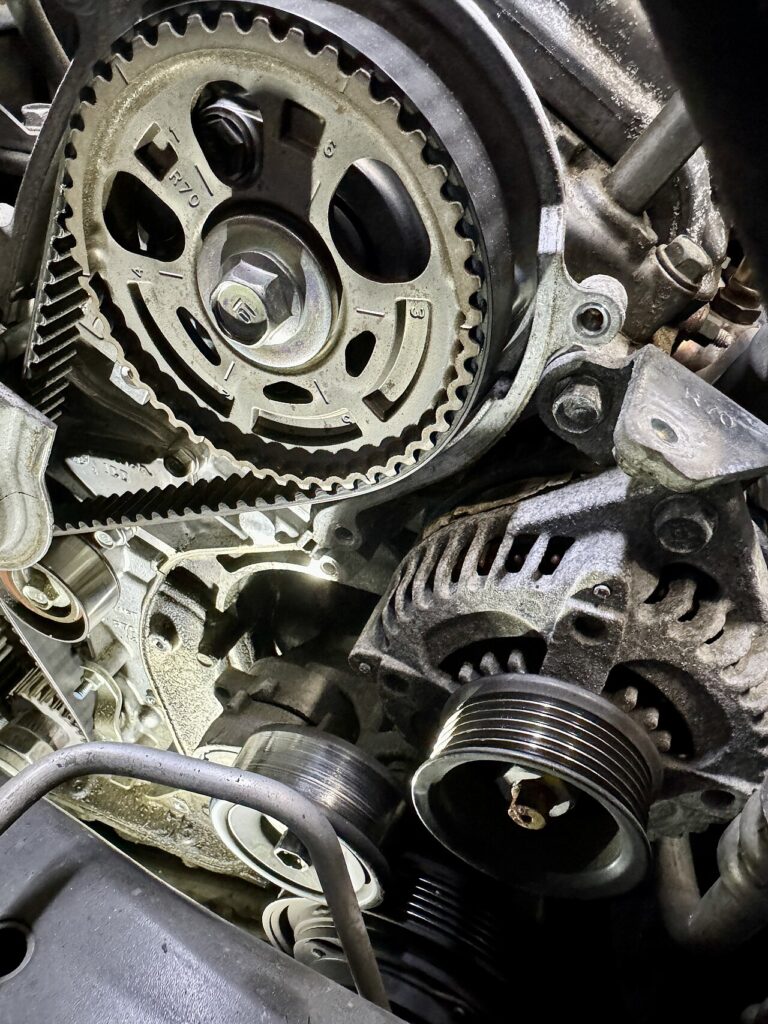
The spark plugs looked normal. The intake ports did not. Looking down them, he found valves hanging open. Under the valve cover, many rocker arms were missing or knocked out of place, the camshaft lobes were gouged, and shreds of belt fiber sat in the head. The belt came off cracked and torn apart. With the head removed, the valve reliefs in the piston crowns, the shallow pockets that give the valves room to open, had been hammered larger. Eric said every valve was damaged. With four valves per cylinder, that is 12.
That damage is what an interference engine does when its timing drive lets go. The pistons and the open valves take turns occupying the same space at the top of each cylinder, and the belt is the only thing keeping their schedules apart. Once the belt stops turning the camshafts, the crankshaft keeps driving the pistons up into whichever valves were left open. Eric said good used LIH engines sell for about $600 to $700, and that swapping one in costs far less than repairing a head full of bent valves.
What one teardown can’t establish
Eric pulled the vehicle’s history and said the Trailblazer had been wrecked and totaled. He reasoned that a car has to be moving under its own power to hit something, and an engine in this condition couldn’t have moved it. The Carfax report, he said, showed a large block of work shortly before the collision, which he read as a possible engine replacement, while allowing that the theory might be a stretch. So the 84,000 miles belong to the vehicle, and how far this particular belt went, and on what oil, isn’t established.
He said the records showed many oil changes, possibly stretched past the recommended interval, and nothing he would call neglect. He also stressed that he had one engine, not 50 lined up with the same failure, and told owners of GM’s 1.2- and 1.3-liter three-cylinders not to rush to trade their vehicles in.
There’s a reason more of these haven’t reached a teardown stand. Eric said the core value of a dead LIH is so low that a salvage yard makes more by dropping it in its own scrap bin than by shipping it to a core buyer. Engines that go to the shredder leave no record, so one teardown can draw hundreds of thousands of views while any other failures disappear as scrap metal.
A belt that lives in the oil
A conventional timing belt runs dry behind a cover on the end of the engine, where a technician can pull the cover and look at it. A wet belt runs inside the engine, bathed in its oil. That ties the belt’s life to the oil’s condition, and it means anything the belt sheds travels wherever the oil goes. GM’s schedule for the LIH also lists an oil pump drive belt, so on this engine a belt both times the valves and turns the pump that feeds them. Eric said the pump belt on his engine looked fine.
The 2021 owner’s manual specifies oil meeting GM’s dexos1 standard and lists the 150,000-mile, 15-year belt replacement on both its normal and severe-service schedules. The 2024 Trailblazer manual, in a revision GM dated November 2025, still carries the same interval for the 1.2-liter.
What NHTSA found inside Ford’s 1.0-liter
NHTSA’s Office of Defects Investigation opened a preliminary evaluation of Ford’s 1.0-liter wet belt on Dec. 18, 2025, and upgraded it to an engineering analysis on July 31, 2026. It covers 135,551 vehicles: 2014–2017 Fiestas and 2015–2018 Focuses with the 1.0-liter and a manual transmission. Automatic-transmission 2018–2021 EcoSports and 2016–2018 Focuses are being studied alongside them because their belts use similar material.
The agency describes the failure this way. The belt material can degrade and shed debris that clogs the engine’s mesh oil pump pick-up screen. Oil pressure drops, drivers often see a low-oil-pressure warning, and the engine loses power, in some cases with no warning first. ODI said failures averaged about 70,000 miles, that 98% happened before the 150,000-mile replacement interval, and that they occurred despite evidence of proper oil maintenance. The pick-up screen isn’t serviceable, so the debris can’t be checked or cleared without pulling the engine.
Ford informed the agency on June 2, 2026, of a customer satisfaction program, which is not a safety recall, that cuts the replacement interval to 100,000 miles or six years and reimburses some owners who paid for engine repairs. Stellantis went further in Europe. Since March 2024 it has covered 100% of parts and labor on earlier PureTech 1.0 and 1.2 engines for excessive oil consumption or premature timing belt degradation for up to 10 years or 180,000 kilometers, under conditions, and it set up a compensation platform for owners who paid for those repairs between Jan. 1, 2022, and Dec. 31, 2024.
None of that is evidence against GM’s belt. These are different engines, and nothing in NHTSA’s Ford file mentions GM. I found no NHTSA recall or defect investigation covering the LIH’s timing belt. The agency does have an open engineering analysis on a different GM engine, the L87 V8 and its recall fix. What the Ford file does establish is that 150,000 miles was a wet-belt interval one automaker published and then shortened once the field failures came in.
NHTSA’s page for the 2021 Trailblazer lists four recalls, no investigations and 203 owner complaints across all components. One, filed Aug. 3, 2026, says the timing belt snapped prematurely and the engine lost all power on the highway; it gives no mileage. Another, filed Sept. 3, describes a sudden low-oil-pressure warning on a 2021 Trailblazer LT telling the driver to stop the engine, and says the dealer and GM declined to help with costs after the owner’s extended warranty ran out. It doesn’t name a cause. Complaints are owners’ accounts, not findings.
The warranty ends 90,000 miles before the belt is due
Chevrolet’s powertrain warranty runs 5 years or 60,000 miles. The LIH’s belt service comes due at 150,000. A belt failure anywhere in the 90,000 miles between lands on an owner who followed GM’s schedule to the letter and had nothing yet due. Most 2021 Trailblazers are past the five-year mark by now, so the odometer hardly matters for them. The same owners may already be following the federal suit over GM’s CVTs, the transmission paired with the 1.2-liter.
Eric estimated a belt job at $1,200 to $1,500. Based on this engine, he said he would replace the belt at no more than half of GM’s interval, and he argued that a cheap crossover carrying a big scheduled bill would be a harder sell, so the interval gets pushed out. That is his reading of GM’s motive. GM’s published owner materials don’t explain how it arrived at 150,000 miles.
For owners and shoppers, the practical steps are dull and cheap. Use oil that meets dexos1 and keep the receipts; Chevrolet’s warranty booklet puts scheduled maintenance on the owner and says GM recommends keeping the records. Treat a low-oil-pressure warning as a reason to get off the road and shut the engine down, since that warning came first in many of Ford’s failures. And on any used vehicle with the 1.2, assume the belt is original. Nothing in GM’s schedule would have given an earlier owner a reason to change it.
Will the 150,000-mile number survive?
GM’s next batch of owner’s manuals for the 1.2-liter will answer that directly. NHTSA’s Ford analysis could answer it sideways: a recall there would put a federal finding on the record that a wet belt can starve an engine of oil before its scheduled replacement. And one shredded belt on a YouTube channel only becomes a pattern, or gets written off as a fluke, if more dead LIH engines reach a teardown stand before the scrap bin eats them.
If you owned a 2021 Trailblazer with 80,000 miles on it, would you pay to replace the timing belt now or hold GM to its 150,000-mile number?