
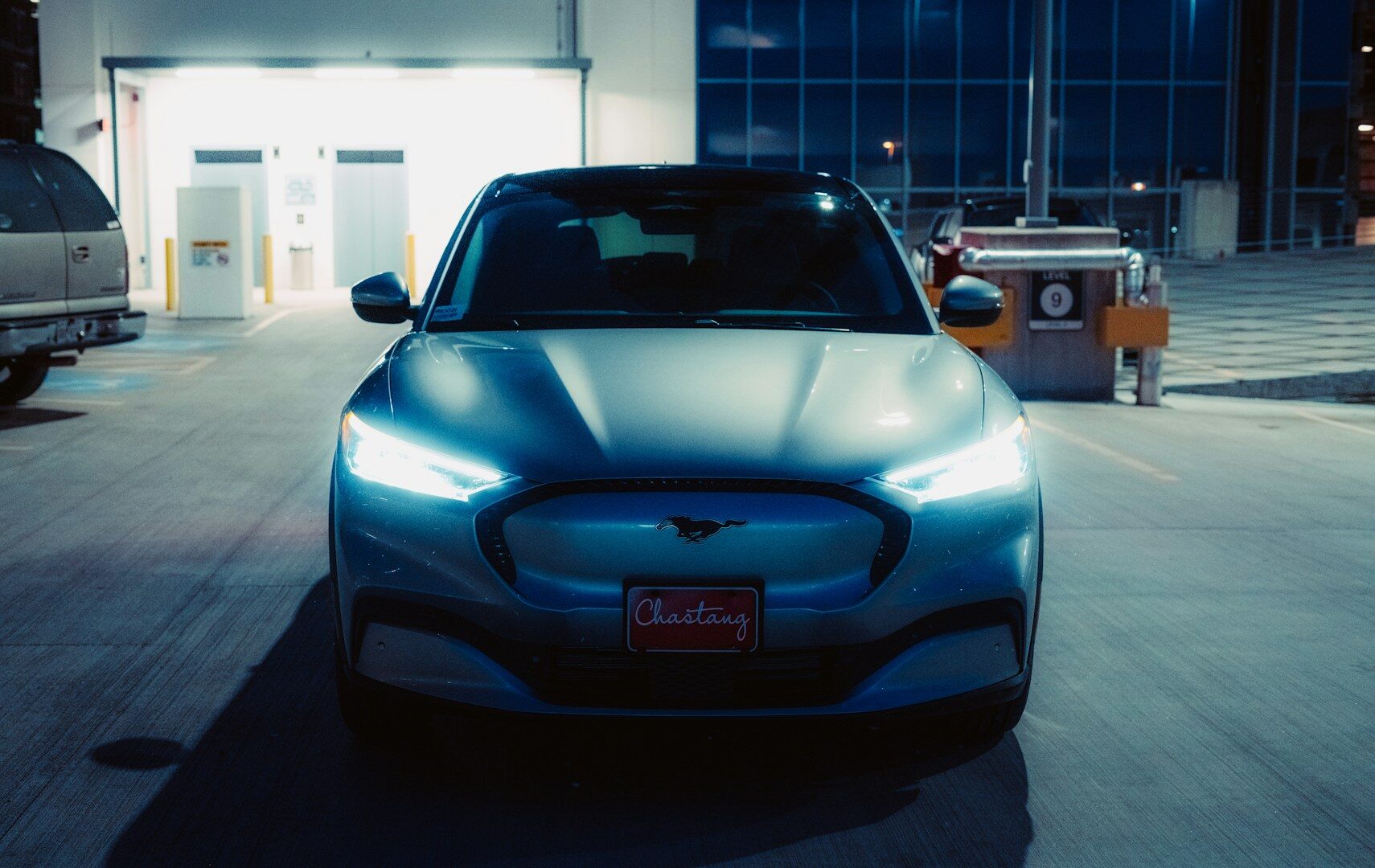
Ford filed two new recalls with federal safety regulators this week covering 110,626 Mustangs, and on paper they read like an odd couple: a wiper motor that gets stuck on high speed in cold weather, and a rear axle shaft on the electric Mustang Mach-E that can crack in half. Different cars, different parts, different suppliers, probably. Except this is the second time in about two weeks that Ford has told NHTSA one of its vehicles might not stay put once it’s parked. And this time, the failure doesn’t share a single part, a single platform, or even a single powertrain with the last one.
That pattern, not the wiper motor, is the story.
The two recalls, as filed
The larger campaign, logged June 30, covers 67,842 units of the 2026 Mustang and Mustang GTD. In cold conditions, the wiper system can default to its high-speed setting with no low-speed option, and the washer pump may not spray fluid at all, the kind of defect that looks trivial until it’s happening at highway speed in freezing rain with no way to clear the glass. The second, smaller campaign covers 42,784 examples of the Mustang Mach-E, Ford’s electric crossover. Its rear differential pinion shaft, the forged shaft that carries torque from the drive motor into the ring-and-pinion gearset, can fracture. Ford’s filing lists two consequences: loss of drive power, or, if the vehicle is left parked without the parking brake engaged, unintended movement. Dealers will inspect and replace the affected parts at no cost in both cases.
Read those two sentences again. A broken axle shaft, on its own, should not let a parked car roll. Something else has to be missing for that to happen. That something is the parking brake, and Ford spelling it out that plainly is worth pausing on.
Why “Park” isn’t one thing
Every automatic transmission, and every single-speed EV reduction gearbox, uses some version of a parking pawl: a spring-loaded steel tooth that drops into a notched gear on the output shaft when the driver selects Park. It’s a purely mechanical device, and it only has one job, to lock that one gear so the driveline can’t turn. What it cannot do is protect against a break anywhere downstream of it. If the shaft carrying that gear’s motion out to the wheels snaps between the pawl and the axle, the pawl is still locked, the dash still shows Park, and the car can still roll, because the mechanical link between locked and wheels no longer exists.
We’ve seen this exact caveat surface elsewhere this year. A Nissan recall on the 2025 Sentra flagged a front driveshaft that can work its way out of the transaxle, and Nissan’s own filing noted that the parking pawl alone may not hold the car if that shaft disengages, that the parking brake is the only backup once the driveline itself is compromised. Ford is now telling Mach-E owners something structurally identical. That’s two different automakers, two different vehicles, two different failure points, landing on the same uncomfortable engineering truth in the same twelve months. Park was never a single fail-safe. It’s a chain, and this year has been unusually good at finding the weak links in it.
Ford, specifically, has now found three. On June 26, a 741,195-vehicle recall covering the Expedition, Navigator, Explorer, Aviator and F-150 became searchable on NHTSA’s site. The defect lives in the parking pawl itself, the mechanical tooth that’s supposed to lock the output shaft, which a software condition can let slam home before the shaft has slowed down, chipping the pawl so it can’t reliably hold later. That’s a software-timing failure. The Mach-E’s pinion shaft is a manufacturing or metallurgical failure, nothing to do with code. Different root cause, same result: a vehicle that thinks it’s parked and isn’t.
The Mustang’s rougher year
The wiper recall also means the gas-powered 2026 Mustang has now been the subject of three separate safety campaigns in about seven months of being on sale, on top of an unrelated recall last fall that hit Mustangs equipped with dealer-installed superchargers over an acceleration software flaw. In December, Ford recalled early 2026 units over an engine oil leak that can reach hot exhaust components and start a fire. In March, more were recalled over piston circlips that weren’t installed correctly, a defect that has nothing to do with a bad batch of parts and everything to do with assembly line execution. A circlip is a small retaining ring that keeps a piston’s wrist pin from walking sideways inside the cylinder, and it either gets seated correctly by a technician or a torque-controlled tool, or it doesn’t. There’s no supplier to blame when the part itself is fine and the installation wasn’t. Now, in June, it’s the wipers. Three unrelated systems, three separate NHTSA campaigns, one nameplate, inside its first model year.
None of this happens in a vacuum. Ford entered July with more than 10.3 million vehicles recalled across 37 separate campaigns industry-wide in 2026 alone, and the total kept climbing just days later with a Bronco fender-flare recall and a software fix for a Lincoln Nautilus and Explorer Hybrid pedestrian warning sound that wasn’t sounding. If you want the fuller list of what else is open right now across the industry, we keep a running guide to it. Ford, like most of Detroit, has spent the last several years pushing more software and more electronics into vehicles that used to be mechanically simpler, and every one of those systems is a new place for something to go wrong in a way a torque wrench alone can’t catch.
What it means if you own one
If you drive an affected Mustang, the wiper fix is straightforward and dealers will handle it at no cost. If you drive a Mach-E within the affected range, treat the parking brake as mandatory, not optional, until your car has been inspected, regardless of what the shifter says. That’s true of any car with an open rollaway-adjacent recall this year, not just Ford’s. And if the worst happens and a parked vehicle actually rolls and causes damage before a fix is completed, that’s a fact pattern insurers and subrogation attorneys will be very interested in once the recall record shows the defect predated the loss.
The wiper motor and the axle shaft are not, on their own, an important story. A parking system that keeps failing in new ways, on new platforms, using none of the same parts twice, is. Ford didn’t build one bad component this year. It’s been finding, one recall at a time, every different way a modern vehicle can fail to do the one thing Park is supposed to guarantee.