
Ford Bronco
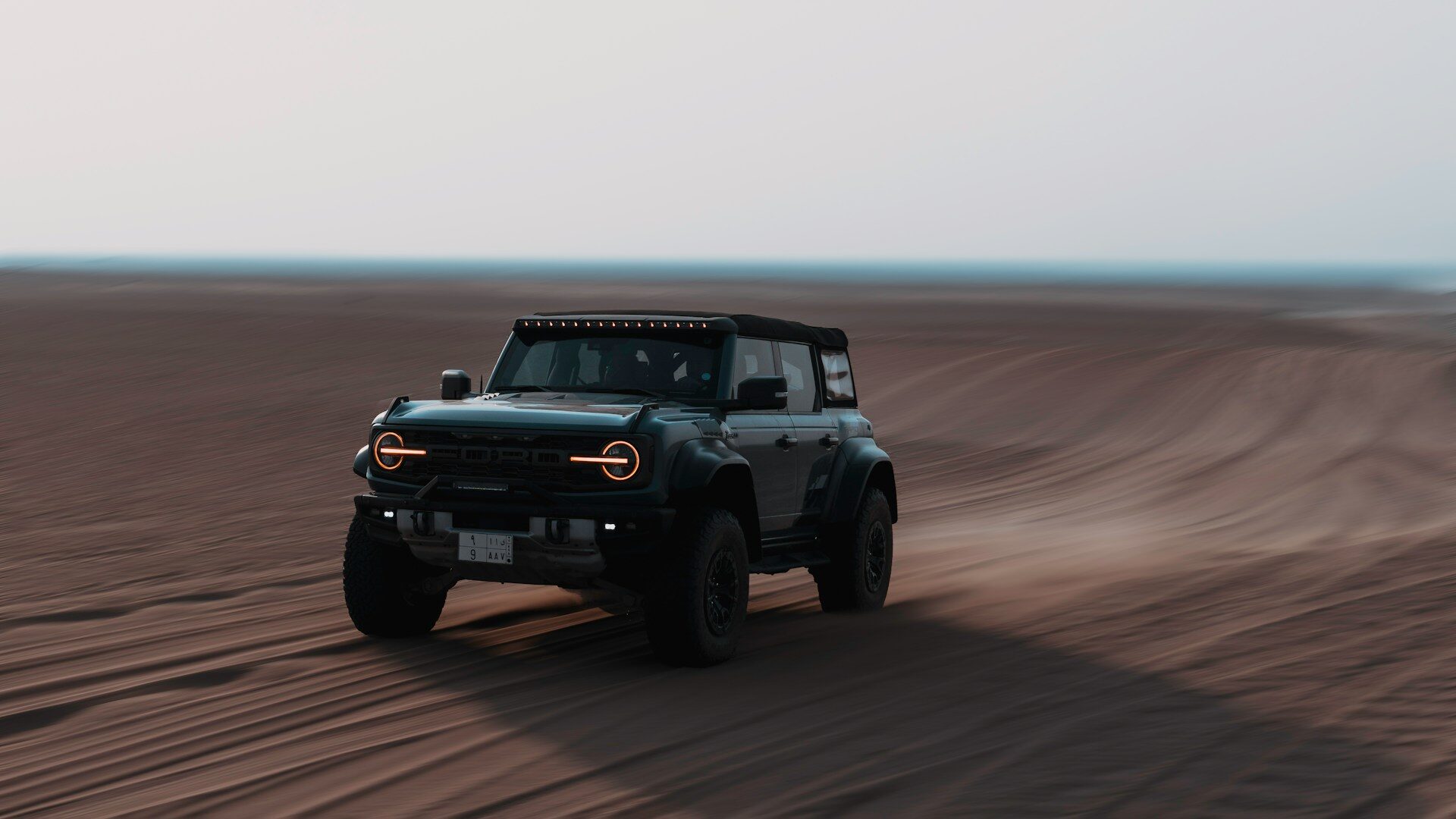
The Ford Bronco is the rugged, body-on-frame off-road SUV that revived a legendary nameplate when it returned for the 2021 model year. Designed to take on the Jeep Wrangler head-on, the modern Bronco combines serious trail capability with removable doors and roof panels, a wide range of trims, and turbocharged power. This guide covers the current Bronco lineup in depth, including its history, engines, performance, off-road hardware, interior, technology, safety, towing, trims, pricing, competitors, and reliability, along with a detailed FAQ.
Note that this guide covers the full-size, body-on-frame Bronco, not the smaller unibody Bronco Sport, which is a separate vehicle. Specifications are drawn from manufacturer information and independent testing. Figures vary by model year, configuration, and package, so where a number cannot be confirmed with confidence we say so directly. Always verify current details with Ford or an authorized dealer before purchasing.
Overview
The Bronco is offered in two-door and four-door body styles, both built on a dedicated body-on-frame platform engineered for off-road use. Its defining feature is modularity: the doors and roof panels can be removed for open-air driving, and the SUV offers a broad menu of off-road packages and trims. Power comes from turbocharged EcoBoost engines, with the high-performance Bronco Raptor sitting at the top of the range.
Ford positioned the Bronco squarely against the Jeep Wrangler, matching its rival’s removable panels and trail focus while offering turbocharged engines and a distinct design language. The result has been one of the most talked-about SUV launches in recent memory, with extensive personalization options and a strong enthusiast following.
Vehicle History
The original Ford Bronco debuted in 1966 as a compact, rugged off-roader and grew into a larger full-size SUV through several generations before production ended in 1996. Over those decades the Bronco built a reputation for capability and became a cultural icon, with early first-generation models especially prized by collectors today.
After a long hiatus, Ford revived the Bronco for the 2021 model year as an all-new, purpose-built off-road SUV. Rather than reviving the nameplate as a soft crossover, Ford engineered a genuine body-on-frame trail machine with removable doors and roof, solid off-road hardware, and styling that nods to the original. The modern Bronco arrived alongside the smaller Bronco Sport, a unibody crossover that shares the name but targets a different buyer.
Latest Generation
The current Bronco continues to be offered in two-door and four-door configurations with a long list of trims and the range-topping Bronco Raptor. Ford has continued to expand the lineup with special and heritage-themed editions, keeping the model fresh. The core formula remains unchanged: a capable 4×4 with removable panels, available front and rear locking differentials on higher trims, and a focus on off-road performance.
Across the lineup, the Bronco emphasizes trail readiness, with available features such as a disconnecting front stabilizer bar, multiple selectable drive modes for different terrain (Ford’s G.O.A.T. Modes, short for Goes Over Any Type of Terrain), and the Sasquatch package that adds 35-inch tires, electronic locking differentials, and increased ground clearance.
Engine Options
The Bronco offers a choice of turbocharged EcoBoost engines, with the most powerful reserved for the Raptor. Most trims come standard with a 2.3-liter EcoBoost four-cylinder, while a 2.7-liter EcoBoost V6 is available for buyers who want more power and torque.
The standard 2.3-liter EcoBoost four-cylinder produces 300 horsepower. The optional 2.7-liter EcoBoost twin-turbo V6 raises output to 330 horsepower with a substantial increase in torque, making it the choice for towing and effortless highway power. The Bronco Raptor uses a 3.0-liter EcoBoost V6 rated at 418 horsepower and 440 lb-ft of torque on premium fuel, paired with the high-performance HOSS suspension system designed for high-speed desert running.
Horsepower & Torque
| Engine | Availability | Horsepower | Notes |
|---|---|---|---|
| 2.3L EcoBoost I-4 | Standard (most trims) | 300 hp | Available with 7-speed manual |
| 2.7L EcoBoost V6 | Optional | 330 hp | Higher torque; automatic only |
| 3.0L EcoBoost V6 | Bronco Raptor | 418 hp / 440 lb-ft (premium fuel) | HOSS suspension |
Transmissions
One of the Bronco’s distinctive features is the availability of a seven-speed manual transmission with the 2.3-liter engine, which includes a dedicated crawler gear for low-speed off-road control. A 10-speed automatic is available across the range and is standard on the V6 engines. All Broncos are four-wheel drive, with available two-speed transfer cases offering low-range gearing for serious off-road use.
Performance
The Bronco’s performance priorities are tilted toward off-road capability rather than on-road speed, with the notable exception of the Raptor. The standard 2.3-liter and optional 2.7-liter engines provide adequate-to-strong acceleration for a heavy, tall SUV, with the V6 delivering noticeably more effortless passing power. The Bronco Raptor, by contrast, is built for high-speed off-road performance and uses its 418-horsepower V6, wider track, and long-travel suspension to tackle desert terrain at speed.
Off the pavement, the Bronco’s capability is defined by its hardware: available locking differentials, the disconnecting front stabilizer bar for greater wheel articulation, generous ground clearance, and selectable terrain modes. With the Sasquatch package, ground clearance increases to around 11.6 inches and the Bronco rolls on 35-inch tires from the factory, improving approach, departure, and breakover angles.
Fuel Economy
As a tall, boxy, body-on-frame SUV, the Bronco is not designed for efficiency, though its turbocharged engines help. EPA estimates for the base 2.3-liter engine land around 18 to 20 mpg city and roughly 21 mpg highway, with a combined figure near 20 mpg in many configurations. The larger engines and aggressive tire and lift packages such as Sasquatch reduce fuel economy further.
| Engine | Approx. City MPG | Approx. Highway MPG |
|---|---|---|
| 2.3L EcoBoost I-4 | ~18–20 | ~21 |
| 2.7L EcoBoost V6 | Lower; verify EPA rating | Verify EPA rating |
| 3.0L EcoBoost V6 (Raptor) | Lowest; verify EPA rating | Verify EPA rating |
Real-world fuel economy depends heavily on tires, gearing, and driving conditions. Off-road tires and lift kits, along with higher-output engines, will lower these figures. Confirm EPA ratings for the exact engine and package combination you are considering.
Interior
The Bronco’s interior reflects its rugged mission. The cabin is designed to be durable and washable, with available rubberized flooring and drain plugs that let owners hose out the interior after a muddy adventure. Marine-grade vinyl seating is available on some trims for the same reason. The dashboard features grab handles and a purposeful, utilitarian design with exposed fasteners and clearly labeled controls.
Despite the rugged focus, higher trims add comfort and convenience features, including upgraded upholstery and additional sound insulation. Some reviewers note that lower trims feature a lot of hard plastic, which is consistent with the vehicle’s wash-it-out philosophy. Removable doors and roof panels are central to the experience, and the four-door model offers more passenger and cargo space than the two-door.
Technology
The Bronco runs Ford’s SYNC infotainment system on a central touchscreen, with available wireless Apple CarPlay and Android Auto. A digital instrument cluster is available, and the system includes off-road-specific features such as trail mapping, available forward-facing and other cameras to aid spotting obstacles, and displays for vehicle pitch and roll.
The Bronco’s terrain management system, marketed as G.O.A.T. Modes, lets the driver select settings tuned for different surfaces such as mud, sand, and rock. Trail Control functions as a low-speed cruise control for off-roading, and a one-pedal drive feature on some configurations aids precise rock crawling. These tools make the Bronco’s considerable capability more accessible to less-experienced off-roaders.
Safety
The Bronco offers Ford’s Co-Pilot360 suite of driver-assistance features, which typically includes automatic emergency braking, blind-spot monitoring, and lane-keeping aids, with adaptive cruise control available on higher trims or in packages. The removable-roof design and tall ride height are characteristic of the rugged-SUV class.
As with other specialized off-road vehicles, crash-test coverage can vary by body style and model year, so buyers should check current NHTSA and IIHS ratings for the specific two-door or four-door configuration they are considering. Standard airbags, stability control, and a rearview camera are included.
Towing & Payload
Towing capacity varies with engine and configuration. Depending on the setup, the Bronco is rated to tow in the range of roughly 3,080 to 4,500 pounds, with the higher figures generally tied to properly equipped configurations and the Raptor’s tow package. This makes the Bronco capable of pulling small trailers, watercraft, or off-road toys, though it is not a heavy-duty tow vehicle.
Buyers planning to tow should confirm the exact rating for their chosen engine, body style, and package, and should factor in payload, hitch type, and trailer weight. The available tow packages add equipment to support towing within the rated limits. Exceeding published limits can compromise safety and capability.
Trim Levels
The Bronco lineup is unusually broad. Trims have included Base, Big Bend, Black Diamond, Outer Banks, Badlands, Wildtrak, and Heritage variants, with the high-performance Bronco Raptor and various special editions such as the Stroppe Edition at the top. Each trim targets a different blend of comfort and capability: Outer Banks leans toward on-road refinement, while Badlands and Wildtrak emphasize off-road hardware.
The Sasquatch package is a popular option that can be added to many trims, bringing 35-inch tires, electronic locking front and rear differentials, upgraded suspension, and increased ground clearance. Because trim availability and naming can shift by model year, confirm the current lineup with Ford when shopping.
Pricing
Bronco pricing starts around the low-$40,000s for entry trims and climbs significantly with larger engines, the Sasquatch package, and higher trims. The Bronco Raptor sits well above the rest of the lineup, reaching into the $80,000-plus range when equipped. Independent listings have placed a well-equipped base four-door around $41,990, but exact figures depend heavily on configuration.
Because options such as engine choice, the Sasquatch package, and special editions add up quickly, the Bronco’s price range is wide. Confirm current MSRPs and package pricing with Ford or a dealer, and note that in-demand configurations have at times carried market adjustments.
Competitors
The Bronco’s primary rival is the Jeep Wrangler, the vehicle it was explicitly designed to challenge. Both offer removable doors and roofs, serious off-road hardware, and extensive customization. Beyond the Wrangler, shoppers may also consider the Toyota 4Runner and, at a higher price point, the Land Rover Defender.
| Vehicle | Type | Notable Trait |
|---|---|---|
| Ford Bronco | Body-on-frame 4×4 | Removable panels; turbo engines; broad trims |
| Jeep Wrangler | Body-on-frame 4×4 | Benchmark off-roader; removable panels |
| Toyota 4Runner | Body-on-frame SUV | Reputation for durability |
| Land Rover Defender | Unibody 4×4 | More premium and on-road refined |
Against the Wrangler in particular, the Bronco tends to offer competitive or better fuel economy from its turbocharged engines and a distinct take on the rugged-SUV formula, while the Wrangler counters with its own deep aftermarket and heritage.
Reliability
The Bronco uses Ford’s established EcoBoost engine family and a broad dealer network, which supports parts and service availability. As a relatively recent reintroduction with significant new technology and modular hardware, early production drew some attention for quality issues, as is common with all-new vehicles.
Off-road vehicles also see harder use than typical SUVs, which can accelerate wear. Prospective buyers should review the specific model year’s recall and technical-service-bulletin history and consult current third-party reliability data, since these details evolve as the platform matures.
Frequently Asked Questions
What is the difference between the Bronco and the Bronco Sport?
The Bronco is a larger, body-on-frame off-road SUV with removable doors and roof, while the Bronco Sport is a smaller unibody crossover. They share a name and styling cues but are different vehicles aimed at different buyers.
Does the Bronco come with a manual transmission?
Yes. A seven-speed manual with a dedicated crawler gear is available with the 2.3-liter engine. A 10-speed automatic is available across the range and standard on the V6 engines.
Can you remove the doors and roof?
Yes. The Bronco’s doors and roof panels are removable for open-air driving, one of its defining features and a direct counter to the Jeep Wrangler.
How much horsepower does the Bronco have?
The standard 2.3-liter EcoBoost makes 300 horsepower, the optional 2.7-liter V6 makes 330 horsepower, and the Bronco Raptor’s 3.0-liter V6 makes 418 horsepower on premium fuel.
What is the Sasquatch package?
Sasquatch is an off-road package that adds 35-inch tires, electronic locking front and rear differentials, upgraded suspension, and increased ground clearance of around 11.6 inches. It can be added to many trims.
How much can the Bronco tow?
Depending on configuration, the Bronco is rated to tow roughly 3,080 to 4,500 pounds. Confirm the exact rating for your chosen engine, body style, and tow package.
What is the Bronco Raptor?
The Bronco Raptor is the high-performance version built for high-speed off-road running, with a 418-horsepower 3.0-liter V6, a wider track, long-travel HOSS suspension, and 37-inch tires available.
Is the Bronco a two-door or four-door?
Both. Ford offers the Bronco in two-door and four-door body styles, with the four-door providing more passenger and cargo space.
What fuel economy does the Bronco get?
The base 2.3-liter engine is rated around 18 to 20 mpg city and roughly 21 mpg highway. Larger engines and off-road packages reduce these figures.
How does the Bronco compare to the Jeep Wrangler?
Both are capable, removable-panel off-roaders. The Bronco often offers competitive or better fuel economy from its turbo engines, while the Wrangler counters with its heritage and vast aftermarket. The best choice depends on priorities.
Is the Bronco good on road?
Higher trims and the V6 improve on-road comfort and power, but as a tall, body-on-frame off-roader, the Bronco prioritizes trail capability over car-like road manners. Aggressive tire packages affect ride and noise.
How much does a Bronco cost?
Pricing starts around the low-$40,000s and climbs with engines, packages, and trims, with the Bronco Raptor reaching into the $80,000-plus range. Confirm current pricing with Ford.
Is the Bronco reliable?
It uses Ford’s established EcoBoost engines and dealer network. As a relatively new reintroduction, checking model-year-specific recall history and current third-party reliability data is recommended.
Is the Bronco a true off-roader?
Yes. With body-on-frame construction, available locking differentials, a disconnecting front sway bar, generous ground clearance, and terrain modes, the Bronco is a genuine off-road vehicle, especially in Badlands, Wildtrak, and Raptor form.
Final Summary
The Ford Bronco successfully revived a legendary nameplate as a genuine, body-on-frame off-road SUV built to challenge the Jeep Wrangler. With removable doors and roof, turbocharged EcoBoost engines ranging from the 300-horsepower 2.3-liter four to the 418-horsepower Raptor V6, a rare available manual transmission, serious off-road hardware, and an exceptionally broad lineup of trims and packages, the Bronco offers something for a wide range of adventurers. It is not the most efficient or refined on-road SUV, but that is not its mission. For buyers who want open-air freedom and real trail capability with strong personalization options, the Bronco is a compelling choice. As always, verify current specifications, towing ratings, fuel economy, and pricing with Ford or an authorized dealer before purchasing.