
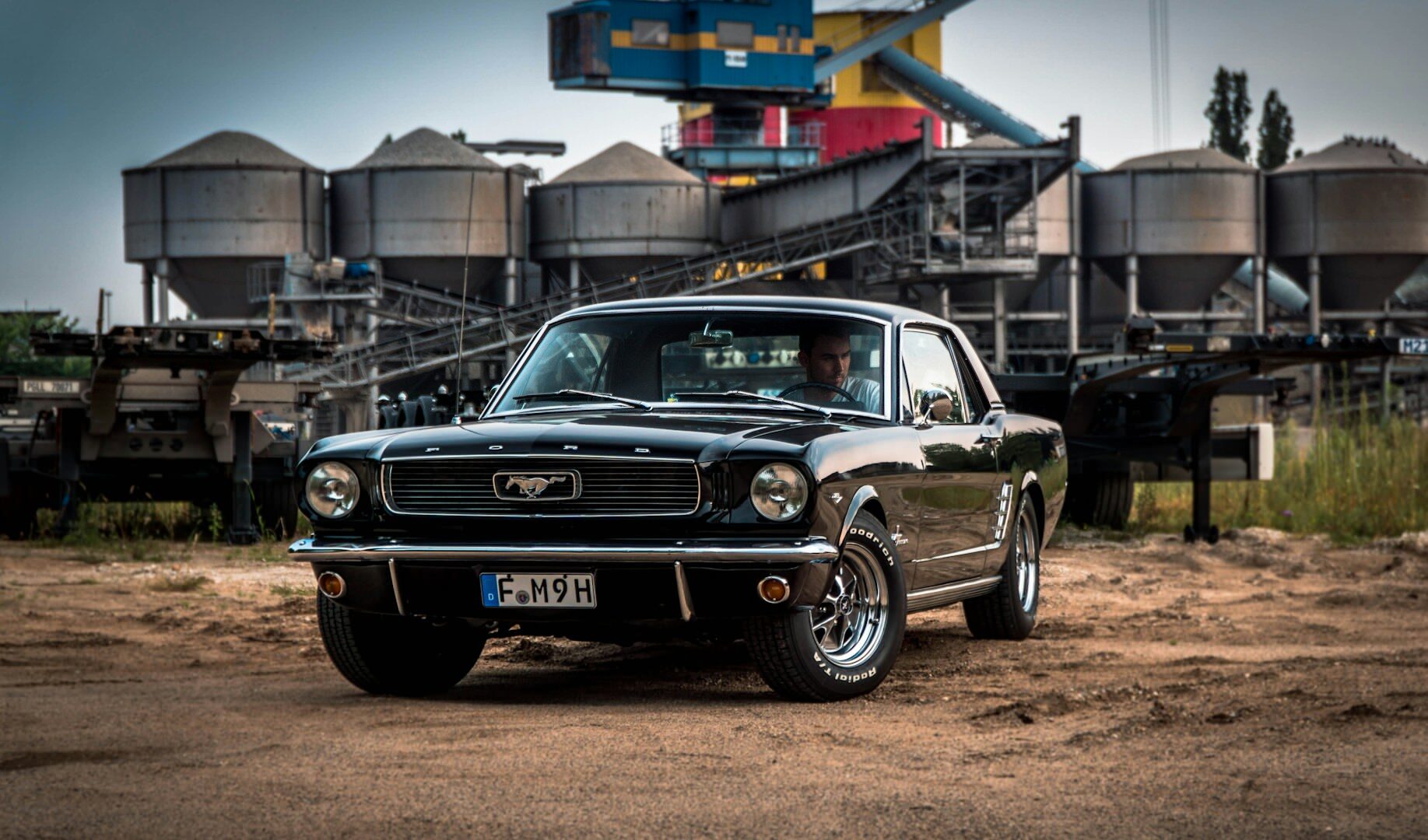
The usual restomod recipe starts with a tired 1967 fastback and spends six figures fixing everything 1967 got wrong. Vintage Modern, the Atlanta company best known for Bronco-style trucks built on new chassis, does it the other way around. Its new Vintage Fastback starts with a car Ford still builds, then spends about a quarter-million dollars making it look old.
The car went on public display at Rétromobile New York this week. The company’s press release spells out the method: take a 2026–27 S650 Mustang, replace the body panels with carbon fiber hand-laid in Detroit, then assemble and finish the car in Atlanta. Vintage Modern says each car takes more than 900 hours of labor. The Fastback order page lists a starting price of $295,500.
What’s under the carbon
Look past the bodywork and the base car is pure Ford. Its 486 hp and 418 lb-ft match exactly what Ford quotes for the 5.0-liter Coyote with active exhaust. The six-speed manual with rev-matching and the 10-speed automatic are both Ford gearboxes. The MagneRide dampers are hardware Ford sells in its GT Performance Package, according to its technical specifications.
Related Articles
- California Kicked Waymo Off Its Freeways for Driving Into Construction Zones. Hours Later, Waymo Quit Freeways Everywhere
- A Drought in Mississippi Uncovered a 2005 Jaguar in the Big Black River. It Was Stolen in 2010, and the VIN Still Told on It
That makes the base Fastback a well-optioned GT in a very expensive suit. Ford’s build-and-price tool starts a GT fastback at $48,795, so roughly $246,700 of the sticker pays for carbon, cabin, paint and labor.
The big number comes from an optional 3.0-liter Whipple supercharger. Vintage Modern rates it at 840 hp and 615 lb-ft on 93 octane, which is 354 hp and 197 lb-ft more than the base engine. The company estimates 0–60 mph in 2.9 seconds. For comparison, Ford’s own Dark Horse SC uses the GTD’s supercharged 5.2-liter and makes 795 horsepower for $106,585.
What the carbon doesn’t touch
Here’s what Vintage Modern leaves alone. The donor car keeps its eight airbags, crumple zones, side-impact beams, stability control and ABS. Ford builds the S650 as a unitized steel body with an aluminum hood and steel front fenders. Bolt-on skins carry very little of the car’s structure, so swapping them for carbon doesn’t rewrite the crash structure. A new nose can still change how the front end crushes, though, and that matters for airbag timing and sensor placement.
Under 49 CFR 567.7, anyone who alters a certified vehicle has to confirm it still meets federal standards. They also take on legal liability for that certification and add their own label next to the factory one. Vintage Modern’s release says the Fastback “will meet applicable Federal Motor Vehicle Safety Standards (FMVSS) and undergo physical crash testing.” That’s future tense. The same release’s company boilerplate says every Vintage Modern vehicle is already FMVSS-compliant and crash-tested. Anyone reserving a first-production build should ask which statement covers their car, and ask to see the alteration label.
What it costs after the deposit clears
Repairs: Engine, transmission and electronics are Ford parts any Ford dealer can service. Body damage is a different problem. The hand-laid panels come from one supplier, so a parking-lot scrape becomes a wait for parts plus a job for a carbon-repair specialist.
Insurance: A standard policy may value this car as a Mustang GT. Owners will want an agreed-value policy backed by build documents, and they should disclose the supercharger up front.
Warranty: The launch materials don’t give warranty terms, and they don’t say how an aftermarket supercharger affects Ford’s powertrain coverage. Get both in writing before you sign.
Related Articles
- A California Antitrust Suit Says Tesla Sold Hertz Model 3s Below Cost in a $4.2 Billion Deal. Hertz Later Ate $245 Million
- A Houston Cop Rear-Ended Her Car on a Burglary Call. The City Denied Her Claim, Then HPD Auctioned the Car for $10
Resale: No resale market exists for these yet. The company says it builds more than 250 vehicles a year across its lineup and plans to triple capacity within two years. Rare helps the bragging rights. It doesn’t tell you what the car is worth in 2030.
The Eleanor question
Vintage Modern’s materials never use the word “Eleanor.” They describe a long hood, a billet grille with twin auxiliary lights, side scoops and “signature stripes.” Anyone who saw the 2000 Gone in 60 Seconds remake will recognize that list.
Legally, the look is less restricted than it once was. In May 2025, the Ninth Circuit held that Eleanor is not a character protected by copyright. The Supreme Court denied review that November. Builders now have more room to imitate the shape. Using the name is a different matter, and Vintage Modern seems to know it.
Real 1967 fastback shells are a shrinking supply, and S650s roll off Ford’s line every day. Vintage Modern is betting that wealthy buyers want the shape, not the old car’s rust and drum brakes. Before anyone wires a deposit, that crash-testing line needs to change from “will” to “has.” Would you pay $295,500 for the shape, or spend it hunting down a real ’67?