
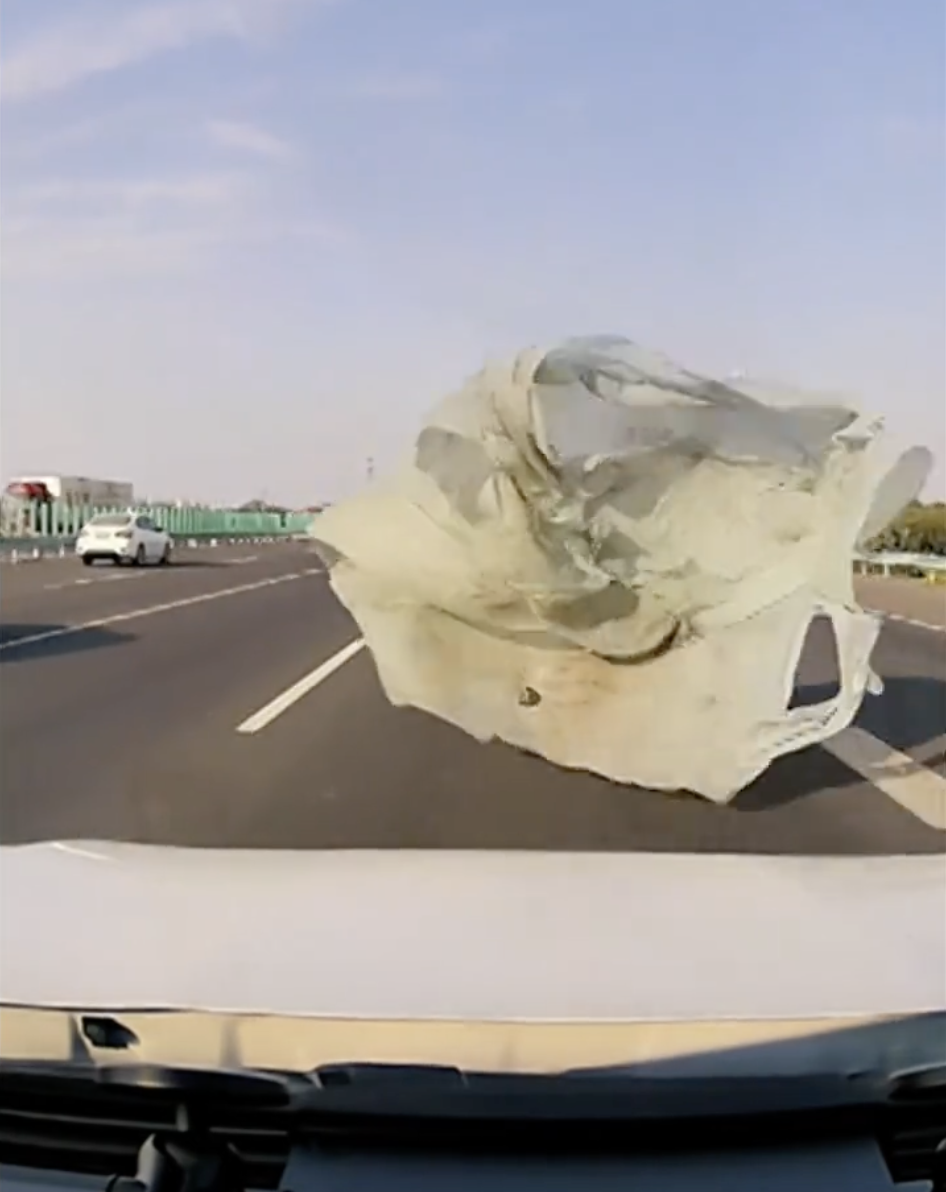
A tarp tearing loose from a truck and slapping across your windshield sounds like a bad dream. For one driver on a highway in Xinjiang, China, it happened for real, and the moment was caught on dash-cam video that’s since made the rounds online. One second the lane ahead was clear. The next, the entire windshield was a wall of fabric, and the car was still moving at highway speed with a driver who suddenly couldn’t see any of it.
What the Driver Did Right in the First Few Seconds
What makes the clip worth studying isn’t the tarp — it’s what the driver did in the seconds after losing sight of the road entirely. No panic braking. No yanking the wheel to feel around for the shoulder. The hazard lights came on immediately, the throttle came off, and the car was allowed to scrub off speed gradually while holding its line. Only once the car had slowed substantially did the driver ease toward the shoulder, roll to a stop, and finally reach up to pull the tarp away. No one was hurt, and no crash occurred.
@foxnews A driver narrowly avoided disaster after a tarp flew off a truck and completely covered the windshield of a moving car on a highway in Xinjiang, China. With visibility instantly reduced to zero, the driver kept calm, switched on the hazard lights, gradually slowed the vehicle, and safely pulled onto the shoulder instead of making a sudden maneuver. After stopping, the tarp was removed from the windshield. No one was injured, and the incident ended without a crash.
Why “Do Less” Was the Correct Emergency Response
Every bit of driver training that actually matters comes down to this exact scenario: when you lose critical information, the answer is almost never to react harder. Stab the brakes while blind on a highway and you risk a following vehicle — which still has full visibility and no warning you’ve gone dark — plowing into your rear bumper at speed. Wrench the wheel hoping to find the shoulder and you risk leaving your lane into traffic you can no longer see. Hazard lights solve the communication problem instantly, telling everyone behind you that something is wrong before you’ve even decided what to do next. Gradual deceleration solves the physics problem, keeping the car balanced and predictable instead of snapping weight onto the front tires. It’s the same logic taught for sudden fog banks, dust storms, or a windshield full of snowmelt off a semi’s trailer: slow is smooth, and blind is not the time to get creative.
The Real Culprit Is a Cargo Strap, Not the Weather
Strip away the dramatic footage and this is a load-securement failure, full stop. A tarp doesn’t detach from a truck bed on its own — it comes loose because it wasn’t tied down to a standard that accounts for highway wind speeds, and it’s one of the most common, most preventable hazards on any highway in the world. In the United States, unsecured loads are a citable offense under state vehicle codes, and if flying debris causes a crash or injury, the vehicle’s owner or operator can face civil liability and, depending on the state and severity, criminal charges as well. China’s road transport regulations carry similar cargo-securement requirements on paper. What this video actually demonstrates isn’t a gap in the law; it’s a gap in enforcement and roadside inspection, which is exactly why these near-misses keep showing up on dash cams instead of staying rare.
What to Actually Do If It Happens to You
File this away, because the exact circumstances here are unusual but the underlying scenario — sudden, total loss of forward visibility at speed — is not as rare as it sounds. Debris strikes, dust storms, sudden downpours, and even a poorly timed windshield-washer failure in winter grime can all blind a driver for a few critical seconds. The fundamentals shown in this video hold regardless of the cause: hazards on first, ease off the accelerator rather than braking hard, keep the steering inputs small and smooth, and use mirrors or a cracked side window to find a reference point before committing to a lane change toward the shoulder. It’s not a maneuver anyone practices, which is exactly why it’s worth thinking through before the day you need it.
Related Reading
- The Right-to-Repair Map: Which States Actually Let You Fix Your Own Car in 2026
- Tesla Cybertruck vs Ford F-150 Lightning: Which Electric Truck Wins in 2026?
- California Man Pleads Guilty in $476K Fake-License Car Loan Fraud
- Mercedes C300 Flees Trooper, Hits Semi Head-On the Wrong Way on I-55