
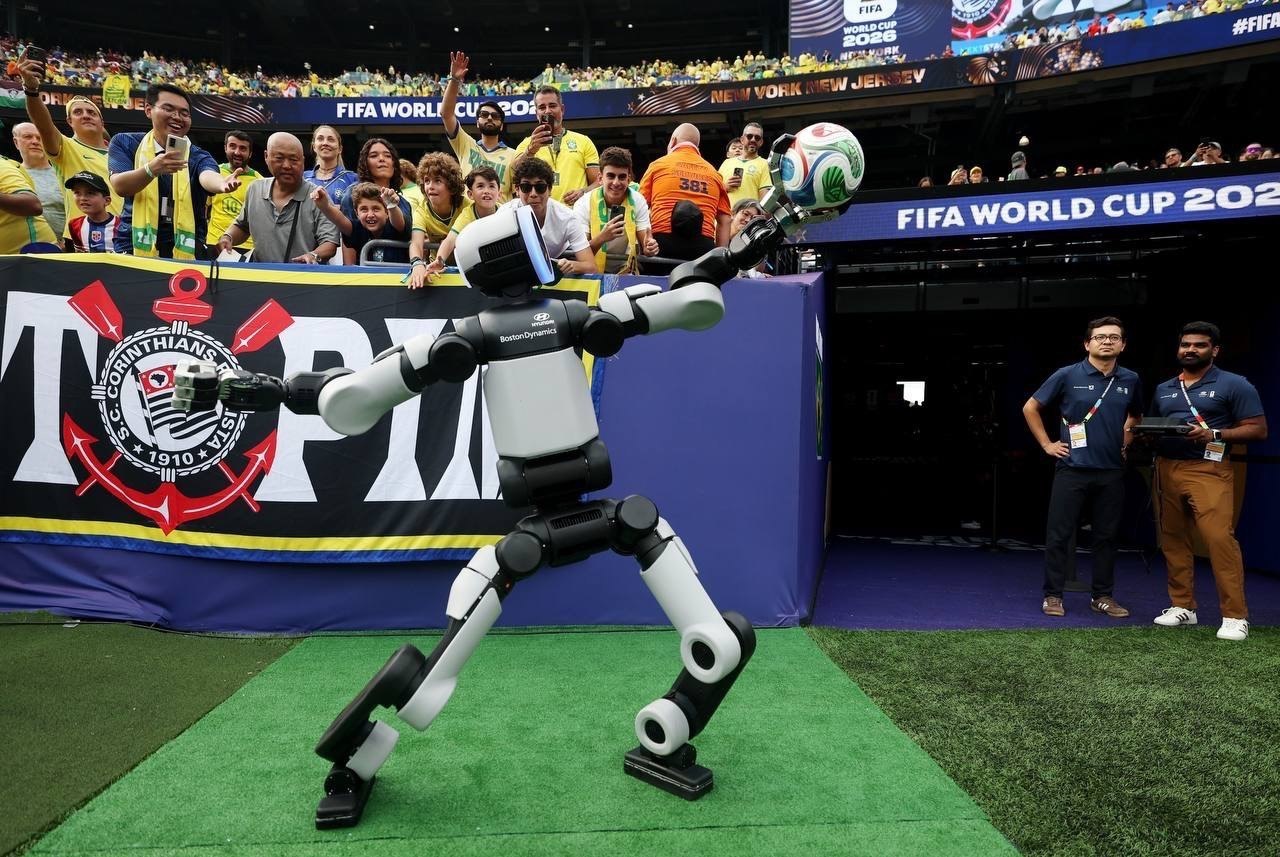
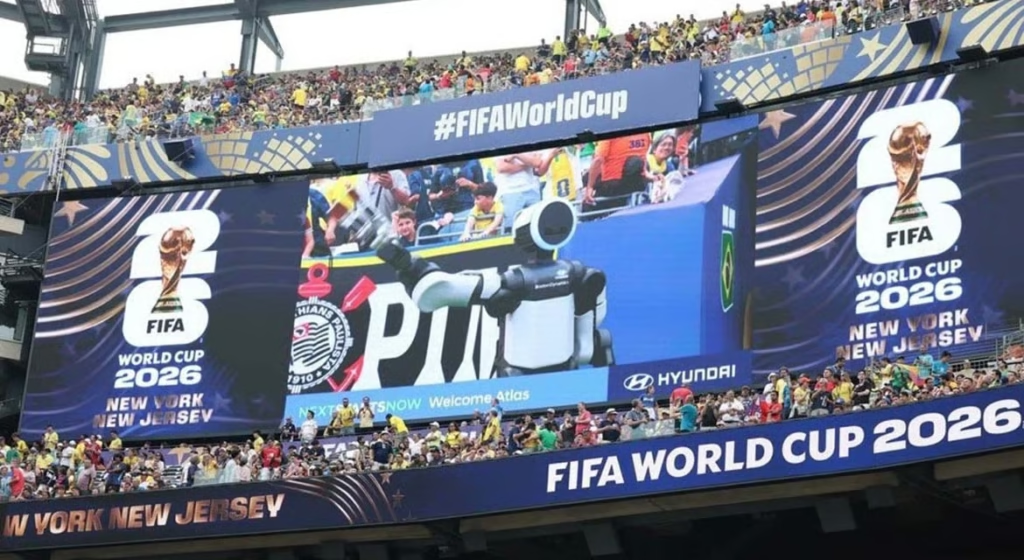
A dancing robot delivering a soccer ball to a referee is the kind of story that writes itself as a novelty. Boston Dynamics’ Atlas took the field at halftime of a FIFA World Cup Round of 16 match, threw a few goal celebrations, and handed off the match ball. Cute. Shareable. Forgettable by Monday.
Except it isn’t, and here’s why.
This wasn’t a marketing stunt wearing an engineering costume. It was an engineering validation exercise wearing a marketing costume. Hyundai spent roughly $1.1 billion acquiring Boston Dynamics back in 2021, and five years later it still needs to prove that purchase was about more than owning a cool robotics brand. A packed, unpredictable stadium in front of a global television audience is precisely the kind of chaotic, unscripted environment no engineering team can fully simulate in a lab. That’s the real headline: Hyundai just let the world’s biggest sporting stage do R&D work that would otherwise take months of controlled field trials.
Here’s the detail buried in the release that most readers will skip past: this was the first public demonstration of the production version of Atlas, the one introduced at CES earlier this year. Not the research prototype. Not a controlled demo reel. The commercial hardware, tested live, with real turf, real crowd noise, real lighting, and zero do-overs. Automakers run exactly this kind of exercise before shipping a new vehicle platform, with durability loops and climate testing, because a lab can’t replicate everything reality throws at a machine. Hyundai just ran that same philosophy on a bipedal robot, in front of hundreds of millions of people, and called it entertainment.
Now the part that should genuinely surprise people who don’t follow robotics closely. According to Boston Dynamics, the techniques used to teach Atlas its goal celebrations, retargeting human movement onto a robotic frame, reinforcement learning through thousands of simulated repetitions, and whole-body control to keep the machine balanced during dynamic motion, are the same pipeline used to train Atlas for industrial work. The dance moves and the warehouse tasks come from the identical training stack. That’s worth sitting with for a second: the frivolous halftime show and the serious factory-floor application aren’t different products. They’re the same technology, pointed at different goals. Hyundai didn’t build a party trick and a work robot. It built one system, and the party trick is how the public got introduced to it.
There’s a quieter angle here too, one that automotive people in particular should notice. Car companies understand liability and safety cases better than almost anyone, because they’ve spent decades building them for autonomous vehicle testing on public roads. Operating an autonomous, dynamically balancing robot near a live crowd, a referee, and broadcast cameras is not a trivial safety problem. It required the same kind of risk engineering, worst-case failure modes, fallback behaviors, human proximity protocols, that automakers already apply to self-driving test fleets. Hyundai essentially imported its automotive safety-validation mindset into robotics, in public, and nothing went wrong. That’s not a small accomplishment; it’s a demonstrated safety case.
Step back further and the pattern becomes obvious. Hyundai isn’t the only automaker recasting itself as a robotics company. The entire industry has spent the last few years quietly repositioning around what’s now being called physical AI, machines that perceive, decide, and act in the real world, whether that machine has four wheels or two legs. General Motors has already shown what that looks like on the factory floor, trading human headcount for robotic arms and posting a multibillion-dollar quarter in the process. The overlap in sensors, actuators, control software, and simulation training is enormous. A car is already a robot that happens to roll instead of walk. Hyundai’s halftime show wasn’t a detour from its automotive identity. It was a preview of what that identity is becoming.
None of this means Atlas is headed for showrooms, and Hyundai isn’t claiming that. What it is claiming, more usefully, is that a $1.1 billion robotics bet is starting to produce field-tested, camera-ready proof of capability rather than lab demos and investor slides. It also fits a company that has bet heavily on building things domestically and owning its production process end to end, rather than treating manufacturing as an afterthought. That’s a meaningfully different phase for the acquisition, and it’s the part of this story actually worth remembering.
The goal celebrations will be forgotten by next week. The fact that Hyundai just let a live, uncontrolled, globally televised environment do the validation work its engineers used to need a proving ground for, that’s the part that matters five years from now.