
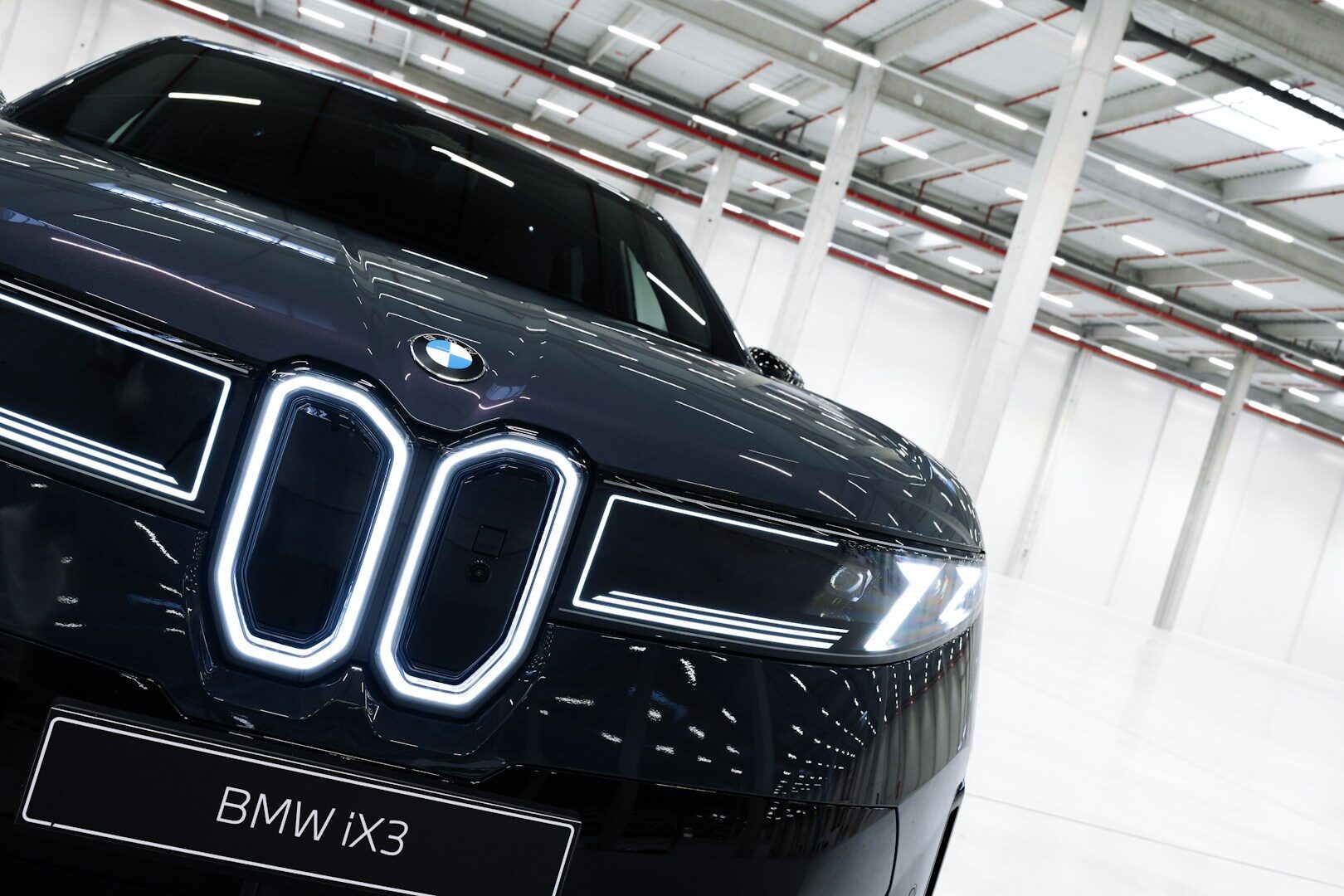
BMW just confirmed that its next electric sedan and crossover will come off the line in San Luis Potosí, Mexico, starting in 2027, backed by a new battery hall built specifically for them. Read as a press release, that’s a groundbreaking story. Read as an industry story, it’s closer to an admission: a factory built to serve the United States is being re-engineered to avoid it.
That part, BMW isn’t saying directly. The numbers say it instead.
What’s Actually Happening in San Luis Potosí
BMW’s San Luis Potosí plant will begin building the Neue Klasse i3 sedan and iX3 crossover in 2027, along with high-voltage battery assembly for both. It’s one of only four plants worldwide chosen to build the Neue Klasse platform, joining Munich, Debrecen in Hungary, and a site in China. Worth pausing on that list: BMW’s home country, its newest EV-only European plant, its biggest single market, and Mexico. No other North American plant made the cut.
The rollout is funded by an €800 million ($870 million) expansion first announced in 2023, and the math inside that figure says more than the total does. A 110,000-square-meter building dedicated purely to high-voltage battery assembly absorbed 62.5% of the budget, more than the vehicle assembly upgrades themselves received. Over the past decade, BMW has invested nearly $2 billion in the site, which has already produced more than 500,000 vehicles and supports over 32,000 direct and indirect jobs across the state, on top of the 3 Series, 2 Series Coupé, and M2 it builds today.
The Tariff Problem BMW Won’t Stop Talking About
Here’s the detail that should stop any car enthusiast mid-scroll. A BMW assembled in Mexico currently faces a 25% US tariff under Section 232. A BMW assembled in Germany faces 15%.
Sit with that for a second.
Mexico and the United States operate under a standing free trade agreement, USMCA, built specifically to remove costs like this. Germany has no comparable deal with Washington. Yet the car built inside the free trade zone pays the higher toll.
“It puts us in a position that is not beneficial in comparison with other plants that we have within the group,” said Klaus von Moltke, president and CEO of BMW Group Plant San Luis Potosí.
That’s a diplomatic way of saying the free trade deal isn’t functioning like one, at least not for cars. Section 232 tariffs are justified on national security grounds rather than ordinary trade law, and they don’t answer to USMCA’s rules the way a standard import duty would. USMCA was supposed to make North American-built vehicles more competitive in the US market. Right now, for BMW, it’s doing the opposite.
BMW isn’t the only automaker saying this out loud. Volkswagen has been publicly pushing for tariff parity on its own Mexico-built Jetta and Taos, essentially asking Washington for the same math BMW wants. Canada, facing a related fight over the same tariff structure, chose to retaliate instead of negotiate. This is a pattern now, not one company’s complaint.
The Plant Was Never Just a US Feeder Line
Here’s a fact that undercuts the usual assumption about Mexican auto plants. San Luis Potosí currently ships only 30% to 42% of its total output to the United States. Up to 40% of certain models go to China instead. That’s the opposite of what most American buyers assume about a Mexican-built car, that it exists mainly to dodge labor costs and ship north. This plant was engineered from day one as a global export hub, built to use Mexico’s dense network of trade agreements with the European Union, the Pacific Alliance, and countries across the Middle East and North Africa.
“Only 30 or 40% of our production goes to the United States,” von Moltke said at the plant’s 10th-anniversary event, adding that the real goal is exporting to every country where Mexico holds a trade agreement.
With more than 70% of new European vehicle registrations now zero- or low-emission, and US EV demand cooling in the near term, BMW’s answer to a punishing American tariff isn’t to leave Mexico. It’s to lean harder into every other trade agreement Mexico already has, and let the United States become an option rather than the point of the plant.
The Name Is the Tell
There’s a historical detail worth knowing here. “Neue Klasse” isn’t a new marketing invention for the EV era. BMW used that exact name once before, in 1962, for the BMW 1500 sedan that arguably saved the company. In the late 1950s, BMW was circling bankruptcy, and its own shareholders came within a vote of merging the company into Mercedes-Benz. The New Class sedans pulled BMW back from that ledge and established the small, sporting, inline-six formula that still defines the brand.
Reviving that name is not a subtle choice.
BMW is telling its own workforce, and its investors, that this generation of cars carries the same stakes as the one that kept the company independent six decades ago. The first plant outside Germany trusted with it happens to sit in the one country in the group getting the worst tariff treatment.
Why the Battery Hall Got the Bigger Check
It’s worth explaining why 62.5% of an $870 million budget went toward a battery building rather than the cars themselves. High-voltage battery packs are the heaviest, most expensive, and most tightly regulated component in an EV. They require humidity-controlled “dry rooms” for cell and module handling, dedicated fire suppression systems, and specialized handling, because a finished battery pack is legally treated as hazardous cargo once it leaves the building. Shipping completed packs long distances is expensive and risky, which is why automakers increasingly build pack assembly next to final vehicle assembly rather than trucking batteries in from elsewhere.
The battery hall isn’t a bonus facility. It’s the plant.
What Readers Should Remember
USMCA is due for a mandatory joint review, and BMW’s leadership is already working directly with Mexico’s Ministry of Economy, AMIA, and INA ahead of it. That timing isn’t an accident. It’s lobbying, dressed up as a plant tour.
The real story out of San Luis Potosí isn’t that BMW is building electric cars in Mexico. It’s that a plant built explicitly to serve the American market is being quietly re-pointed at the rest of the world, because the “free” in free trade agreement stopped meaning what car buyers assumed it meant.
San Luis Potosí was built to sell cars to America. Increasingly, it’s being built to sell cars to everyone else, just in case America doesn’t want them on the terms BMW can afford.