
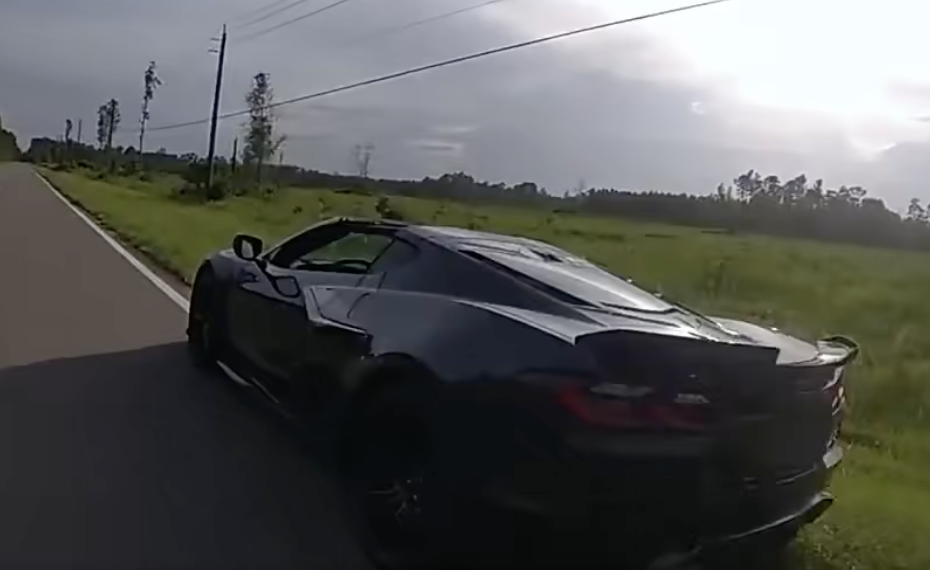
The St. Johns County Sheriff’s Office says a deputy stopped a Chevrolet Corvette on County Road 13 North near Joe Ashton Road doing 130 mph in a posted 45. The driver went to the St. Johns County Jail on a charge of Dangerous Excessive Speeding. SJSO put the body camera footage out publicly and used the caption space to run a public-service explainer on the statute, which tells you exactly how the agency wants this story to land.
Eighty-five over is not a lapse of attention. That’s a decision. But the interesting part of this arrest isn’t the number on the radar — it’s the law being applied, which is barely a year old, quietly narrower than most people think, and in one important respect softer than the charge it was designed to supplement.
What the statute actually says
Florida Statute 316.1922 didn’t exist before July 1, 2025. It arrived via HB 351, and the enrolled text is short enough to read in ninety seconds. You commit dangerous excessive speeding if you operate a motor vehicle “In excess of the speed limit by 50 mph or more” or “At 100 mph or more in a manner that threatens the safety of other persons or property or interferes with the operation of any vehicle.”
Related Articles
- 10 Best Oscillating Multi-Tool Accessory Deals on Amazon Right Now
- Ford’s Empty Spanish Factory Found a Savior: The Chinese Company It Sold Volvo To in 2010
Read those two prongs again, because the difference matters enormously and almost nobody explains it.
The 50-over prong has no manner element. None. The state proves the posted limit, proves your speed, and it’s done. No traffic, no weather, no swerving, no witnesses required. It is functionally strict liability on a number.
The 100-plus prong is the opposite. Speed alone doesn’t get there. The state has to prove your driving threatened someone’s safety or property, or interfered with another vehicle. Hit 105 at 3 a.m. on an empty rural highway posted at 65 and you’re only 40 over, which means the prosecution has to carry that “manner” burden — and an empty road makes it a real fight.
In this case, 130 in a 45 clears the 50-over prong with 35 mph to spare, which is why it’s a clean charge. The deputy didn’t need to establish anything beyond the reading.
The part that should surprise you
Everybody assumes the shiny new criminal speeding law hits harder than what came before. It doesn’t, at least not on jail exposure.
The enrolled statute sets its own penalties: a first conviction gets up to 30 days or a $500 fine or both; a second or subsequent gets up to 90 days or $1,000 or both. Compare that to reckless driving, where the House staff analysis confirms a first conviction already carried up to 90 days in jail and a fine of $25 to $500. So a first-offense dangerous excessive speeding conviction tops out at one-third the jail time of a first-offense reckless.
That’s not a drafting accident. That same analysis records that the Criminal Justice Subcommittee amended the bill specifically to create a standalone offense “rather than classifying such prohibited conduct as reckless driving per se,” and cut the second-offense fine from a proposed floor of $5,000 down to $1,000. The Senate side later bolted the “in a manner that threatens” language onto the 100-mph prong, which wasn’t in the House committee version at all. This law got sanded down twice on its way to the governor’s desk.
Why create it at all, then? Because Florida courts had made the old approach unworkable. The staff analysis cites Harris v. State, 318 So. 3d 645 (Fla. 2d DCA 2021), for the proposition that excessive speed by itself doesn’t constitute reckless driving — prosecutors needed evidence of circumstances beyond speeding showing conscious indifference. Trooper clocks you at 120, defense argues the road was dry, empty, and straight, and reckless falls apart. 316.1922 exists to give the state a charge that speed alone can carry.
One correction to the sheriff’s own post
SJSO’s write-up says a person convicted twice within five years “may have their driving privilege revoked for at least 180 days.”
The statute says shall. The enrolled text reads: a person convicted of a second or subsequent violation within five years of a prior conviction “shall have his or her driving privilege revoked for at least 180 days but no more than 1 year.” That’s mandatory, with a ceiling — the court doesn’t get to skip it, and it doesn’t get to exceed a year. Small word, big difference if you’re the one in front of the judge.
The bill nobody mentions
Here’s what gets lost in the “criminal charge” headlines: the civil infraction didn’t go away.
Section 316.1926(2) still says a person exceeding the limit by 50 mph or more shall be cited for a moving violation punishable under Chapter 318. HB 351 layered the criminal offense on top and then, in Section 3, added 316.1926(2) infractions to the list of violations requiring a mandatory hearing under 318.19. Florida’s own citation reference materials put the 316.1926(2) fine at $1,000 for a first offense, with a second violation carrying $2,500 and a one-year revocation, and a third rising to a third-degree felony with a $5,000 fine and a ten-year revocation.
So the realistic worst case here isn’t “30 days or $500.” It’s a criminal charge, a separate four-figure civil penalty, mandatory court dates on both, and a criminal traffic conviction that no online payment portal and no traffic-school election can make disappear. HB 351 also amended 318.14(2) so that anyone cited for a mandatory-hearing violation or any criminal traffic violation in Chapter 316 must sign a promise to appear. There is no pay-and-forget option.
Related Articles
- 10 Best Tire Shine Deals on Amazon Right Now
- DeKalb County Paid $19 Million for a No-Bid Decade of Car Surveillance
That’s before the insurance conversation. Carriers underwrite civil speeding infractions and criminal traffic convictions very differently, and a criminal disposition is the kind of thing that shows up in background checks years after the ticket would have aged off. If you hold a CDL or any job requiring a clean driving record, this is a career problem, not a wallet problem.
The physics the number is hiding
Enthusiasts get numb to speed figures because modern performance cars make triple digits feel like a Tuesday. That’s exactly the trap.
Kinetic energy scales with the square of velocity. Going 130 instead of 45 isn’t roughly three times the energy — it’s about 8.3 times. Everything downstream scales with it: the guardrail, the tree, the other car’s structure, the human body.
Stopping distance is worse, because it stacks a linear term on a squared one. Give a sharp driver 1.5 seconds of perception and reaction and a full 1.0 g of braking, which is optimistic on a public road with dust and gravel. At 45 mph you cover about 100 feet before the brakes bite and roughly 68 feet slowing down — call it 170 feet, roughly half a football field. At 130 mph, you cover about 286 feet just reacting, then need roughly 565 feet to stop. That’s over 850 feet total. A tenth of a mile. Nearly three football fields.
On a county road with driveways, mailboxes, tractors, and deer, 850 feet of stopping distance means anything that appears is already unavoidable. The car’s capability is irrelevant. A C8 will hold 130 mph with such composure that the driver genuinely may not feel like he’s doing anything dangerous, which is precisely the problem the legislature was aiming at. Chassis competence outran road design decades ago.
Worth noting for the tire nerds: sustained high-speed running is a load case most street tires never see in daily use, and heat build-up on a warm Florida afternoon is not linear either. A speed rating is a certification of survival at speed under specified test conditions, not a promise about a worn tire at unknown pressure on a road nobody swept.
The practical version
If you want to use the car, buy track days. It’s the only legal place to find out what the thing actually does, and it’s cheaper than a criminal defense attorney. Check your policy language before you go, because personal auto policies commonly exclude speed events, and “my insurance covers it” is an assumption people make wrong constantly.
If you’re already in this situation: understand you’re a criminal defendant, not a ticket holder. The mandatory-appearance provisions are in the statute. Speed measurement in Florida turns on the device, its calibration records, and the officer’s certification — that’s a factual record with real discovery value, and it’s the sort of thing that gets a charge negotiated rather than tried.
And if you’re just reading this and thinking the odds are on your side, note that SJSO called this “another” super speed arrest. Agencies have found a charge that’s easy to prove, generates cooperative bodycam content, and produces the kind of Facebook post that gets shared statewide. This enforcement pattern is not a phase.
Screenshot From Video Via: St. Johns County Sheriff’s Office