
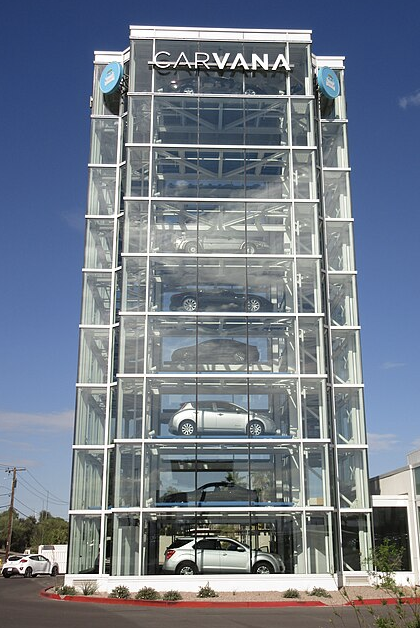
Carvana just printed the best quarter in its history, and the press release invites you to credit execution. Fine. But before anyone files this under “used car market goes brrr,” go look at what the federal government says used cars actually cost right now.
The Bureau of Labor Statistics reported that the used cars and trucks index fell 1.8 percent over the 12 months ending in June, and slipped another 0.2 percent that month. New vehicles were up all of 0.5 percent on the year. That is not a hot retail market. That’s a flat one. bls
So how did Carvana’s average retail selling price climb 17.4 percent?
The numbers, straight from the filing
Carvana’s 8-K exhibit lays out Q2 2026: 197,325 retail units, up 37.7 percent. Revenue of $7.376 billion, up 52.4 percent. Net income of $513 million against $308 million a year ago. Adjusted EBITDA of $769 million.
Now the line nobody quotes. Revenue per retail vehicle went from $23,765 to $27,908 — a $4,143 jump. Meanwhile revenue per wholesale vehicle went the other way, from $10,746 to $10,633.
Sit with that. The same company, in the same quarter, saw the cars it sells at auction get marginally cheaper while the cars it sells to you got 17 percent dearer. Whatever is driving the retail number, it isn’t the price of used cars.
Related Articles
- Inside the Senate Connected Vehicle Bill: Airbags, Batteries and the 15% Rule
- Stellantis Is Profitable Again. It Also Just Told You Which Of Its 14 Brands Don’t Matter.
Cox Automotive’s Manheim index — the wholesale benchmark the entire trade watches — has June at 212.9, up 2.1 percent year over year and 0.1 percent from May. By mid-July it had slid to 211.5 with wholesale days’ supply at 28 and off-lease volume climbing. Wholesale up two, retail down two. For anyone who buys cars at auction and retails them, that’s a vise, not a windfall.
The actual explanation, and it’s a good one
Carvana tells you itself. In the shareholder letter, management attributes higher retail gross profit per unit to rising industry retail prices following FTC guidance requiring dealers to fold mandatory fees into advertised prices — and adds, parenthetically, that Carvana doesn’t charge those fees.
Here’s the backstory. The FTC’s CARS Rule got tossed by the Fifth Circuit on procedural grounds. So the agency went the other route: on March 13, 2026, it sent warning letters to 97 dealership groups saying the advertised price must be the total price a buyer will pay, mandatory fees included, taxes excluded. Doc fees, reconditioning fees, dealer prep, nitrogen in the tires — all of it has to be in the number on the windshield.
Which means thousands of advertised prices across the country went up overnight without a single car becoming more expensive. And Carvana, which already priced all-in, suddenly had headroom it hadn’t earned. The letter’s phrasing on this is admirably blunt: the company simply followed the market on pricing.
Translation for anyone shopping: your Carvana quote in Q2 2026 was higher than it would have been in Q2 2025 partly because the competition finally stopped hiding its fees. The transparency you got at the dealership got quietly repriced into the online seller you were using to escape the dealership. Compare out-the-door totals, not advertised numbers, and compare them across at least three sellers. That gap closed and nobody sent you a memo.
Where the record profit really came from
Not from selling cars better. Total gross profit per unit was $7,014, down $412 from a year ago. Retail gross profit per unit fell 2.4 percent to $3,547. Wholesale gross profit per retail unit dropped from $921 to $801. Other gross profit per unit — finance and ancillary — slid from $2,869 to $2,666.
Every single gross profit line went backwards on a per-car basis. The record came from volume, plus two levers below the gross profit line: SG&A per retail unit dropped from $3,846 to $3,568, and net interest expense fell from $143 million to $101 million as the balance sheet healed.
That’s a leverage story and a refinancing story. It is not a pricing story, and it is definitely not a hot-market story.
The part that should interest you as a borrower
Look again at that $2,666 of “other” gross profit per unit. That’s finance income, and it’s roughly three-quarters the size of the gross profit on the metal itself. The cash flow statement makes the mechanism explicit: over six months Carvana originated $9.005 billion in finance receivables, sold $9.323 billion, and booked $703 million in gain on loan sales — against six-month net income of $918 million.
Carvana is a very good used car retailer bolted to a loan-origination-and-securitization machine, and the machine is where a large share of the profit lives.
The letter also says something that matters if you’re financing right now: with benchmark rates drifting higher in the quarter, the company held customer-facing interest rates steady rather than passing the increase through. That’s why “other” GPU fell $203 a car. Carvana ate a rate increase to protect volume.
So the practical read is that Carvana’s APR is currently more competitive against the rate environment than it was a year ago — because the company chose margin sacrifice over unit sacrifice. Still get a credit union pre-approval before you accept it. But know that the number you’re being offered is deliberately sharpened right now, and that it may not stay that way.
What the guidance is actually telling you
Carvana guided to $2.7 to $3.0 billion of adjusted EBITDA for full-year 2026, up from $2.24 billion in 2025. Sounds great. Do the arithmetic.
Q2 adjusted EBITDA was $769 million. Q1 revenue backs out to $6.432 billion at a stated 10.4 percent margin, so roughly $669 million. First half: about $1.44 billion. The guidance range therefore implies a second half between roughly $1.26 and $1.56 billion — with a midpoint slightly below what the company just did in the first half, even while promising sequential unit growth in Q3.
Related Articles
- Mercedes Recalled 310,000 Cars Over a Rollaway Risk, and the Parking Brake Was Never the Problem
- This State’s New AI Truck Cameras Aren’t Really About Safety. They’re About Lawsuits.
Management is telling you, in the polite dialect of guidance ranges, that the margin tailwind from fee-inclusive competitor pricing and from lapping easy comparisons is finished. Adjusted EBITDA margin already fell from 12.4 percent to 10.4 percent year over year.
Two more things buried in the balance sheet
First, taxes have arrived. The income tax provision was $66 million this quarter versus zero a year ago, and the deferred tax asset shrank from $3.064 billion to $2.968 billion. The enormous shelter that made Carvana’s post-crisis earnings look so clean is being consumed.
Second, of that $513 million in net income, $203 million was attributable to non-controlling interests. Class A shareholders got $310 million. Separately, the balance sheet carries a $2.130 billion tax receivable agreement liability, of which $1.645 billion is owed to related parties. The company earns, and a defined slice flows out through structures most retail investors never read about.
Takeaways if you’re actually in the market
Selling privately or trading in: wholesale peaked in March and has been drifting since, with off-lease supply building through the back half. Waiting is not a strategy that pays here.
Buying: the advertised-price landscape changed in March and prices went up without cars getting better. Negotiate on the total, and remember that a retailer earning $2,666 a car on finance and ancillaries has room to move on financing that it doesn’t have on sheet metal.
And when the next headline tells you a hot used car market minted somebody a record profit, check the CPI first. Sometimes the market is just fine, and someone got very good at the parts of the business that aren’t the car.
Images Via: Wikipedia