
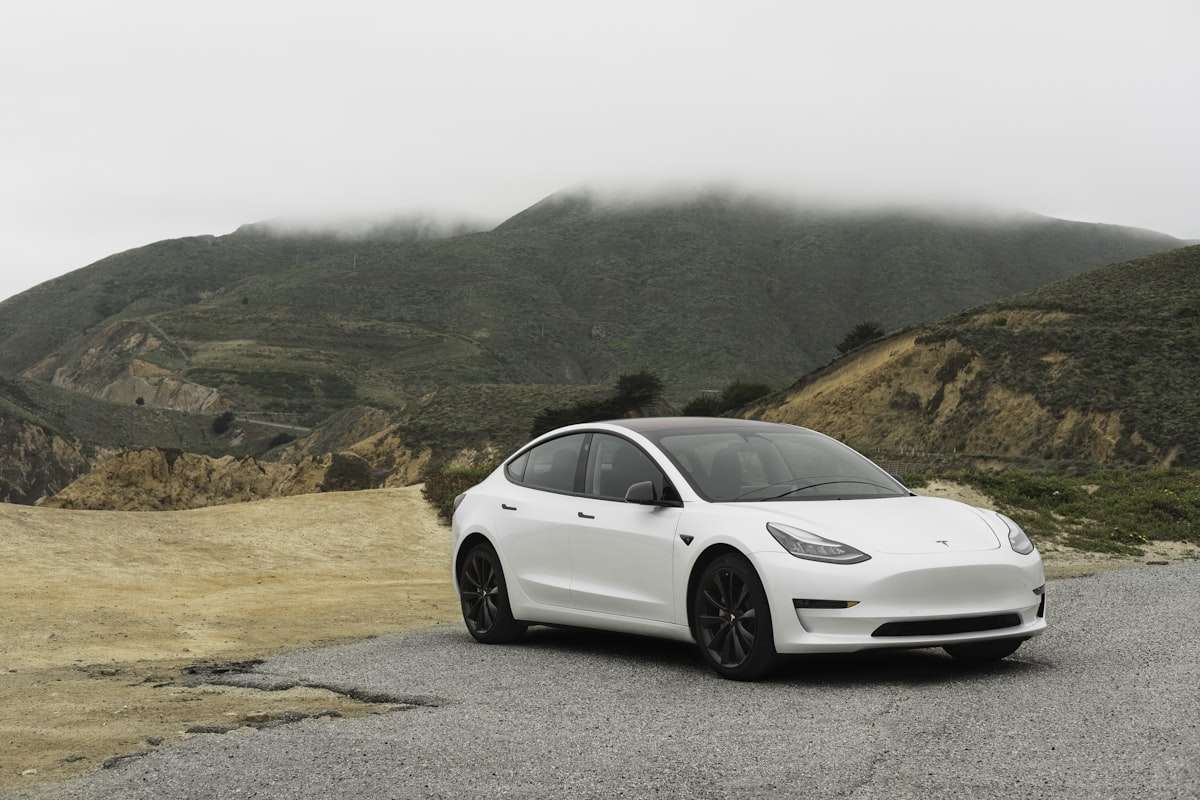
Federal safety regulators just opened a new investigation into Tesla’s front suspension. That’s not really the news. Tesla has been down this exact road before, twice, and both times the company said, in effect, that it had already fixed the problem. A single sentence buried in NHTSA’s own paperwork now says otherwise.
On July 29, 2026, the National Highway Traffic Safety Administration’s Office of Defects Investigation opened Preliminary Evaluation PE26006, covering the front lower lateral link on 2018-2020 and 2023 Model 3 sedans and 2021-2023 Model Y crossovers. ODI says it has logged 156 complaints describing the link detaching from the front suspension, an event that can send the car out of directional control with essentially no warning. Some drivers report a noise beforehand, but Tesla’s dashboard gives no visual alert before it happens. Once the link lets go, the car frequently cannot be driven and has to be towed.
A lower lateral link, sometimes called a control arm, is one of the unglamorous rods that pins a front wheel’s hub to the chassis and keeps it from swinging sideways under cornering and braking loads. It looks like a spare part, and it does an outsized job. On a steered front axle, losing it doesn’t just change ride height, it can change which way the car is pointed. That’s a meaningfully different failure than the rear toe-link separations The Auto Wire covered in Rivian’s R1S and R1T recall, where the unsettled end of the car was the back, not the end doing the steering.
Here is the detail that should stop any Tesla owner mid-scroll: this is not Tesla’s first lateral-link recall. It is the third time regulators have examined this exact failure mode. In late 2021, Tesla recalled 2,791 Model 3s built for model years 2019 through 2021 (campaign 21V-835) after tracing detached lateral links to what it called a production issue. In 2023, a second recall, 23V-235, covered another 422 Model 3s from 2018 and 2019, again attributed to that same narrow explanation. Add the two together and Tesla has already, on paper, fixed this precise defect in roughly 3,200 cars.
Now read what NHTSA’s opening resume says about the failures behind PE26006: they exceed the scope of those two recalls, and investigators say they “do not appear to be related” to the production issue behind either one. In plain terms, the fix Tesla has now shipped twice does not explain the cars failing today. A “production issue” is corporate shorthand for a bad batch, a supplier lot, a torque spec missed on one line during one window. It is not a design defect, and it does not require an automaker to prove that a part is durable across every car built on the same underlying architecture. Two narrow recalls let Tesla answer a smaller question without ever having to answer the larger one.
It’s worth being precise about what a Preliminary Evaluation actually is, since “NHTSA investigation” gets used as a synonym for “recall about to happen.” It isn’t one. A PE is the first rung of a three-step process: NHTSA gathers complaints, crash data, and sometimes physical vehicle inspections to decide whether a real defect trend exists, and a PE can simply close with no finding at all. If concern remains, the case escalates to an Engineering Analysis, a longer, more technical dive that builds the actual case for or against a recall. Only then does a recall typically follow, voluntary or otherwise. PE26006 is barely a week old as of this writing. There is no recall attached to it, and there may never be one. What is attached to it, right now, is 156 complaints regulators judged serious enough to open a formal file.
That distinction matters because of how this story is already circulating: as an investigation touching well over a million Teslas. That figure isn’t fabricated, it reflects the total population of Model 3 and Model Y vehicles built across the covered years, which is genuinely enormous. But it is not what triggered the investigation. NHTSA opened this file over 156 complaints, not a confirmed failure rate across a seven-figure fleet. Treating “cars eligible to be examined” as though it means “cars confirmed to have a defective part” is exactly how an early-stage inquiry gets reported like a recall that already happened.
None of that makes the underlying pattern less uncomfortable for Tesla. A production-issue recall is the cheapest possible outcome available to an automaker: narrow scope, narrow cost, no admission that a part’s basic design needs rework. Tesla has now leaned on that explanation twice for the identical failure mode. If ODI’s engineers eventually trace the newest failures to the lateral link’s design or duty cycle rather than another bad batch, Tesla loses the option it has used twice already, and a genuinely large share of its two bestselling models, not a few thousand cars from one production window, comes back into play. That would also land on top of a separate, unrelated NHTSA inquiry into Tesla’s Autopilot radar decisions, the kind of regulatory pileup that makes a company’s safety story harder to control no matter how isolated each individual case actually is.
For current owners, the practical takeaway isn’t to panic over a part with a few hundred complaints spread across five model years. It’s to take suspension noise seriously in a way most drivers don’t. There is no warning light for a control arm quietly working its bushings loose. The only early signal is sound, a clunk over bumps, a change in steering feel, and by the time the part actually separates there usually isn’t a second warning. Owners of the affected Model 3 and Model Y years are better served asking a service center to physically inspect the front lower lateral link than waiting on a recall letter that, per NHTSA’s own process, could be a year or more away, if one arrives at all. Genesis owners learned a version of this lesson recently, when a fuel-line fix billed as permanent turned out not to be.
Two recalls did not make this failure mode go away. They made it disappear from view for a while. The real story sitting inside PE26006 isn’t how many Teslas could eventually be covered. It’s that a “production issue” can only get invoked so many times before the explanation itself becomes the thing regulators are investigating.