
Somewhere in Tesla’s files sits a document titled “Radar Saves Us.” Two words past the actual headline, and it may be the most damaging sentence Tesla never intended the public to read. The National Highway Traffic Safety Administration wants that document now, along with every email, test result, and internal argument that produced it. But the memo’s title isn’t really the story here. The story is what Tesla did after someone inside the company apparently wrote it.
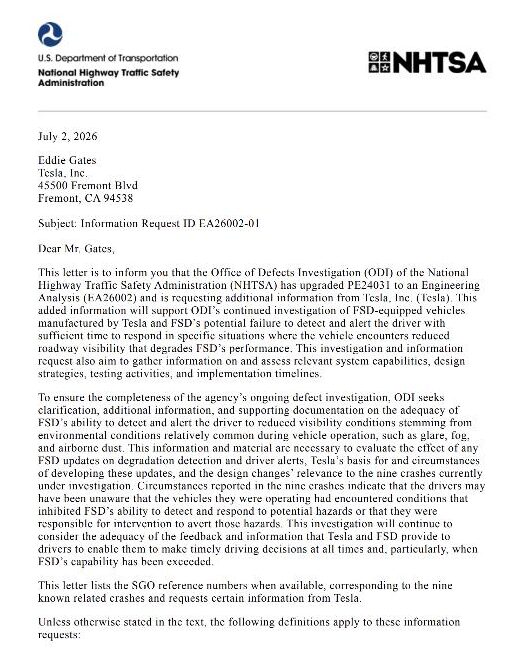
On July 2, NHTSA’s Office of Defects Investigation upgraded its year-old preliminary evaluation of Tesla’s Full Self-Driving system, case PE24031, into something more serious: an Engineering Analysis, case EA26002. That reclassification is not paperwork theater. It is the last procedural rung before a formal recall determination, and it covers roughly 3.2 million FSD-equipped Tesla vehicles on American roads. The trigger is nine crashes sharing an unglamorous common thread: reduced visibility. Glare, fog, and airborne dust, according to the agency’s letter to Tesla, not exotic weather or unusual roads. Ordinary driving conditions that, in nine documented cases, one of them fatal and one of them injurious, apparently overwhelmed a system millions of Tesla owners pay extra to trust.
Most owners have never heard of a Preliminary Evaluation, and would have no reason to. It is the quiet, exploratory phase of NHTSA’s process, the equivalent of a detective reading a case file before deciding whether to open a real investigation. An Engineering Analysis is different. NHTSA escalates to EA status when it believes it has found a pattern worth building a legal case around, and a meaningful share of engineering analyses end in a recall. Tesla, in other words, did not get a form letter. It got the second-to-last letter.
Which brings us to “Radar Saves Us.” NHTSA says Tesla handed the document over confidentially during the earlier, quieter phase of the investigation, and the agency has now folded it into the official case file, along with a demand for the internal communications, testing data, and technical analysis behind it. Here is why that one document might matter more than the nine crash reports combined: American product liability law rarely turns on whether a defect exists. Almost every complex machine has one somewhere. It turns on what the manufacturer knew, and when. If “Radar Saves Us” shows Tesla’s own engineers concluding that a radar-camera combination was safer in exactly the conditions now under investigation, before the company removed radar from every new car it built, that is not a technical footnote. That is a paper trail.
Companies rarely get caught by the crash. They get caught by the memo.
The backstory here is well known, which is exactly what makes it uncomfortable. Tesla stripped front radar out of new production in 2021, rebranding its perception stack as Tesla Vision and betting that camera-only machine learning would eventually outperform sensor fusion. A year later, ultrasonic parking sensors went too. Elon Musk framed the decision as one of signal versus noise, arguing publicly that radar data, at the resolution automotive radar units actually offered, was adding confusion rather than clarity to a vision-based system. Reporting on the internal debate has suggested Tesla’s own engineers were not universally convinced, and were worried specifically about the scenario NHTSA is now investigating: cameras struggling in rain, fog, and glare in ways a radar return simply does not care about. If “Radar Saves Us” is that argument, written down, before the hardware was deleted from the assembly line, it becomes very hard for Tesla to characterize this as a surprise.
Then there is the detail that got less attention in early coverage and deserves more: NHTSA is also scrutinizing Tesla’s decision to change its “FSD Degraded” warning from red to yellow and to drop the audible chime that used to accompany it. Read that again. At the exact moment the system is privately telling itself that it can no longer see well enough to do its job, Tesla made that warning look calmer and sound quieter. Aviation and nuclear engineers have a name for the discipline this violates: alarm management. The entire point of a degraded-capability warning is to interrupt a distracted human’s attention at the moment attention matters most. A quieter, less alarming alert does not just fail to help. It works against the driver’s ability to notice that the car has quietly handed the job back to them.
NHTSA is also asking Tesla to explain marketing language claiming FSD can operate in “whiteout” conditions or “works in all conditions.” That is not a new fight for Tesla. The Auto Wire covered a class-action lawsuit years ago over the gap between Tesla’s Autopilot and Full Self-Driving marketing and what the software could actually do, and the company has spent the years since defending exactly this kind of claim. What is different now is the source of the skepticism. It is not a plaintiff’s attorney making the argument. It is the same federal agency that just spent a year reading Tesla’s own crash telemetry.
Here is the part that should worry Tesla more than the memo’s headline. Most Tesla recalls have been almost invisible to owners, a software update pushed overnight while the car sat in a garage, problem solved by breakfast. That remedy only works when the fix lives in code. If NHTSA concludes that camera-only perception has a genuine, physics-level limitation in glare, fog, and dust, no over-the-air update fixes a sensor that was removed from the bill of materials five years ago. Tesla can patch software instantly. It cannot un-delete a sensor from 3.2 million vehicles already on the road with the same overnight ease.
You can push a software update to a camera. You cannot push a software update to a radar unit that was never installed.
This is why the sensor debate matters beyond Tesla’s stock price. Most of the rest of the industry, and most robotaxi operators, kept radar or lidar as a redundant layer precisely because cameras degrade in exactly the conditions NHTSA is now investigating: backlight, particulate, and precipitation. Tesla made the opposite bet, publicly, for cost and manufacturing simplicity as much as for any pure engineering conviction. That bet has looked smart on a spreadsheet for five years. This investigation is the first time it is being tested in a venue where “the cameras are good enough” has to survive scrutiny rather than a shareholder call.
Owners should understand what this actually changes today, which is close to nothing, and what it could change later, which is significant. Nothing in an Engineering Analysis requires Tesla to do anything yet; the company has until August 12 to respond to NHTSA’s two dozen points of inquiry or face fines for noncompliance. But EA-stage investigations shape insurance underwriting and resale expectations long before any recall is ordered, because insurers and used-car buyers price in regulatory risk, not just confirmed defects. A vehicle under active federal scrutiny over a safety system’s core sensing capability is a harder car to insure cheaply and a harder car to resell confidently, recall or not.
This is not Tesla’s only open file with federal safety regulators right now, either. NHTSA is separately examining FSD’s pattern of running red lights, and Tesla is fighting a lawsuit built partly on statements from its own earnings calls, following an NTSB finding that put a driver, not FSD, at fault in a fatal Katy, Texas crash that made national headlines. Read together, the pattern is not nine unlucky crashes. It is a company whose public confidence in its own technology keeps generating the paper trail its lawyers now have to explain.
Forget the crash count by next year. Forget the specific wording of the marketing claims. The idea worth keeping is simpler: a company that deletes its own backup sensors is a company betting there is nothing left to back up. NHTSA is now asking Tesla’s own engineers to explain, on the record, whether they ever believed that bet.