
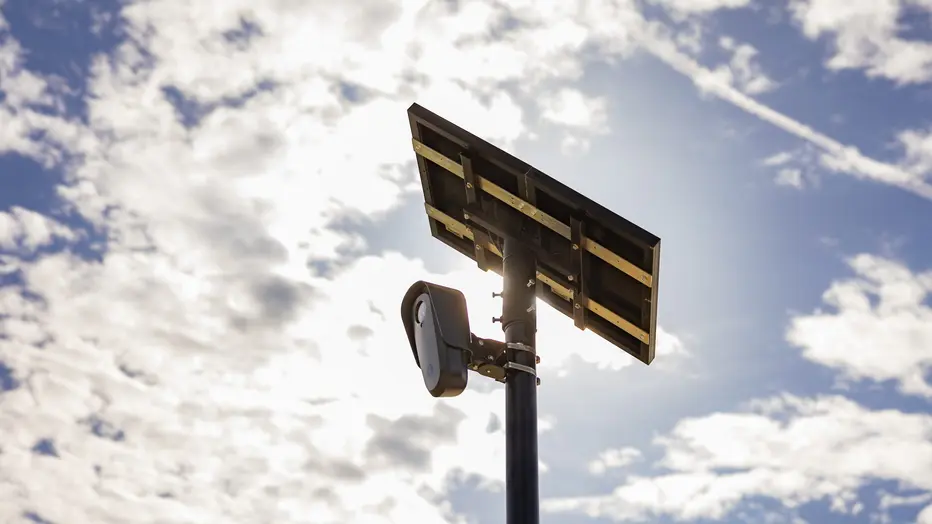
Six people did not lose access to Savannah’s Flock cameras this week because Georgia grows worse cops than everywhere else. They lost it because Georgia is nearly the only place that would tell you when it happens.
Savannah Mayor Van Johnson announced the suspensions in a Facebook post Friday: four police officers and two civilian employees, placed on administrative leave pending an investigation into how they used the city’s automated license plate reader network. The department referred the matter to the Georgia Bureau of Investigation rather than handling it internally, and all six now face possible termination on top of whatever the GBI turns up. Johnson didn’t name the employees or describe what, specifically, they allegedly did. “Public trust is non-negotiable,” he wrote.
That vagueness is normal for a personnel matter. What isn’t normal is the company Savannah is suddenly keeping. The same day Johnson posted, the Habersham County Sheriff’s Office announced it had fired and arrested a deputy for pulling Flock data for personal reasons. In the two months before that, Georgia authorities disclosed cases involving three Cherokee County deputies, five Albany officers, and three Richmond County officers, on top of a Conyers Real-Time Crime Center supervisor arrested in July for running her domestic partner’s plate more than 30 times in four months. Add Savannah’s six, and the running count of Georgia public employees disciplined or charged for personal Flock searches over roughly a year comfortably clears two dozen.
Read that paragraph again and it sounds like Georgia has a rot problem. It doesn’t, necessarily. What Georgia has is a law most states don’t bother with.
Georgia treats unauthorized use of retained license plate data as a specific criminal offense, not just a fireable one, and pairs it with a step most departments elsewhere skip entirely: routing suspected misuse to an outside agency for independent review instead of settling it quietly through internal affairs. That combination is what turns a personnel file into a police blotter item, and a police blotter item into a wire story. Most states hand this kind of thing to internal affairs and never issue a press release. Georgia hands it to state investigators, and a mayor posts about it on Facebook. The volume of Georgia cases isn’t necessarily proof of Georgia’s dirtier holsters. It may just be the only jurisdiction that turns the lights on and makes everyone watch what the flashlight finds.
Here’s the detail worth sitting with: two of Savannah’s six are civilians, not officers. Flock’s license plate network isn’t only operated by badge-carrying cops who went through use-of-force training and academy vetting. In most departments, crime-center analysts, dispatchers, and other civilian staff get the same search terminal, the same login, and largely the same ability to type a plate number into a box and pull up months of a stranger’s movements. Nobody voted on giving a records clerk the same surveillance reach as a detective. It just came bundled with the software license.
Six at once is also structurally different from how these stories usually break. The Conyers case earlier this summer started with one flagged pattern: Flock’s own Audit Assistance tool, part of a compliance suite the company built after years of headlines like this one, spotted a supervisor’s searches looking off-policy and routed the case to a human reviewer. A batch of six suggests something closer to a department-wide records pull than a single tip. That’s arguably the audit system finally doing, at scale, what Flock has been promising it could do since it started selling police departments on the idea that its own network could police itself.
None of this is happening in a vacuum. The same weeks Georgia racked up its latest disciplinary cases, the Los Angeles Police Department suspended its own 138-camera Flock network, and small Connecticut towns started ripping cameras out entirely, unconvinced that any audit trail could fully account for who else might get to look. Two states reached two very different conclusions about the same technology. Georgia decided the fix was better internal policing of a network it intends to keep. Connecticut decided the fix was not having the network in the first place.
For the driver whose plate got logged on the way to work, to church, or to a doctor’s appointment nowhere near a crime scene, neither approach offers much comfort in real time. You don’t get a notification when your plate is searched. You don’t get to see who looked, or why, unless a state happens to criminalize the wrong kind of looking and a reporter files the right records request. Most states don’t. Georgia, almost by accident, built the paperwork trail that lets the rest of us count.
Savannah’s six will have their disciplinary hearings, and the GBI will decide whether any of it was criminal. The department will point to the referral as proof the system caught itself, and in a narrow sense, it will be right. But the bigger story isn’t that Savannah found six people misusing a camera network.
It’s that a scoreboard only tells you who got caught playing. It doesn’t tell you how many cities never bothered keeping score at all.