
Governors love a podium with a future on it. Ron DeSantis got a good one this week: a concrete pad in Auburndale, Polk County, with the word “vertiport” attached to it and the phrase “flying cars” printed in his own press release.
Strip out the Jetsons framing and there’s a real story underneath, though it’s a slower and more interesting one than the headline suggests.
What actually got announced
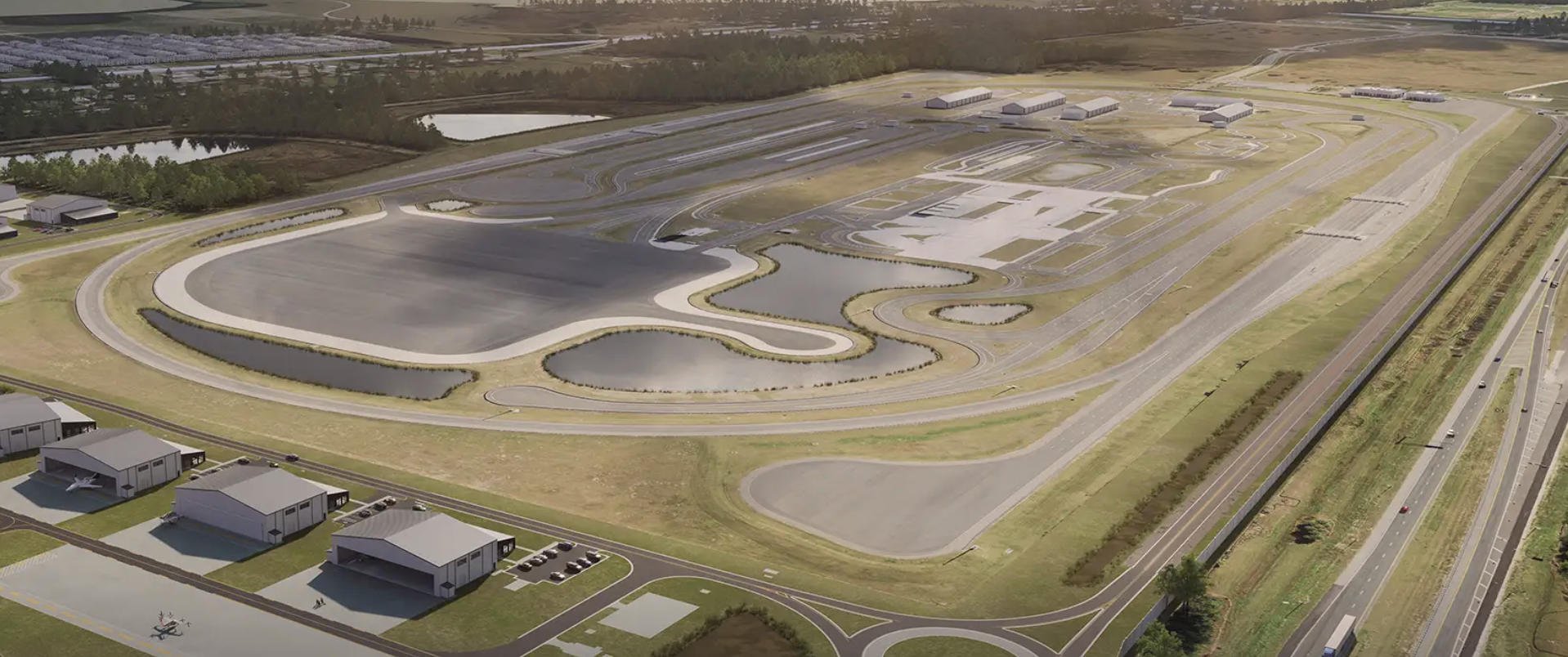
SunTrax is a 775-acre state testing campus sitting on the I-4 corridor between Tampa and Orlando. It was built to test connected and autonomous ground vehicles — closed high-speed loop, simulated rain, fake urban streetscape, pedestrian crossings, graded inclines, the works. Florida’s own description calls it the only high-speed autonomous test track in the Southeastern United States.
The new part is SunTrax Air: two vertiports and what the state bills as the nation’s first dedicated Advanced Air Mobility aerial test track, plus tenant hangars pitched for research, light manufacturing and final assembly. The governor’s claim is that eVTOL testing will be underway at SunTrax by the end of this year.
That’s the announcement. Testing. Not service, not tickets, not a Tampa–Orlando commuter hop. Worth keeping straight, because the two get blurred constantly.
Why Florida, and why now
This didn’t come out of nowhere. In March, USDOT and the FAA named eight projects for the eVTOL Integration Pilot Program, spanning 26 states out of more than 30 proposals. Florida DOT was one of the eight, with a staged statewide program covering cargo delivery, passenger transport, automation and medical response, and with Archer, BETA, Electra and Joby named as partners.
The eIPP exists because of a June 2025 executive order, and its stated purpose is to generate operational data the FAA can use to write the actual rules later. The agency has already logged a first milestone under the program: BETA and United Therapeutics flying an organ-transport mission from Virginia into Maryland with Pennsylvania DOT.
So the federal government has effectively created a supervised sandbox that lets these aircraft operate commercially-ish before the certification process finishes. That’s genuinely novel. It’s also the thing that makes the timeline sound faster than it is.
The certification wall nobody mentions at the podium
Here’s the load-bearing fact: as of right now, no eVTOL air taxi holds an FAA type certificate. None. Not one aircraft in this entire sector is legally cleared for routine commercial passenger service in the United States.
Joby, the furthest along, began flight testing its first FAA-conforming aircraft in March 2026, opening the door for FAA pilots to conduct “for credit” Type Inspection Authorization testing later this year. TIA is the last major phase — the point where government test pilots climb in and evaluate the thing themselves, alongside scrutiny of maintenance manuals, training curricula and system redundancy.
Getting to TIA is a genuine achievement. It is also not a type certificate, and the gap between those two states has swallowed optimistic aerospace timelines before.
The regulatory scaffolding underneath is newer than most people realize too. The FAA only finalized its framework for powered-lift pilot certification and operations in late 2024, and it did so as a Special Federal Aviation Regulation with a ten-year shelf life. Powered-lift is the first genuinely new civil aircraft category since helicopters arrived in the 1940s. The rule is temporary by design because nobody, including the regulator, is confident enough to write permanent law yet.
One detail from that rule tells you a lot about the state of the art: the FAA had to create an alternate pathway to certify pilots in aircraft with a single set of flight controls and a single pilot station. Traditional training requires two — one for the student, one for the instructor. These aircraft physically can’t accommodate that, so the rule bent around the hardware. That’s the regulatory equivalent of building the road while the car is already rolling.
The ground half is the part already working
Which brings us to the less glamorous but far more consequential half of the announcement.
Florida didn’t get Waymo operating in Miami and Orlando by accident. It got them because of a statute most people have never read. Under Florida Statute 316.85, a licensed human operator isn’t required to operate a fully autonomous vehicle, the automated driving system is legally deemed the operator, and local governments are barred from imposing their own taxes, fees or for-hire requirements on AVs.
Read that last clause again. Miami-Dade cannot write its own robotaxi ordinance. That preemption is the single biggest reason Florida is competitive with Arizona and Texas for AV deployment, and it’s why the state’s announcement mentions Waymo’s Tampa launch expected this fall alongside completed mapping and rider-only testing.
The insurance asymmetry worth knowing
Here’s a practical takeaway that never makes the press release.
If you’re hit by an ordinary Florida driver, the state only requires them to carry $10,000 in personal injury protection and $10,000 in property damage liability. Bodily injury liability isn’t mandatory for most drivers at all. Those limits are famously thin.
If you’re hit by an autonomous vehicle logged onto an on-demand network, Florida Statute 627.749 requires primary liability coverage of at least $1 million for death, bodily injury and property damage, plus PIP and uninsured/underinsured coverage.
That is a hundredfold difference in the primary policy sitting behind the vehicle that hit you. It’s a strange and underappreciated feature of the current landscape: in Florida, from a purely financial-recovery standpoint, being struck by a driverless car is dramatically better news than being struck by your neighbor.
I’d expect that gap to become a talking point the moment the first serious robotaxi injury case reaches a Florida jury.
The honest read
Florida has built infrastructure ahead of the product. That’s not a criticism — it’s how Cape Canaveral happened, and states that wait for certainty get the manufacturing plant built somewhere else. The workforce piece, with FDOT partnering with Embry-Riddle and Polk State College on pilot, technician and engineering credentialing, is arguably the most substantive thing in the whole announcement, because those programs take years to spin up and there’s currently no pool of powered-lift-rated pilots to hire from.
But keep your expectations calibrated. A test flight at a closed facility in Polk County is not an air taxi between Tampa and Orlando. Between here and there sits a type certificate that doesn’t exist yet, a vertiport network that isn’t built, a pilot workforce that hasn’t been trained, and an operating rulebook the FAA explicitly labeled temporary.
The autonomous ground vehicles, meanwhile, are already carrying paying passengers on Florida roads under a law written in 2019. The future arrived on four wheels first, and it did it without a single vertiport.
Images Via: SunTrax