
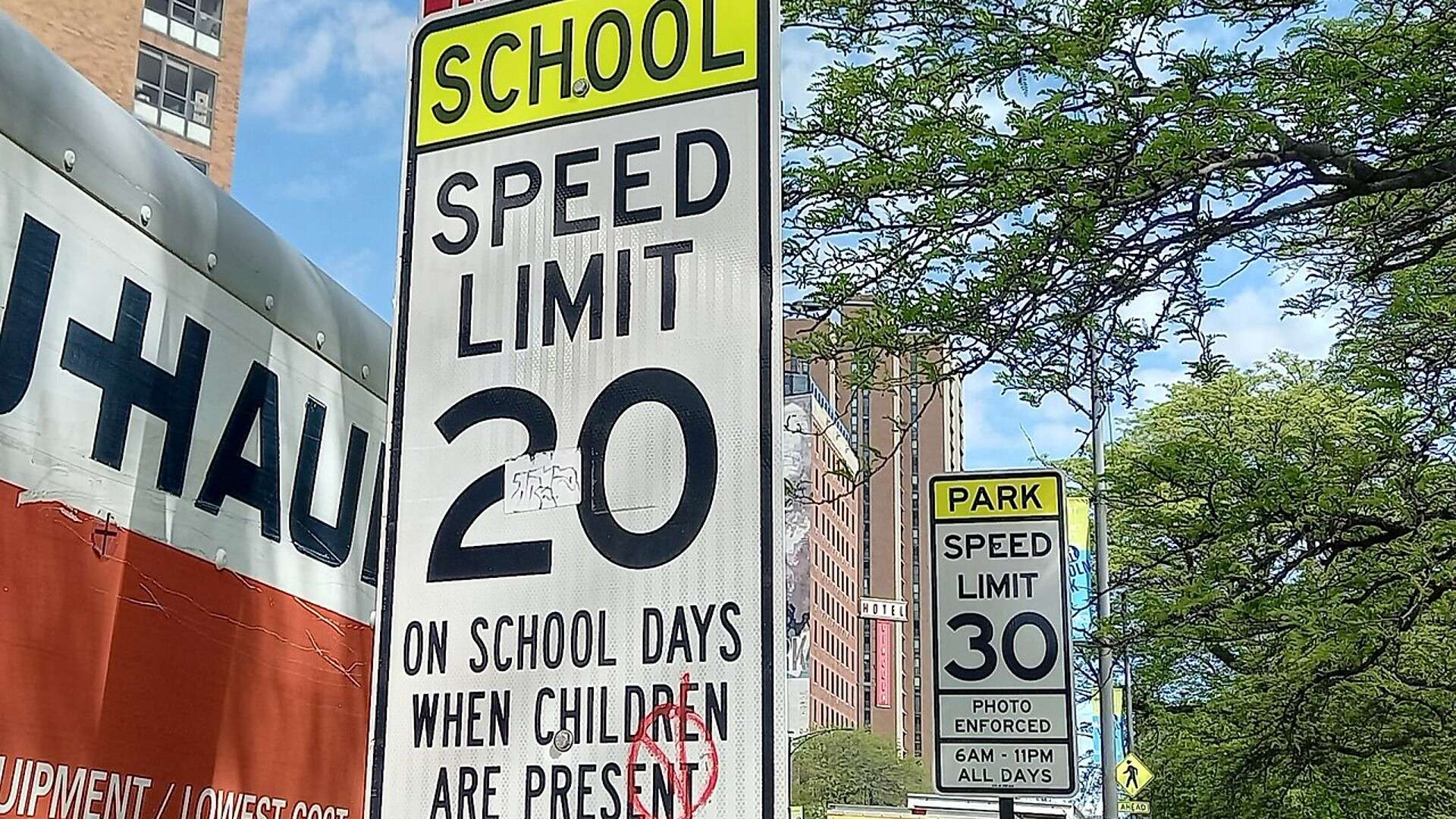
Chicago mailed 1,843,398 speed camera tickets in 2024, according to the Chicago Department of Transportation’s annual report on automated enforcement, which uses ticket data from the city’s Department of Finance. Spread across a leap year, that works out to one ticket roughly every 17 seconds, around the clock.
The figure making the rounds this fall is slower: one ticket every 48 seconds. It comes from a September 16 analysis by Illinois Policy, a free-market think tank. Policy analyst Lilly Rossi counted 529,529 tickets at $35 and 123,786 at $100 in 2025, or 653,315 in all, and put speed camera revenue at $64.2 million, up from $59.6 million in 2024. The group attributes its numbers to the Department of Finance.
I could not make those counts line up with the city’s. For 2024, Illinois Policy lists 424,754 tickets at $35 and 94,906 at $100. CDOT’s report for the same year lists 1,125,376 fined tickets in the $35 tier and 196,032 in the $100 tier. The smaller set would bring in about $24.4 million at face value, well short of the $59.6 million in 2024 revenue the same analysis reports. The city’s larger counts multiply out to $58,991,360, which is the exact “dollar value of tickets issued” in CDOT’s table. Whatever Illinois Policy counted, it was not every ticket the city mailed.
The city’s own paperwork also says more about where the tickets come from than any total does: most of the tickets, and two-thirds of the money, come from drivers going 6 to 10 mph over, a tier Chicago added in 2021. The cameras do slow traffic where they go up. The city’s data also shows a growing share of park-zone drivers getting ticketed more than once a year.
From a radar trigger to a ticket in the mail
CDOT’s 2024 table shows how much filtering happens between a camera firing and a ticket showing up in a mailbox. The 162 active speed cameras captured 6,964,068 events, which the report defines as the radar detecting a potential violation and the camera taking two pictures and a six-second video. After what the city calls multiple human reviews, 2,324,975 of those events were confirmed as violations, about one in three. The city sent 63,493 of them as warnings because the camera was in its first 30 days of operation, and it does not count those as tickets. It also cannot issue a ticket when a plate can’t be matched to an owner’s address. Matching the plate to the right owner is the step that failed when Philadelphia’s cameras billed a Dallas man for a Mercedes he did not own.
Of the 1,843,398 tickets mailed, 521,990 carried no fine at all. Under the city’s rules, each registered license plate gets one extra warning notice the first time it is caught speeding in a safety zone. So in 2024, more than half a million plates triggered a Chicago speed camera for the first time, eleven years after the program started. The report also says 32% of speed camera tickets went to people who live outside Chicago, which helps explain why the pool of first-timers never runs dry.
Leave out the warnings and the city mailed 1,321,408 tickets with a fine attached in 2024, about one every 24 seconds.
The $35 tier carries the program
Chicago’s cameras charge $35 for 6 to 10 mph over the limit and $100 for 11 mph or more. CDOT’s report notes the lower $35 threshold took effect in March 2021. Before that change, the city’s own violation data shows cameras recording 862,596 violations in 2019 and 800,594 in 2020. In 2021 the count jumped to 3,077,604, with roughly the same number of cameras.
In 2024, the $35 tier produced 1,125,376 tickets, 85% of everything that carried a fine. At $35 each, that is $39,388,160, or two-thirds of the $58,991,360 face value of all speed tickets issued that year. The 196,032 tickets for 11 mph or more over accounted for the other $19,603,200.
Chicago is charging less than it could. The Illinois statute that authorizes the cameras, 625 ILCS 5/11-208.8, caps the penalty at $50 for 6 to 10 mph over and $100 for more than 10, plus a late penalty of up to the same amount again. The city’s FAQ says a penalty that can equal the fine is added once a ticket reaches final determination, which can turn a $35 ticket into $70 for anyone who lets it sit.
The same statute limits the damage in ways that matter at renewal time. A camera ticket is a civil penalty, it is not a moving violation, and the law says it may not be recorded on the owner’s driving record. It goes to the registered owner, not whoever was driving, so the person who lent out the car, or the company that owns a fleet van, gets the bill.
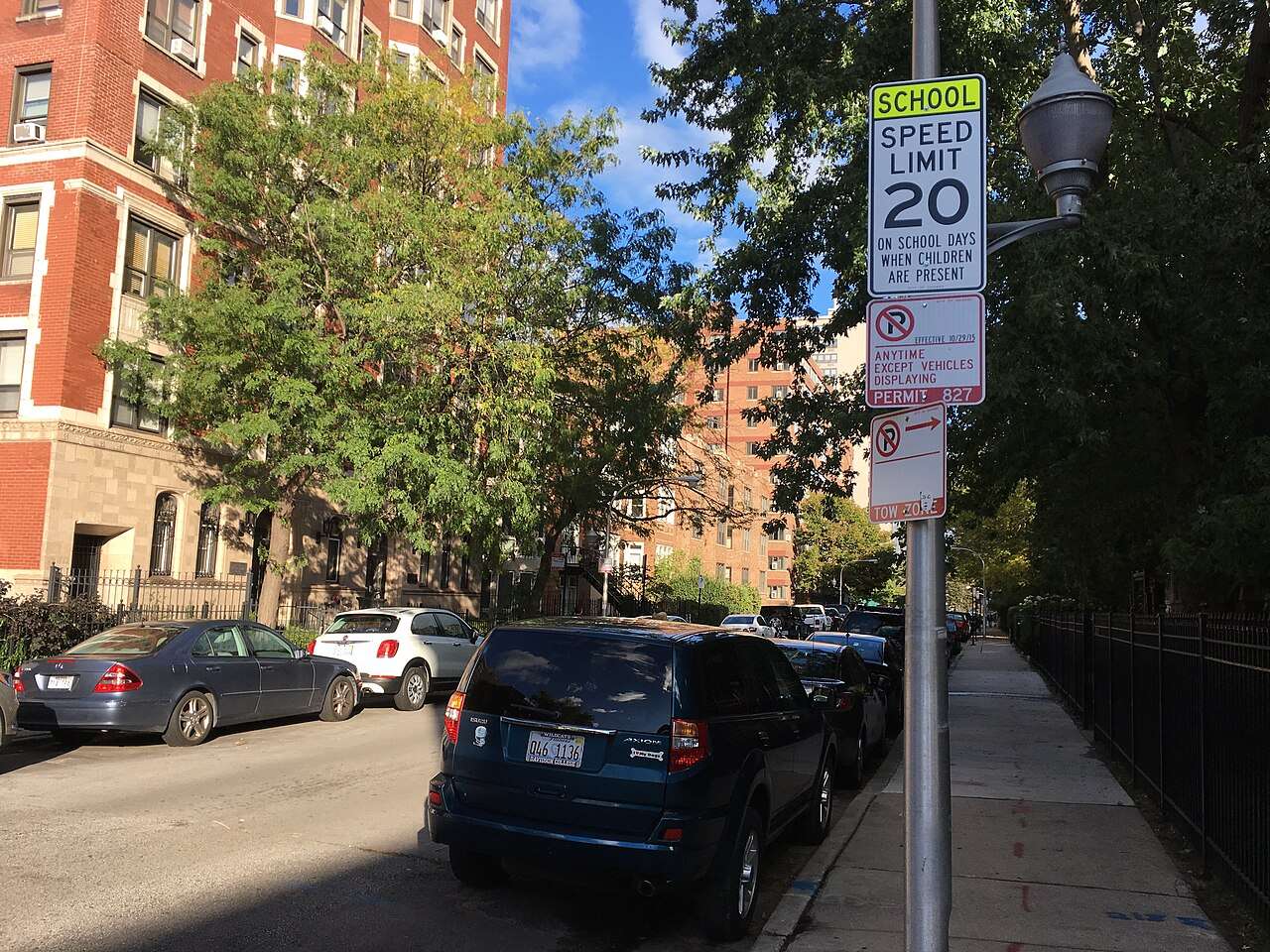
For a driver, the difference between the two kinds of zones matters more than the fine schedule. School zones drop to 20 mph from 7 a.m. to 4 p.m. on school days when children are present. Park zones, according to the city, are typically enforced from 6 a.m. to 11 p.m., every day of the year, at the posted limit. Park cameras wrote the large majority of 2024’s tickets: 1,486,633 of the 1,843,398, by CDOT’s breakdown. On a street posted at 30 mph next to a park, 36 mph at 10 p.m. on a Sunday is a $35 ticket.
Speeds fall at new cameras, and repeat tickets are rising
The city’s safety case rests on what happens at the camera sites. CDOT compared average speeds during enforcement hours in the first two weeks of each camera’s operation with its most recent two weeks, for every camera active at least six months before the end of 2024. Average speed fell from 25.05 mph to 20.83 mph, a drop of 16.9%. The report says fatal and injury crashes near speed cameras rose 2% between 2012-13 and 2023-24, while the citywide increase was 30%. It also cites a University of Illinois Chicago study, funded by CDOT and covering both red light and speed cameras, which found that camera deployment reduced expected fatal and severe injury crashes by 15%.
The city’s data portal shows the same pattern at a single camera. The one at 3358 S. Ashland Ave. went live on June 15, 2025, according to the city’s camera location records. By my count from the violation data, it logged 115,481 violations in 2025, more than any other camera in the city, in about six and a half months. It recorded 30,023 in July 2025, its first full month. In July 2026 it recorded 12,486, a 58% drop. Drivers who use that stretch of Ashland every day learned where the camera was.
The repeat-ticket numbers point the other way. CDOT’s 2024 report says 84.4% of drivers ticketed in a school zone and 66.0% of those ticketed in a park zone did not get a second ticket that year, and it presents that as evidence drivers changed their behavior. The 2022 edition of the same report put those figures at 92.1% and 88.2%. In two years, the share of park-zone drivers who got ticketed again went from about one in eight to about one in three. The report does not say whether the method changed, and it offers no explanation. If the measure holds, a growing group of drivers is paying $35 repeatedly instead of slowing down, which is how the 6 mph tier can raise money without doing much for safety on those streets.
Forty-eight new cameras, and room under the law for far more
Chicago’s camera location records list 48 sites that went live in 2025, most between June and September. Illinois Policy puts the number at 50. The effect shows up in the violation data, which counts every violation the system records whether or not a ticket followed. My tally from that dataset shows 2,239,667 recorded violations in 2024 and 2,444,752 in 2025, up 9.2%. From January through August 2026, with the new cameras running all year, the count is 1,778,132, up 20% from 1,478,814 in the same months of 2025.
The program has plenty of headroom. CDOT says the city identified 1,495 qualifying Child Safety Zones, the areas within an eighth of a mile of schools and parks where state law allows the cameras. The 2012 city ordinance allows cameras in no more than 20% of those zones, or 299. At the end of 2024, Chicago’s 162 cameras enforced 85.
The state law also explains why the argument over motives never gets settled. It applies only to municipalities with at least 1 million residents, which in Illinois means Chicago. It requires that net proceeds, after the cost of running the system, go to school-area safety and policing, pedestrian and traffic safety, after-school programs, or “construction and maintenance of infrastructure within the municipality, including but not limited to roads and bridges.” A speed camera fine can legally pay for pothole repair, which is why the city can call the program a safety measure and its critics can call it a revenue source without either side misreading the law.
Florida has split the same question differently. It pulled license plate readers off its state highways, while school-zone cameras that mail tickets keep spreading there.
The 2025 report will show whether the new cameras worked
The 2024 report used ticket data as of October 1, 2025, so a 2025 edition on the same timetable would draw on data pulled around now. Three numbers in it will say more than the ticket total. One is whether tickets mailed passed 2 million, which the violation counts suggest they could. Another is whether the 48 new cameras show the same speed drop as the old ones, the way the Ashland camera’s monthly counts suggest. The third is the park-zone repeat rate. If the share of drivers getting a second ticket keeps climbing, the $35 tier is working more like a fee than a deterrent for a growing slice of drivers.
Drivers who already owe have options. Chicago’s Clear Path Relief program offers relief to low-income motorists on speed camera, red light and other tickets. Paying within the window still beats paying double.
Should a Chicago speed camera start charging at 6 mph over the limit, or should the city raise that line?