
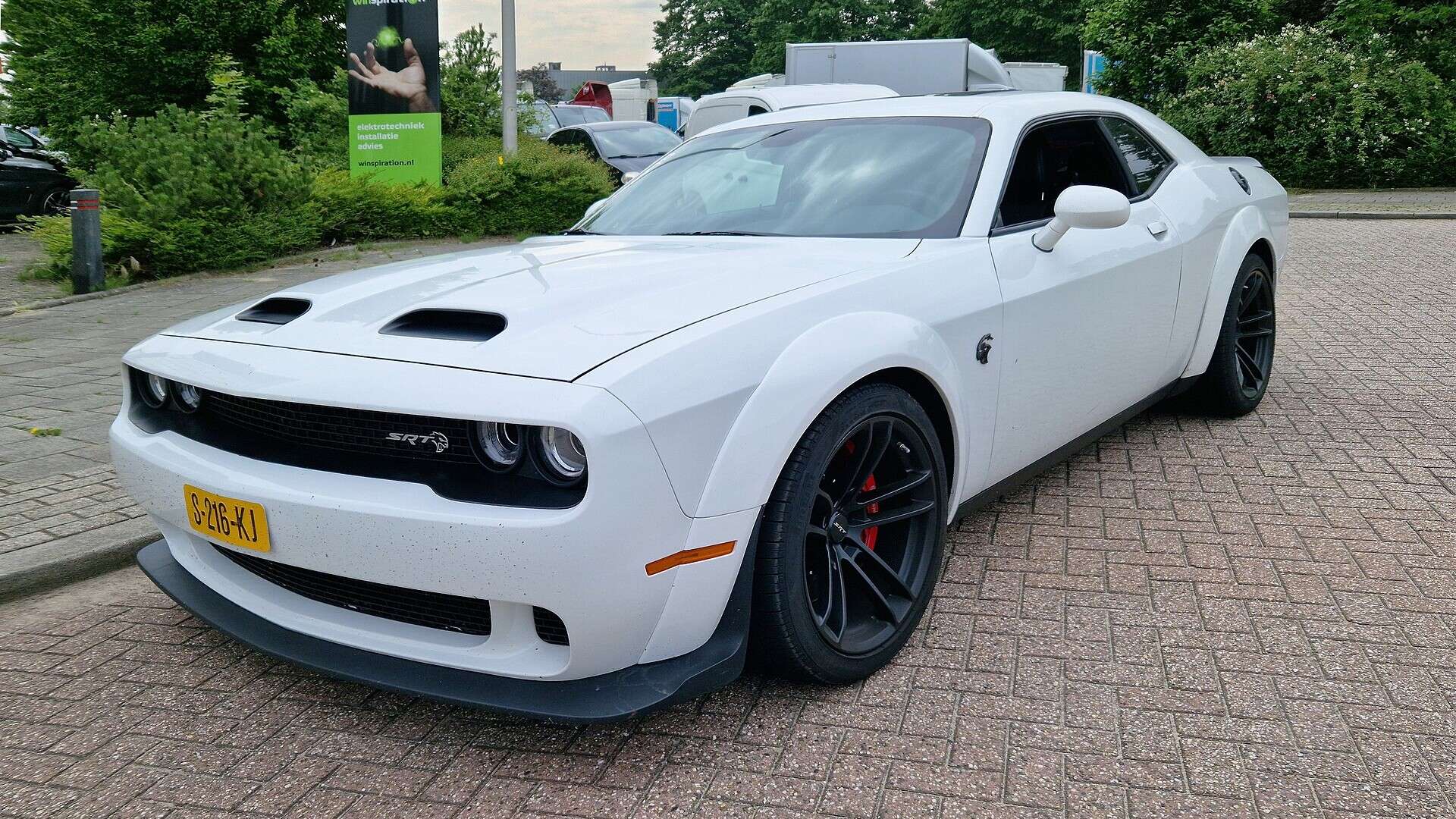
At about 3:12 a.m. on Thursday, Oct. 1, an Auburn, Massachusetts, police officer clocked two Dodge Challengers doing 60 mph in a 40 mph zone on Washington Street. When Officer Lareau tried to pull them over, both drivers took off at well over 100 mph, and he let them go. Both cars, police later said, were stolen.
The Auburn Police Department’s Oct. 6 account credits that decision not to chase for how the night ended: two arrests, made by officers who were waiting for the car rather than following it. It also shows how little Massachusetts law says about the act of running. Refusing to stop for a uniformed officer is a violation of Chapter 90, Section 25 of the General Laws, and the penalty written there is a $100 fine. Legislators have filed bills to change that in at least four sessions since 2017, and every one ended in a study order.
Stop sticks on the way back into Auburn
According to the department, Lareau backed off and put the cars out over the radio rather than start a high-speed pursuit. Officers from neighboring departments kept track of the Challengers. One crashed, its driver climbed into the other, and that car kept going. Then the radio traffic said it was headed back toward Auburn.
Auburn officers set up ahead of it instead of chasing it. Once the Challenger was back in town, Officer Hemingway laid out stop sticks and flattened its tires. In the department’s words, “the Challenger was considerably less challenging without air in the tires.” It crashed a short distance later, and both people inside ran.
Officer Ljunggren and K9 Biza tracked on foot while Officer Laskes flew the department’s drone, and Auburn officers and Massachusetts State Police set up a perimeter. Police said Biza followed a trail through the woods to one person hiding behind a business on Route 20. The second was found nearby. The department’s post does not say where the first Challenger crashed or which neighboring agencies followed the cars.
An 18-year-old charged, and released on GPS
Police arrested an 18-year-old Worcester man, Jaelen Cannon Feraud, and a 16-year-old from Worcester whom they did not name. The department said Cannon Feraud’s charges include failure to stop for police, negligent operation, operating with a suspended license, possession of burglarious tools and receiving a stolen motor vehicle. The 16-year-old is also facing charges, police said, without listing them.
MassLive reported, citing court records that list him as Jaelen Markenzy Cannon-Feraud, that he pleaded not guilty to seven charges at his arraignment in Worcester District Court on Oct. 1. The judge released him on personal recognizance with conditions, including a GPS monitor and an order to stay away from the victims and witnesses, according to that report. Neither the police post nor the MassLive report named a defense attorney or a next court date. The charges are accusations, and he has not been convicted of anything.


The release without cash bail follows the default in the state’s bail statute. Chapter 276, Section 58 says a judge shall release a defendant on personal recognizance unless the judge finds that release will not reasonably assure the person returns to court, and any bail must account for the defendant’s financial resources. The same section lets the judge attach restrictions as a condition of release. The GPS monitor and the stay-away order are those restrictions.
What each Massachusetts charge carries
The heaviest exposure in this case comes from the cars, not from the running. Receiving a stolen motor vehicle under Chapter 266, Section 28 carries up to 15 years in state prison, up to 2½ years in a jail or house of correction, or a fine of up to $15,000, or a fine plus imprisonment. A conviction, or a juvenile delinquency finding on the same charge, also requires the Registry of Motor Vehicles to revoke the person’s license immediately. An appeal does not pause the revocation, and the registry cannot reinstate the license for one year on a first offense, or five years on a second.
Negligent operation, under Chapter 90, Section 24, covers driving recklessly or negligently enough to endanger the public. A first offense carries a fine of $20 to $200, two weeks to two years in jail, or both. The registrar revokes the license, and no new one can issue for 60 days after the conviction, or 180 days for a junior operator.
The burglarious tools statute, Chapter 266, Section 49, carries up to 10 years in state prison. It was written around breaking into buildings, safes and vaults. Its only clause naming cars covers a master key designed to fit more than one motor vehicle, carried with intent to steal. Auburn police did not say what tools they found.
Then there is Section 25. The $100 fine is the same whether a driver rolls a few hundred feet before pulling over or, as police describe here, leaves a 3 a.m. speeding stop at more than 100 mph. Prosecutors can reach the danger of the driving through negligent operation, which tops out at two years. Massachusetts has no separate crime for fleeing police in a car whose penalty rises with how dangerous the flight was.
Four eluding bills on Beacon Hill, four study orders
Rep. Josh Cutler of Duxbury filed “An Act relative to failure to yield to police pursuit” in 2017 as H.759 and again in 2019 as H.3270. The 2019 text would have added a penalty of up to 2½ years in a house of correction and a fine of $1,000 to $10,000 for a driver who will not stop when pursued by an officer in a police vehicle with lights and siren on. The House sent the first bill to a study order on Aug. 9, 2018, and the second on Nov. 12, 2020.
Rep. William Galvin of Canton tried a different design. His “An Act relative to the reckless evasion of a police officer,” filed as H.1503 in 2023 and as H.1707 on Jan. 13, 2025, would create a new Section 25A for drivers who flee or try to elude police willfully or with wanton disregard for people or property. The bill counts causing property damage, or committing three or more moving violations while fleeing, as that kind of disregard. The penalty would be a fine of $100 to $1,000, six months to two years in jail, or both, plus a 60-day license suspension. H.1503 went to a study order on June 5, 2024. H.1707 followed on March 26, 2026.
Cutler’s bill attached the penalty to a driver who keeps going while being pursued by a cruiser with lights and siren. Auburn’s officer did not pursue, and departments that adopt no-chase rules are trying to create fewer of exactly those pursuits. A penalty that applies only once a chase begins does nothing for the departments that decline to start one. Galvin’s version keys on the flight and the driving, which is closer to what the Auburn post describes. That bill sits in a study order for a session that ends this year, so any version would have to be refiled when the next two-year session opens in January 2027.
Why a speeding stop no longer justifies a chase
Lareau’s call matches what the national police-executive guidance now recommends. A 2023 guide written by the Police Executive Research Forum for the Justice Department’s COPS Office, with NHTSA as a partner, recommends that agencies allow pursuits only when a violent crime has been committed and the suspect poses an imminent threat to commit another. The guide says more than 90 percent of pursuits start with traffic violations. It cites NHTSA crash data showing pursuit-related deaths rose from 382 in 2015 to 532 in 2020, a 39 percent increase. Under that standard, a 60-in-a-40 stop does not justify a chase, and neither does a stolen car on its own.
The Auburn arrests also depended on the drivers’ route: officers caught these two because the car came back into town, where they had set up ahead of it. In May, police in Moorhead, Minnesota, made a similar call, and the stolen car they let go ended up in a golf course pond. A no-chase policy depends on what officers can do after the fact: radio relays, stop sticks placed ahead of the car, dogs and drones. Under current Massachusetts law, the flight they let go is itself worth a $100 fine.
Dodge’s HEMI cars and the theft numbers behind them
Challengers and Chargers have been near the top of insurance theft data for years. The Highway Loss Data Institute, the insurance industry’s loss-research arm, reported on Aug. 31, 2023 that 2020–22 Dodge Charger HEMI models had a whole-vehicle theft claim frequency of 2,197 on a scale where 100 is the average for all vehicles, nearly 22 times average. The Challenger came in at 766.
Dodge responded with software. On March 22, 2021, the brand announced a free update for 2015–2021 Challenger SRT and Charger SRT models with the 392 or supercharged 6.2-liter HEMI, and for 2019–2021 Scat Packs with the 392. With an owner-set four-digit code, the engine is held to idle, 675 rpm, which Dodge said produces about 2.8 horsepower. Dodge said the feature would help prevent police evasion and high-speed chases of stolen vehicles. Auburn police did not release the model years or trims of the two Challengers, so there is no way to tell from the record whether either was eligible for the update or had it installed. The Auto Wire has covered the gaps in that update’s eligibility list before.
The owners get back two crashed cars. One Challenger crashed during the flight, and the other crashed after running over stop sticks. Theft and the damage that comes with it typically fall under comprehensive coverage, so the claim, and whatever it does to a renewal, lands on owners who were nowhere near the wheel.
What happens next in Worcester
Cannon Feraud’s case is in Worcester District Court, and the release conditions MassLive reported include GPS monitoring while it is pending. The 16-year-old’s case proceeds as a juvenile matter, and The Auto Wire is not naming him. If either is convicted of, or found delinquent on, the receiving charge, the license revocation in Section 28 follows automatically, and that penalty outlasts any fine.
For other drivers in the state, the law is unchanged: Section 25 applies when a uniformed officer signals a stop, whether or not anyone chases, and dangerous driving after the signal is charged separately as negligent operation, with a 60-day minimum before a new license can issue after a first conviction. Whether running from the stop itself should carry jail time is a question the next Legislature can take up only if someone refiles.
Should fleeing a police stop in Massachusetts become its own crime with jail time and a license suspension, or should the state keep the $100 fine and let charges like negligent operation carry the weight while departments decline to chase?