
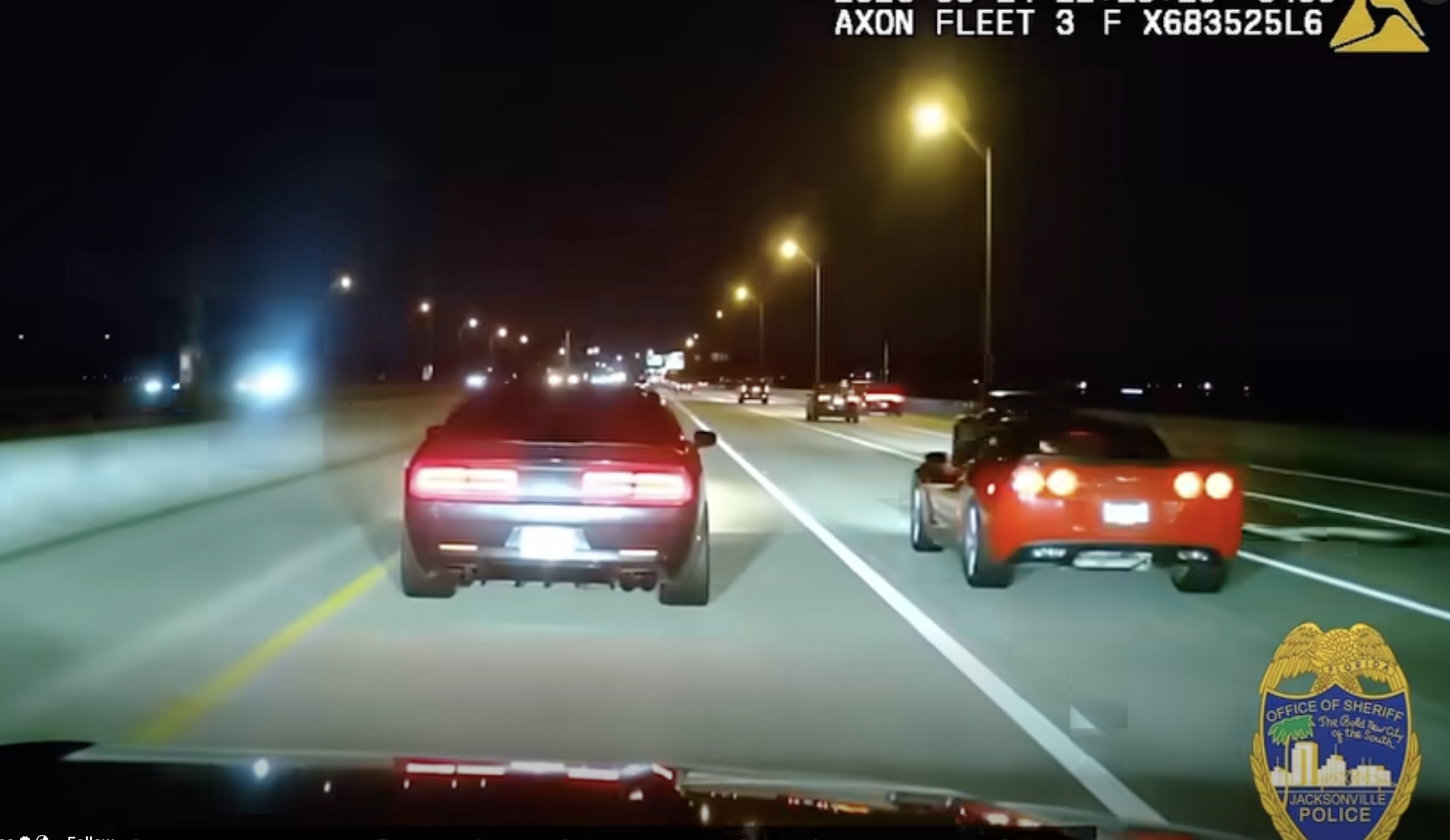
Quashay Frazier Jr. lost a drag race on the Buckman Bridge in Jacksonville on a Friday night. He did not lose his driver’s license because he was doing 120 mph. He lost it because he raced. That distinction sounds like a technicality. It isn’t. It’s the actual story here, and it’s the part almost nobody covering this arrest has bothered to explain.
Jacksonville Sheriff’s Office released the video this week, and it plays like a car-guy fever dream gone wrong. Officer Ernesto Valerio, with JSO’s Specialized Traffic Enforcement Unit, was cruising the bridge in an unmarked SUV when he pulled up behind a Dodge Challenger and a red Corvette running side by side, blocking both lanes. One driver hung an arm out the window and gave the signal. Both cars took off. “Oh, and they’re racing now, right in front of me,” Valerio says on the recording, sounding almost delighted. He caught up, pulled the Challenger over, and made the arrest. The Corvette got away clean.
Frazier, 22, was booked on a felony and multiple misdemeanors, including counts of super speeding and racing. The arrest was one of eight made across Jacksonville that Friday and Saturday as part of a weekend operation the agency is calling Operation Double Down. JSO says more than 100 people have died on the city’s roads so far this year, with speed and impaired driving among the leading factors. That’s the backdrop for this crackdown, and it’s a real one.
Here’s the part that matters to anyone who owns, insures, or covets a fast car in Florida, or anywhere lawmakers are eyeing a similar crackdown: the “super speeder” label is doing almost none of the legal heavy lifting in this case.
Florida’s dangerous excessive speeding statute took effect on July 1, 2025, and it’s the one that generated a wave of local coverage under the Super Speeder nickname. Auto Wire covered an earlier case out of St. Johns County involving a Corvette clocked at 130 mph in a 45 zone. The law makes it a crime, not just a ticket, to drive 50 mph or more over the posted limit, or 100 mph or more in a way that endangers people or property. Frazier’s 120 mph easily clears that bar. But read the penalty section closely: a first conviction carries up to 30 days in jail, a $500 fine, or both. That’s it. No license suspension is triggered automatically. On a first offense, Florida’s flashy new statute is, relatively speaking, gentle.
The racing charge is a different animal, and it’s been sitting on Florida’s books since 1971. Under the state’s racing-on-highways statute, a first conviction carries a fine of $500 to $2,000 and a mandatory one-year revocation of the driver’s license, automatically, with a hearing available only to contest it after the fact. There’s no equivalent grace period the way there is for simple excessive speed. Challenge a stranger to a race on a public road in Florida and the state takes your license for a year on the very first offense. That’s the charge doing the real damage here, not the one with the catchier nickname.
There’s a second detail buried in that same statute that ought to make car-content creators nervous. Florida lawmakers rewrote the racing law in 2024, adding formal definitions for street takeovers, burnouts, doughnuts, and coordinated takeovers involving ten or more vehicles. Tucked inside that rewrite is a section making it illegal to simply be a spectator at a drag race or takeover, punishable by a $400 fine. The statute spells out how prosecutors can prove someone was a spectator rather than an innocent bystander: whether they were filming the event, and whether they posted it to social media. The law was written with an eye toward the exact behavior that turns street races into viral content in the first place. Point a phone at a takeover and upload the video, and Florida’s statute has already anticipated you.
Keep racing, and the consequences escalate past inconvenience. A second offense within a year becomes a third-degree felony. A vehicle used in a coordinated takeover can be impounded for 30 business days on the spot, and if the same registered owner is caught again within five years, Florida can seize and forfeit the car outright under the state’s Contraband Forfeiture Act, the same legal tool used to permanently take property from drug traffickers. The Auto Wire has covered plenty of impound stories over the years, including a Mustang and a Camaro pulled off a Florida road for racing and hit with $736 fines apiece. What’s changed since then is how much further the law now reaches: past the driver, past the car, and into anyone who shows up to watch.
None of this stays inside the courtroom. A racing conviction is the kind of thing insurance carriers file under “major violation,” in the same tier as a DUI or reckless driving, not a garden-variety speeding ticket. That typically means non-renewal at the next policy cycle and a multi-year stretch shopping the high-risk market, where premiums run several times higher than standard coverage, assuming a carrier will write the policy at all. Auto Wire recently broke down how insurers, not regulators, are increasingly the ones deciding which cars and driving habits get treated as dangerous. A street racing conviction is about as fast a way as exists to land on that list.
The unmarked SUV matters too. Traffic units running plainclothes vehicles specifically to blend into the kind of traffic street racers look for is a tactical shift, and it’s a direct response to how this activity has evolved. Racers no longer just happen to line up at a stoplight. They coordinate meetups over social media, sometimes bringing ten or more cars to shut down an intersection or a stretch of highway on purpose, which is precisely the behavior lawmakers named and criminalized by writing “coordinated street takeover” into the statute for the first time last year. Police adapting their patrol tactics to match how a crime is now organized is its own small story about how thoroughly social media has restructured car culture, for better and for worse.
Frazier’s Challenger lost the race. What comes of the felony count JSO hasn’t detailed will show up eventually in court records, not in a press release. None of that is really the point. The point is that Florida spent the last two years quietly building a legal structure where a ten-second decision on a bridge can cost a driver a license for a year, a car for a month or forever, and an insurance rate for half a decade, and the law getting all the attention isn’t the one doing most of that work. The quarter mile ends in seconds. Everything the state attaches to it doesn’t.