
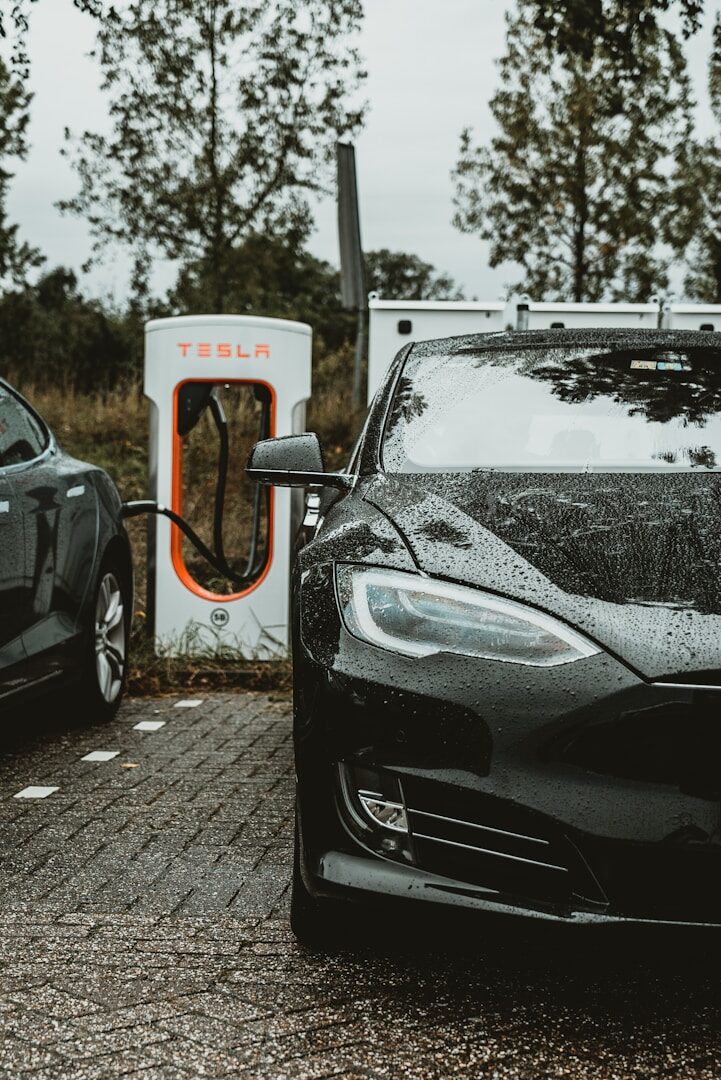
A 64-stall Supercharger is going up in Maspeth, Queens, and the framing everywhere is that it’s a mega-stop for people driving out to Montauk. That framing is wrong, and the reason it’s wrong is more interesting than the stall count.
Start with a correction, though, because the number being passed around doesn’t survive contact with Tesla’s own website. The site everyone is calling the East Coast’s biggest — Halifax, North Carolina, at 10401 NC-903 — is listed by Tesla at 60 Superchargers, up to 325 kW, not 68. Stall counts drift as Tesla expands sites, so treat any “ties for largest” claim with a raised eyebrow. What’s not in dispute is that 64 stalls in New York City is an outlier by a mile.
What 64 stalls actually means in hardware
Tesla publishes the specifications for its current generation, and the numbers explain the site layout better than any drone photo. A V4 cabinet puts out up to 1,200 kW shared across eight posts, with each post rated to 500 kW, 615 amps continuous, and a 0–1,000 VDC range. The older V3 cabinet managed 387 kW across four posts.
Related Articles
- A Robot Didn’t Kill This Stellantis Mechanic. A Bypass Key Did, and OSHA Predicted It Decades Ago.
- China’s EV Price War Got So Brutal, Automakers Are Bribing You With Karaoke Machines Now
Sixty-four is exactly eight V4 cabinets. That’s not a coincidence — it’s the natural build unit. Which also tells you the “64 to 68” range you keep seeing is soft: 68 would require a ninth cabinet running half-empty, and nobody spends that money without a reason.
Eight cabinets at full tilt is 9.6 megawatts. That is office-tower territory. In practice, the site will never see it — power sharing across eight posts per cabinet means the cabinet allocates what cars can actually accept, and a bank of Model Ys tapering off past 50 percent state of charge collectively pull a fraction of nameplate. But the utility still has to be able to serve the worst case, and in New York City that’s the entire ballgame.
The utility problem nobody covers
Here’s the detail that should have been the headline. Con Edison’s PowerReady make-ready program — the thing that has been paying for the utility-side infrastructure behind commercial charging in the five boroughs and Westchester — is not accepting new applications. Level 2 applications closed on April 22, 2026, and DC fast charging applications are paused until further notice, with existing projects sitting on a waitlist in date order.
Read that alongside a 64-stall build going vertical in Queens and the picture sharpens. Either Tesla got into that queue early, or it is paying for the interconnection itself. Neither is a small check. In dense urban work the make-ready — service entrance, transformer, conduit, vault coordination — routinely dwarfs the cost of the charging hardware sitting on top of it.
Then there’s the operating side, which is where most DC fast charging businesses quietly bleed out. Commercial electric rates are built around demand charges: you pay for your single highest 15-minute peak, every month, whether you hit it once or a thousand times. A charging site that’s empty at 3 a.m. and slammed at 6 p.m. has a terrible load factor, and the demand charge lands on a small pile of kilowatt-hours.
New York built a workaround. Con Edison’s EV Phase-In Rate introduces demand-based delivery charges gradually, scaled to how heavily the site is actually used. You qualify with a charging ratio of at least 50 percent or separately metered charging, and you graduate off the rate once your load factor hits 25 percent for four consecutive evaluation periods — two years. In other words, the state subsidizes your bill until you’re busy enough not to need it.
That subsidy structure is the single best explanation for why the site is 64 stalls instead of 12. Utilization is the metric that matters, and a site that fills up is a site that pencils.
Who’s actually going to fill it
Now the part that gets missed. New York’s Taxi and Limousine Commission publishes an annual license review, and the February 2026 edition says the for-hire fleet contains 13,115 EVs, up from 12,415 a year earlier. It also notes plainly that TLC drivers make up a large share of the city’s EV drivers and charging users, and that the Green Rides Initiative requires high-volume bases to dispatch 25 percent of trips in 2026 to wheelchair accessible vehicles or EVs — a target the agency estimates may require roughly 1,000 additional EVs beyond normal fleet turnover.
That program traces back to the Green Rides rule the TLC passed in 2023, committing the city’s entire rideshare fleet to zero-emission or wheelchair accessible by 2030.
Now think about who those drivers are. They live in apartments. They do not have a garage, a 240-volt outlet, or a landlord who wants to hear about either. They drive 200-plus miles a shift. Every electron they use comes from a public DC fast charger, and they need it in the middle of a workday, not overnight.
That’s a customer who plugs in multiple times a day, seven days a week, in the outer boroughs. It’s the load profile that fixes the load-factor math. Weekend Hamptons traffic is a rounding error next to it.
Perspective on how bad it’s been
To understand the scale of the jump, look at what New Yorkers have now. Tesla’s Flushing site at Queens Crossing is four stalls at up to 72 kW, and it isn’t even open around the clock — the listing shows 6:00 to 23:59. Out on Long Island, Garden City offers 16 stalls at up to 325 kW. Those are the options.
Related Articles
- Musk Says Tesla Builds America’s Most American Car. His Own Truck Skipped the Test
- Medford Takeover Bust: Why Seven Seized Cars May Never Come Home
Globally, Tesla’s Q2 update counted 8,704 stations and 82,357 connectors, with more than 2,400 net new stalls added in the quarter and 17 percent connector growth year over year. New York City has been getting a laughably thin slice of that. One 64-stall site changes the city’s fast-charging picture more than the previous five years of four-plug installations combined.
Practical notes for anyone who’ll use it
If you drive an EV in the metro area, a few things worth internalizing. Peak demand at a site like this will track rideshare shift patterns, not commuter patterns — expect it busiest in late morning and late afternoon, and expect it quiet on Sunday morning. Congestion fees on Tesla’s network are real and are billed per minute once a site is busy, so treat a full bank as a reason to leave at 80 percent rather than a reason to sit.
And if you’re a for-hire driver doing the math on Manhattan runs, remember the TLC has documented a $1.50 congestion surcharge on high-volume trips into the central business district versus $0.75 for yellow cabs. Charging in Queens and working the outer boroughs is looking more rational every quarter.
The stall count is the fun number. The utility interconnection, the phase-in rate, and 13,115 electric for-hire vehicles with nowhere to plug in at home are the actual story.