

The fine for missing the new Corporate Average Fuel Economy (CAFE) standards is zero dollars. Congress set it there in July 2025, starting with 2022 models. The final rule Transportation Secretary Sean Duffy announced Monday simply writes that zero into federal regulations. Yet you won’t find that detail in the Transportation Department’s announcement, which leads with $1,300 in savings per vehicle.
So the number getting all the attention is, for now, a target with nothing behind it. That’s a fleetwide requirement of roughly 34.9 mpg for 2031, down from the roughly 50.4 mpg projected under the 2024 rule. The provision most likely to outlast that number sits more than 700 pages into the National Highway Traffic Safety Administration’s 892-page final rule. It settles a question the agency looked at and shelved in 2010 and 2012.
What, exactly, is a truck? Washington has been putting off that question for decades.
Starting with the 2030 model year, a fold-flat third row no longer makes a vehicle a light truck. Neither does all-wheel drive plus a little extra ground clearance. To stay a truck, an SUV or crossover will need real off-road geometry. Or it will need payload and towing ratings that add up to at least 8,500 pounds. Pickups keep their status thanks to their beds. The Transportation Department expects the regulated fleet to flip from roughly 70 percent trucks to roughly 70 percent cars.
The rule, which covers model years 2022 through 2031, also ends trading of CAFE credits earned from 2028 on. The mpg targets are the part that keeps changing: Washington has rewritten them four times since 2020. The rules for sorting cars from trucks have barely moved since 1977, and they’ve been quietly deciding what sits in American driveways ever since.
A 1977 rule for vans, applied to crossovers
CAFE standards have always treated new vehicles as two fleets. One is passenger cars. The other is “non-passenger automobiles,” which everyone outside a federal agency calls light trucks. NHTSA wrote the sorting rules in 1977, based on a 1975 market in which trucks made up 19.3 percent of new light-duty vehicles. Today, by NHTSA’s count, the figure is 64.7 percent.
The three-row provision is a perfect fossil. In 1977, NHTSA let passenger vans count as trucks because their seats came out and they shared the chassis, springs and suspension of cargo vans. A buyer could have bought the cargo version instead. Over time, that became a broader rule. Give a vehicle three standard rows and seats that fold flat or come out, and it could be a truck.
NHTSA now points out that today’s light-duty fleet has no cargo-van twins. It does, however, have a whole lot of three-row crossovers. The agency’s new position is blunt: three rows of seats are evidence that a vehicle was built to carry people. It says it received no substantive comments on dropping the provision.
The approach angle that gave the game away
The off-road pathway aged even worse. Under current rules, a vehicle with four-wheel drive or a gross vehicle weight rating above 6,000 pounds can qualify. It just has to pass four of five clearance measurements, and all-wheel drive counts. NHTSA examined 2024 models that got in by passing exactly four. It found 98.9 percent had failed the same one: the 28-degree approach angle. That’s the measure of how steep an obstacle the nose can meet before the bumper hits it. In fact, two-thirds had approach angles under 20 degrees, shallower than the minimum the rule sets for the back of the vehicle.
NHTSA’s conclusion is hard to argue with. Most of today’s light trucks, it writes, are built to move people but carry “additional features solely to meet regulatory definitions.” One example, by NHTSA’s account: after a 2009 reclassification, automakers dropped front-drive versions so all-wheel-drive-only models could stay in the truck fleet. We covered that history when the proposal surfaced.
The agency saw it coming, too. In 2012, NHTSA acknowledged that automakers might make “more deliberate redesign efforts” to move vehicles into the truck fleet “in order to obtain the lower target.” But “no one can predict with certainty how the market will change between now and 2025,” it wrote. So it kept watching. By 2024, trucks were nearly two-thirds of the market.
How the new CAFE standards define a truck: pull, carry or climb
From model year 2030, a vehicle stays a light truck only by showing capability, not equipment:
- An open bed. Pickups are untouched.
- Real off-road geometry. Four-wheel drive or a GVWR above 6,000 pounds, plus all four of these, not four of five: an approach angle of at least 28 degrees, breakover of 14, departure of 20 and running clearance of 20 centimeters (about 7.9 inches). Axle clearance drops out.
- Real work capacity. A new “light-duty work factor” adds payload (GVWR minus curb weight) to the trailer weight rating determined under the SAE J2807 towing standard. At 8,500 pounds or more, it’s a truck.
A few old paths survive, including seating for more than 10, living quarters, or more cargo room than passenger room, as in a cargo van.
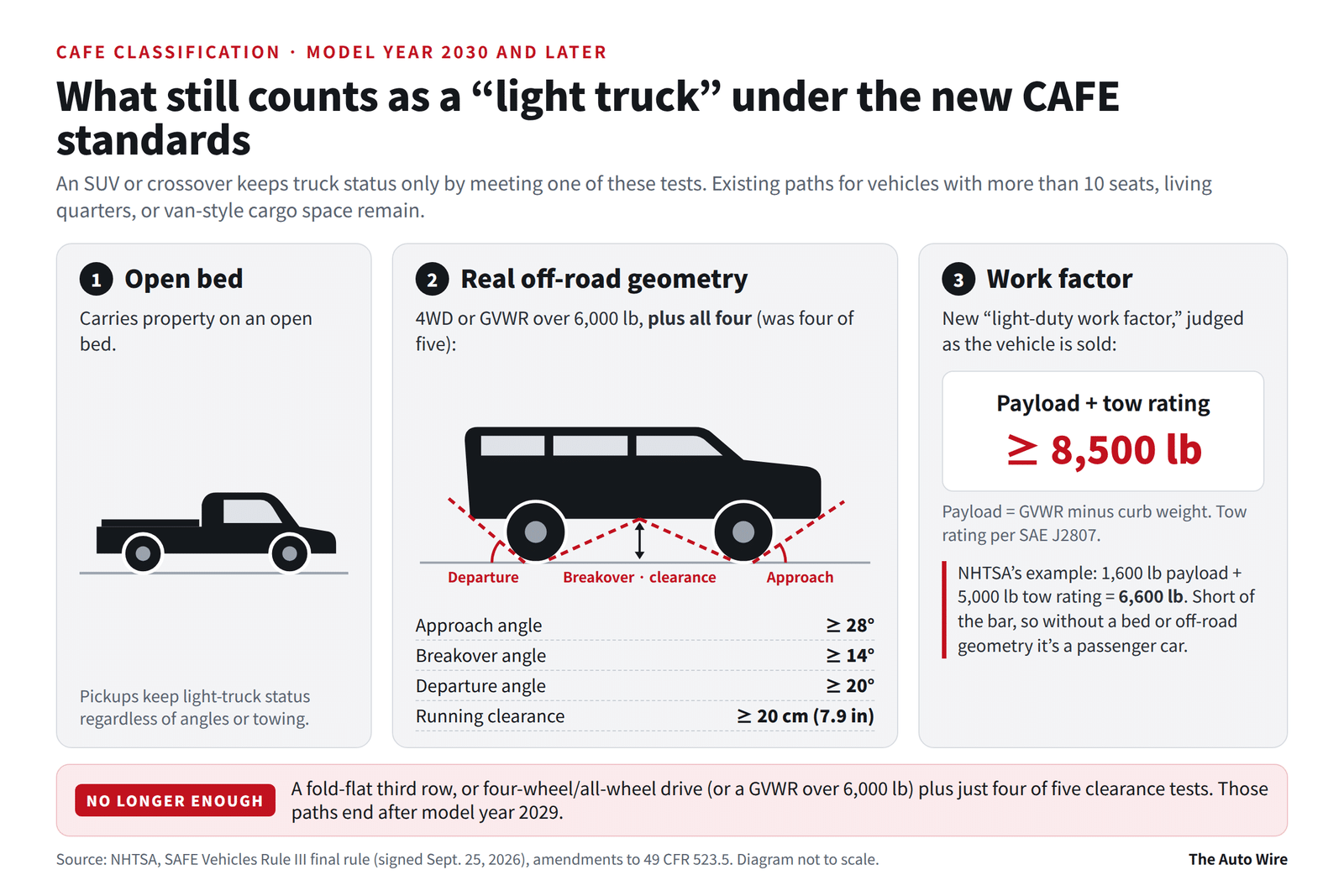
Run the example NHTSA uses in the rule itself: 1,600 pounds of payload and a 5,000-pound tow rating add up to 6,600. Without a bed or genuine off-road geometry, that’s a passenger car. Now consider the Dodge Durango, a three-row SUV that Dodge says can tow up to 8,700 pounds when properly equipped. A properly equipped one clears the bar on towing alone.
The test looks at what a vehicle can actually pull, carry or climb, rather than the equipment it comes with. There’s a catch in the wording, though. The work factor is judged “as sold to the first retail purchaser,” which turns the tow package into a classification device. NHTSA’s analysis assumes automakers won’t strip trailering equipment from vehicles designed to carry it. History says automakers design to whatever the definition rewards. If fines ever return, a standard hitch could become the new standard all-wheel drive.
What the new CAFE standards change on paper, and what they don’t
Reclassification does strange things to the numbers. In NHTSA’s own tables, the light-truck requirement falls from 30.6 mpg in 2029 to 26.2 mpg in 2030. Yet no truck gets thirstier. The category simply loses its commuter crossovers and keeps its pickups, off-roaders and haulers. That same year, the combined requirement jumps from 32.6 to 34.6 mpg. That’s because more vehicles land in the car column, and CAFE’s footprint-based car targets run higher than truck targets for a vehicle of the same size. When commenters noted that the shuffle provides “no stringency benefit at fleet level,” NHTSA’s response was unusually candid: “This assessment is correct.”
The calendar moved, too. NHTSA originally proposed reclassifying vehicles for 2028. Porsche and Subaru told the agency that wasn’t enough lead time. Kia, Stellantis and Subaru pointed to the law’s 18-month notice requirement for tougher standards. The final rule pushes every classification change back two model years, to 2030, which puts it on the far side of the 2028 election.
With the fine at zero, none of this costs an automaker anything today. Its bite comes later, if at all. The 2025 law that zeroed the penalty also capped the Transportation Secretary’s power to raise it at $0.00. Only Congress can bring it back. If Congress does, the crossover-heavy lineups of the 2030s get graded on the tougher car curve. Meanwhile, pickups and SUVs with real tow ratings keep the truck curve.
An old definition that still costs money
Definitions also tend to stick around. Consider the one federal charge tied to a new car’s fuel economy that still costs real money. With CAFE fines at zero and EPA’s vehicle greenhouse gas rules erased in February, that’s the Gas Guzzler Tax. Congress created it in the Energy Tax Act of 1978. It charges $1,000 to $7,700 on passenger cars rated below 22.5 mpg. It has never applied to pickups, SUVs or minivans, and its brackets haven’t changed since 1991.
So how does the IRS decide what counts as a truck for that tax? By NHTSA’s definition as it stood on Nov. 9, 1978. The Treasury regulation says so in as many words, and NHTSA confirms that nothing it changes now will have any bearing on it. Come 2030, a three-row crossover could be a car in NHTSA’s eyes while the tax code keeps judging it by a rulebook older than Chrysler’s first minivan.
The new definition is also already spreading beyond the CAFE standards. NHTSA says EPA intends to use the revised criteria to define a “light-duty truck” in its own emissions rules beginning in 2029. (NHTSA adds that under EPA’s proposal, the key tailpipe pollutant limits would be the same for cars and trucks by 2030.)
What else the rule changes
The truck definition gets the least attention, but it isn’t the only change. Starting with model year 2028, NHTSA ends CAFE credit trading, which the agency describes as a subsidy that propped up EV makers at legacy automakers’ expense. Under the old system, a company that beat its target, usually an EV-heavy brand, could sell surplus credits to one that fell short. For an EV-only automaker, that was revenue with almost no cost attached. With the fine already at zero, there was little reason left to buy those credits. The rule makes that permanent.
The rule also leans on NHTSA’s June 2025 interpretive rule, which said the previous administration broke the law by factoring electric vehicles into how it set the standards. The legal argument is that the statute bars NHTSA from considering EVs when it decides what fuel economy level is “maximum feasible.” Assume a healthy share of EV sales and the achievable number goes up on paper. Take them out of the modeling and it comes down, which helps explain how the 2031 projection fell from about 50.4 mpg to 34.9.
One figure in DOT’s release deserves some skepticism. The department says yearly U.S. oil consumption in 2050 will be about 1.3 billion barrels lower than in 2024. That compares the future against today, not against what the country would have burned under the rules being replaced. A fleet that slowly turns over to newer vehicles would use less oil over 25 years under almost any standard. The comparison that actually matters, 34.9 mpg against 50.4 mpg, is in the regulatory impact analysis, not the press release.
For owners who keep cars a long time, there may be an upside. Less pressure on fleet averages removes one reason automakers have been piling on turbochargers, cylinder deactivation, stop-start systems and 10-speed transmissions. That hardware won’t vanish quickly, because global platforms still have to meet rules in Europe and China. But a U.S. lineup with fewer complex fuel-saving parts could mean fewer expensive repairs once the warranty runs out.
What to watch
None of this changes the window sticker on anything you can buy today, and NHTSA stresses that the reclassification requires no redesigns. If you want to know what the lower target means for your fuel bill, that math deserves its own look. But if you want to know what the American lineup looks like in 2035, watch the definition, not the mpg. Automakers spent 20 years engineering around the truck definition, not the mpg number. Expect them to start on the new one about the time the ink dries.
Where do you land? Should a three-row crossover that never leaves the pavement be graded as a car, or has it earned truck status after years of hauling families, gear and campers? Tell us in the comments.