
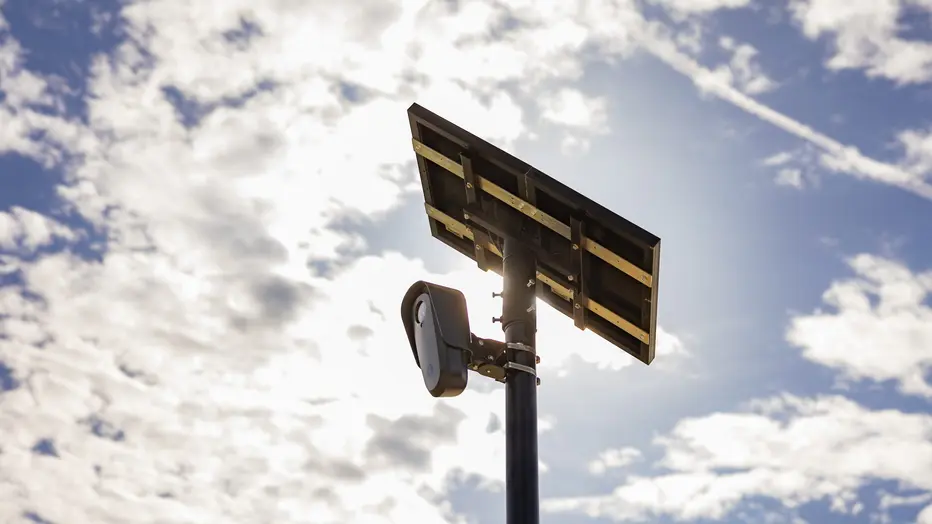
Ban every police license plate camera in Florida tomorrow, and your car does not become any less visible. It just becomes visible to someone else.
That’s the wrinkle missing from Ron DeSantis’s sudden war on automated license plate readers. Speaking at Florida International University this week, the governor called the state’s network of roughly 7,500 plate-scanning cameras “out of control” and asked the Legislature to consider an overhaul, possibly modeled on New Hampshire’s ban on installing the devices along public roads. He brought up a case that would unsettle anyone: a Florida police officer allegedly used the Flock Safety network to track his estranged wife. “What the hell’s going on with this?” DeSantis said.
He’s not wrong to be alarmed. He’s just alarmed about the wrong owner.
A Fight Over the Public Half of the Network
DeSantis’s target is the law enforcement side of the plate-reading business: the roughly 100 Florida police and sheriff’s departments running Flock cameras, part of a national network the company has pushed past 100,000 units. His proposed fix borrows from New Hampshire, one of the only states that bans fixed roadside plate cameras outright, and leans on his stalled “AI bill of rights,” legislation the Florida Senate passed earlier this year but the House wouldn’t touch. It’s a real policy fight, and it may produce a real bill. The Auto Wire has tracked this network’s public failures for months, including a Georgia sheriff’s deputy fired for secretly keeping two years of plate data he had no business holding, and a Massachusetts officer accused of running 259 warrantless searches on an ex. Those are legitimate scandals. They are also just the visible tip of the iceberg.
The invisible part is bigger, runs with no police oversight at all, and won’t disappear no matter what Tallahassee decides.
The Cameras Nobody in Tallahassee Can Touch
Flock is getting all the political heat because it dominates the police market. But police departments were never the only customers for automated plate reading, and they may not even be the largest one. Motorola Solutions, through its Digital Recognition Network unit, mounts plate-reading cameras on tow trucks and repossession vehicles and lets them roam the country. According to the American Civil Liberties Union, that fleet generates a claimed 500 million plate reads a month with no vendor-imposed retention limit, and Motorola sells access to it not only to police, but directly to auto lenders and insurers, for repossession leads and for what the industry calls “risk assessment.”
Read that twice. A private company can log your car’s location every time it passes a participating tow truck, then sell that pattern of movement to the same industries that help set your insurance premium and decide whether your lender sends someone to take your car back. No warrant required, because no government is involved. No police reform bill touches it, because no police department has to be the customer. The Auto Wire covered a version of this fight in California, where a tow-truck-mounted network that has scanned 9 billion plates survived a court challenge almost untouched. DeSantis’s proposed legislation, aimed squarely at police procurement, would not slow that network by a single camera.
Your Tires Are Already Talking
Here’s the part that should bother car people specifically, and it has nothing to do with Flock.
Since the 2000 TREAD Act, passed after the Ford Explorer and Firestone tire failures triggered a wave of rollover deaths and one of the largest tire recalls in U.S. history, federal law has required tire pressure monitoring systems on new passenger vehicles. NHTSA’s first version of that rule, issued in 2002, was so weak on detection thresholds that a federal appeals court vacated it a year later. The agency’s do-over, FMVSS 138, took effect in 2005 and was phased in through the 2008 model year. It was, and still is, a genuinely good safety rule.
What nobody designed TPMS to do was announce a car’s identity to strangers. But TPMS sensors talk to the rest of the vehicle over a low-power wireless signal, and at least one plate-reading competitor, Leonardo’s ELSAG system, advertises the ability to read those wireless emissions right alongside the plate itself, according to the ACLU’s review of the ALPR market. The same capability can pick up a phone, a tablet, or anything else broadcasting a wireless ID from inside the cabin. A regulation written to stop rollovers has become, as a side effect nobody voted on, one more way to fingerprint a car that never drove anywhere near a Flock camera.
That’s not a Flock problem. Banning every camera like it does nothing to that capability. It’s built into radios the federal government already requires every car to carry.
Why the Fix Keeps Being Cosmetic
Flock has spent the past month trying to look like it’s listening. The company has trimmed its standard data retention window, added an “Evidence Mode” for open cases, and let local departments restrict what other agencies can search their data for, amid what the ACLU has documented as a genuine nationwide backlash. Flock’s own comparison of camera bans to car bans didn’t hold up well under scrutiny, and its claimed 11 percent dent in nationwide car theft has drawn its own questions about what got left out of that number.
None of that changes the incentive underneath it. Flock has raised nearly $1 billion from venture investors, according to the ACLU, in a funding model that only pays off if the network keeps growing and keeps sharing data across departments. A camera company whose valuation depends on network size has little durable reason to shrink that network. Every retention cut it announces under pressure can be reversed, tightened, or quietly reinterpreted, because nothing in Florida law or most other state law requires otherwise. Even Flock’s own published evidence policy is a moving target: the version posted this week still describes its default retention period two different ways in two different sections, seven days in the FAQ, thirty days everywhere else.
What LoJack Got Right
There’s an old comparison sitting in front of this story, and it belongs to anyone who remembers buying a LoJack unit. LoJack asked you to opt in. You paid for it, a technician installed it, and it existed to help you get your specific stolen car back. You were the customer.
Flock, Motorola, and Axon flip that relationship. The car owner isn’t the customer. The car owner is the inventory. Nobody asks permission before your plate gets logged outside a grocery store, and unlike a credit report, there is no federally guaranteed right to pull your own file and see who searched it, when, or why. DeSantis’s proposed fix would let Floridians vote out the officials who buy this technology for their police departments. It does nothing about the private companies that were never on a ballot to begin with.
The Part Worth Remembering
DeSantis is picking a real fight, and Florida lawmakers should probably have it. But the debate as framed only regulates the customer everyone can see. The bigger customer, the one buying your movements to help set your insurance rate or send a tow truck to your driveway, isn’t in the room, doesn’t need a warrant, and won’t be affected by a single word of a police reform bill.
Ban the cop’s camera, and the repo man’s camera keeps rolling. That’s the story underneath the story.