
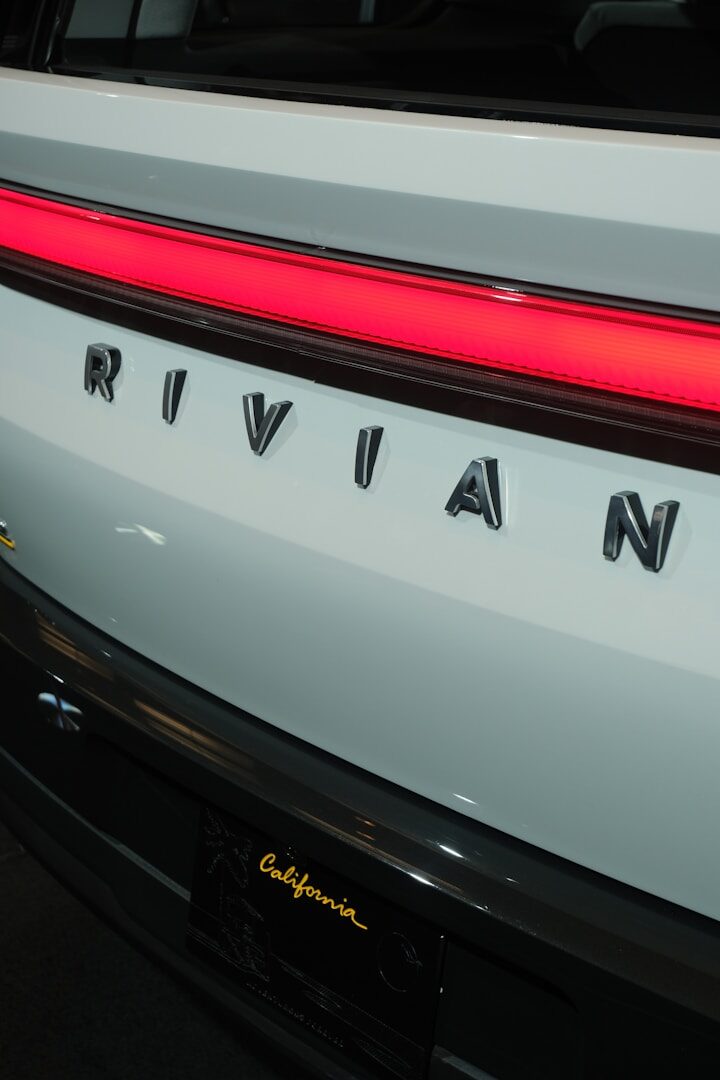
Claire McDonough is leaving Rivian on October 30. That’s the headline, and it’s the least interesting part of the story.
Rivian disclosed the departure in a regulatory filing on August 27, framing it as a move to pursue a new opportunity and relocate to the East Coast to be near family. Derek Mulvey, currently VP of finance and a J.P. Morgan alum who joined Rivian in 2021, is expected to slot in as interim CFO while the company runs an internal-and-external search.
The destination is the tell. GE Vernova said the same day that McDonough joins the power-equipment company in November and takes the CFO title on January 1, 2027, succeeding Ken Parks, who’ll advise into the first quarter and retire in April. She’s leaving a company that has never turned an annual profit for one that sells gas turbines and grid hardware into an electricity market being force-fed by data center construction.
What The Filing Language Actually Means
Worth knowing if you read these things: when a public company loses an executive officer, SEC rules under Item 5.02 of Form 8-K require disclosure within four business days. Companies routinely state that a departure wasn’t the result of any disagreement over operations, policies or practices, because the absence of that statement is itself a signal to the market. It’s boilerplate — but it’s mandatory boilerplate, and its presence is not evidence of anything beyond compliance.
Related Articles
- Stellantis Wants to Beam a Hologram Into Your Robotaxi’s Driver Seat. Here’s What It’s Not Telling You.
- VW’s Layoffs Could Hit 140,000. The Family That Controls the Company Already Wrote Off the Loss and Went Shopping for Drones
The two-month runway is the more useful signal. Executives who leave under pressure leave immediately. Executives who leave for a better job stay long enough to close the books cleanly. McDonough is walking out four weeks before Rivian’s third-quarter earnings, and her successor at GE Vernova is being handed a January 1 start date. That’s a negotiated handoff, not a fire drill.
The Numbers She’s Handing Over
Here’s where it gets genuinely interesting for anyone who owns a Rivian, has one on order, or is thinking about a used R1T.
Rivian’s second-quarter results show consolidated revenue of $1.658 billion, up 27 percent, with gross profit of $179 million and an 11 percent gross margin. Read the segment split and the picture changes completely.
The automotive business — the part that builds trucks — posted a gross loss of $36 million. The software and services segment posted $215 million of gross profit at a 42 percent margin, and 60 percent of that segment’s revenue came from the joint venture with Volkswagen Group.
Say that plainly: the only reliably profitable thing Rivian does right now is sell electrical architecture and software engineering to Volkswagen. The trucks lose money. The code makes money.
Now dig one layer further into that automotive number. Rivian booked $108 million in regulatory credit revenue in the quarter, and automotive alone saw a $103 million year-over-year increase in credits. It also credited an IEEPA tariff refund receivable to automotive gross profit. Strip out the credits and the refund and the vehicle business is considerably deeper in the red than the headline $36 million loss suggests. Rivian also absorbed roughly $100 million in incremental cost of revenues purely from ramping R2 production, which is a real and temporary cost — startup lines are always brutal — but it means the underlying vehicle economics are still being reconstructed in real time.
Net loss for the quarter was $837 million. Free cash flow was negative $849 million. Accumulated deficit sits at $28.2 billion.
The Cash Question
McDonough’s actual legacy is the balance sheet, and it’s better than the loss column implies. Rivian closed the quarter with $5.310 billion in cash, equivalents and short-term investments, $5.846 billion of total liquidity including the revolver, and roughly $7.163 billion pro forma after a July equity raise of 86.25 million Class A shares that brought in about $1.317 billion. Add the Department of Energy loan for the Georgia plant plus targeted future investments — $1 billion in non-recourse debt from Volkswagen and $250 million in equity from Uber, both conditional — and Rivian puts total available and targeted capital above $14 billion.
That $14 billion figure deserves a skeptical eyebrow, because a meaningful chunk of it is conditional on hitting milestones and satisfying loan terms. It is not $14 billion sitting in an account. But the structure of it — a DOE loan, a strategic partner’s non-recourse debt, an equity check from a robotaxi customer — is exactly the kind of layered financing McDonough was hired to build, and it’s the reason Rivian isn’t in the position several dead EV startups found themselves in.
What This Means If You Actually Own One
Executive turnover at a legacy automaker is gossip. At a company still burning $849 million a quarter in free cash flow, the finance chair matters to owners in concrete ways.
Rivian’s service model is direct — company-owned service centers, mobile service, no franchised dealer network to absorb warranty and parts logistics. That network is funded out of the same capital pool as the Georgia factory and the autonomy program. Historically, when EV startups get squeezed, service infrastructure and parts inventory are among the first line items to get quietly rationed. Anyone who’s waited months on a body panel for a low-volume EV knows how that feels.
Related Articles
- Hyundai Just Settled Its Strike. Its Next New Hire Doesn’t Need a Raise, a Union Card, or a Retirement Age.
- Ford’s New Safety Chief Used to Regulate Ford. That’s Exactly the Point.
Practical takeaways: if you’re buying used, verify remaining factory warranty coverage and confirm your nearest service center’s actual capability, not just its existence on a map. If you’re weighing an R2 order, note that Rivian raised delivery guidance to 65,000–70,000 units for 2026 in July, which is a demand signal, but also that a plant ramping a new line has the highest warranty-claim rate it will ever have. Early R2 build slots historically carry more teething issues than later ones across every automaker that has ever launched a volume vehicle.
Also worth tracking: Rivian expects to begin rolling out point-to-point advanced assisted driving by the end of this year, and sells Autonomy+ as a purchase or subscription. Subscription software revenue is precisely the kind of high-margin line a new CFO will be under pressure to grow, and pricing on those features is a lot easier to change than the price of a truck.
The Real Read
McDonough took Rivian public in the largest automotive IPO in decades, structured the Volkswagen joint venture that is now the company’s only profitable division, and pulled gross margin from deeply negative to positive across roughly five quarters. Then she took a job at a company that sells the equipment powering the AI buildout.
Rivian’s next CFO inherits a company that has proven it can build good vehicles and has not yet proven it can build them profitably. The Georgia plant, worth up to 300,000 units of annual capacity for R2, a robotaxi variant and the R3, is the bet that fixes that. Whoever signs the next 8-K owns it.