
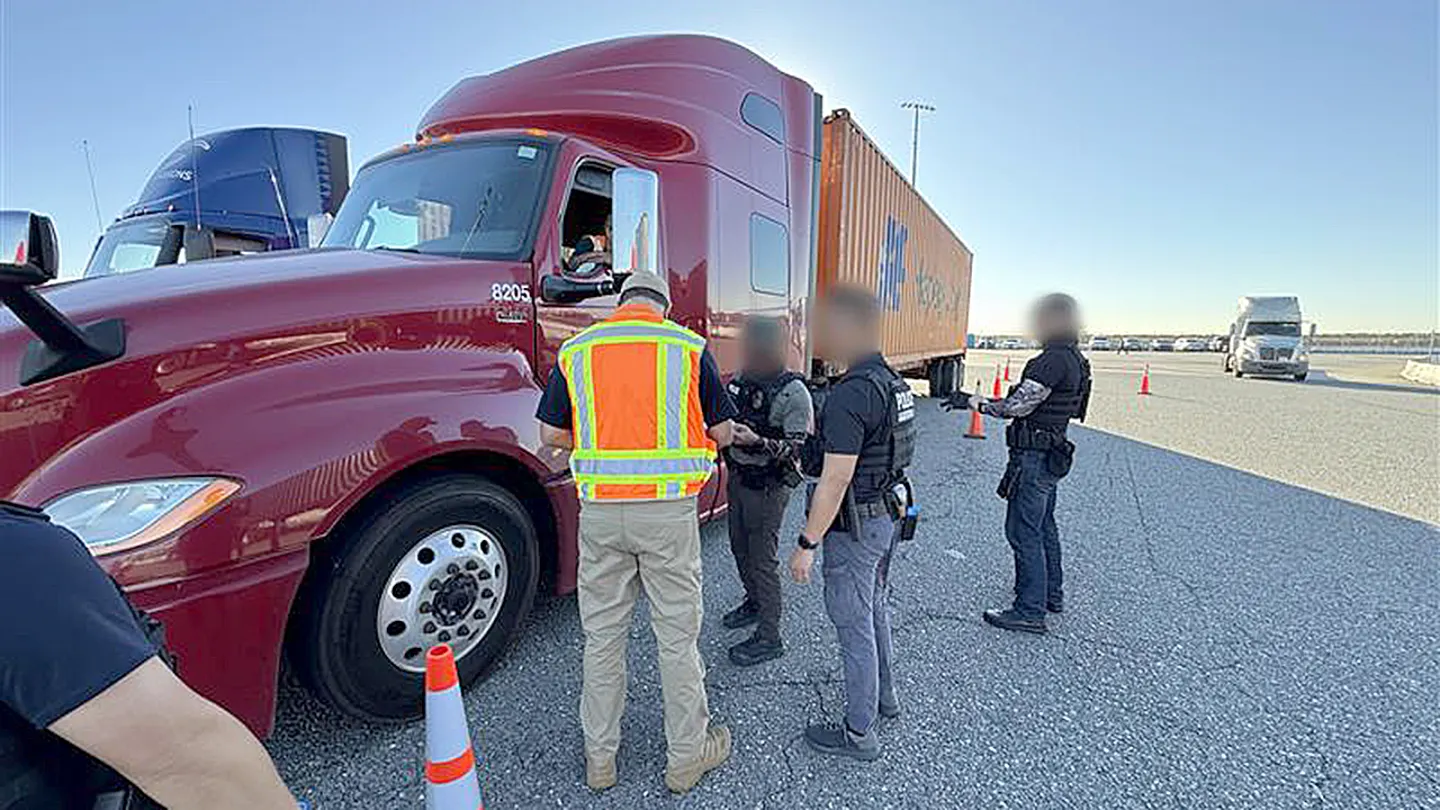
Somewhere in America over the past few weeks, a federal inspector walked into what a trucking school called its classroom and found a school bus. Parked in the back of a trailer. That’s not a metaphor for the state of commercial driver training in this country. It’s a direct finding from a federal enforcement sweep.
On Monday, the Department of Transportation, the Department of Homeland Security, and the Department of Justice announced a joint crackdown on truck driver training fraud. The Federal Motor Carrier Safety Administration pulled more than 110 driving schools off its Training Provider Registry effective immediately, which means those schools can no longer teach a class, run a road test, or certify a single student. Another 160-plus schools are now facing the same fate. DHS ran a synchronized sweep of over 200 more locations across 23 states. The Justice Department stood up a new standing task force, Joint Task Force Crossroads of America, just to keep doing this work going forward.
The headline everyone will write is about English. Failed language tests, canceled licenses, a political fight over who gets to sit behind the wheel of an 80,000-pound truck. That fight is real, and it deserves coverage. But the more interesting story, the one that should worry every fleet owner, insurance underwriter, and everyday driver sharing the highway with an 18-wheeler, isn’t the test. It’s the registry that was supposed to catch this years ago and didn’t.
Here’s what most drivers, including a lot of professional ones, don’t know. Since February 2022, anyone who wants to train new truckers for a commercial license has been required to register with FMCSA’s Training Provider Registry before certifying a single student. It sounds like a strong gatekeeper. In practice, it’s closer to an honor system. A school tells the government what curriculum it teaches, what equipment it uses, and what facility it operates, and FMCSA takes that at its word until something goes wrong. Nobody drives out to confirm the classroom is an actual building rather than, say, a school bus welded into a box trailer.
That’s why this particular truck driving school fraud got caught the way it did. FMCSA didn’t stumble onto it through an audit of the registry itself. Investigators worked backward from roadside inspections, cross-referencing commercial drivers flagged for failing to communicate in English against the training providers who had certified them as qualified in the first place. When the same schools kept turning up next to the same failed inspections, the agency moved. The fraud wasn’t caught at the front door. It was caught by counting problems at the back door, on the side of the highway.
Then there’s the number that should stop you. FMCSA says drivers certified by the 160-plus schools now facing removal are linked to 239 commercial motor vehicle fatalities.
Two hundred and thirty-nine deaths, and the training providers connected to them stayed on a federal registry until this week.
Here’s the detail that gets lost in the politics. The requirement that a commercial driver understand enough English to read road signs, respond to a roadside inspector, and follow a shipping manifest isn’t new. It has been part of federal motor carrier regulation for decades. What changed was enforcement. Guidance issued under the Obama administration told roadside inspectors not to place a driver out of service for English proficiency alone unless the violation was severe, which softened the rule for the better part of a decade. Duffy’s department reversed that guidance last year under direction from the White House, and FMCSA is now writing the stricter standard into a formal rule rather than leaving it as internal guidance. The schools weren’t undone by a brand-new law. They were exposed by an old rule finally being enforced again.
The scale of the campaign is bigger than one Monday announcement suggests. Over the past year and a half, FMCSA says it has placed more than 28,000 drivers out of service for failing English proficiency, forced states to cancel over 30,000 improperly issued licenses, and purged more than 8,000 training providers from its registry entirely. States that don’t clean up their own commercial license programs face a specific financial threat: FMCSA can withhold 4 percent of a noncompliant state’s federal highway funding in the first year, doubling that penalty for every year the problem continues, and can eventually strip a state’s authority to issue commercial licenses altogether. That threat is already reshaping how North Carolina’s DMV operates, after a 54 percent audit failure rate put $50 million in highway funding at risk. That isn’t abstract federal policy. That’s a state legislature deciding whether to fix a licensing office or lose highway money.
This is where fleet owners and insurers should be paying closer attention than anyone. Commercial trucking has spent the past several years getting hit with so-called nuclear verdicts, jury awards well into eight and nine figures against carriers found even partially responsible for a crash. Plaintiff’s attorneys build those cases on negligent hiring and negligent training theories: did the carrier know, or should it have known, that a driver wasn’t properly trained? A federal press release naming your driver’s training school as fraudulent is not a detail a trial lawyer will overlook. Carriers that never bothered to check whether a driver’s CDL school was legitimate now have a public list telling plaintiffs exactly where to start looking.
It also lands on an industry that can’t easily absorb the disruption. Washington state pulled 24,000 truckers off the road earlier this year in the name of safety, then had to launch a veteran recruiting campaign because it no longer had enough drivers to move freight. Multiply that kind of gap across a nationwide sweep of training providers, and the honest answer is that the country doesn’t have a deep bench of already-vetted instructors standing by to replace the ones getting purged. Every legitimate school now absorbing displaced students is also facing more scrutiny than it has ever faced before, because FMCSA just proved it’s actually looking.
It’s worth noticing what’s happening in the background while regulators fight over who is qualified to sit in the driver’s seat. California just used an administrative rule built for fixing typos to open its highways to 80,000-pound driverless trucks, with no human training requirement at all. One part of the government is spending real political capital chasing down fraudulent CDL mills. Another part is quietly removing the human requirement altogether. That contradiction isn’t going away, and it’s worth watching which one wins the decade.
So who actually wins here? Mostly future crash victims, and the carriers who already ran clean training programs and now look better by comparison. Who loses, beyond the schools committing outright fraud? Working drivers who paid real money for a CDL education at a school that gets blacklisted through no fault of their own, and now have to start over. State licensing agencies facing a funding threat regardless of whether their failures were malicious or just underfunded. And carriers who, until this week, could plausibly claim they had no way of knowing a training provider was cutting corners. That excuse just got a lot harder to make.
The English test is the part everyone will argue about on cable news. It’s simple, it’s visible, and it makes for an easy fight. The registry is the part that actually determines whether the truck coming toward you in the other lane was trained by someone who knew what they were doing. A test is something you can bluff your way through for twenty minutes. A registry nobody checks is something you can bluff your way through for years. That’s the real story here, and it’s the one worth remembering the next time an agency rolls out a new online form and calls it reform.
Related Articles
- Truck Driving Over Ducks Sparks Ethics Debate
- Walmart Tractor-Trailer Crashes Into Georgia Home With Resident Inside
- The I-75 Fireworks Truck Fire Exposed a Stack of Safety Violations
- EPA’s New Truck Rule Turns a Federal Felony Into a Factory Setting