
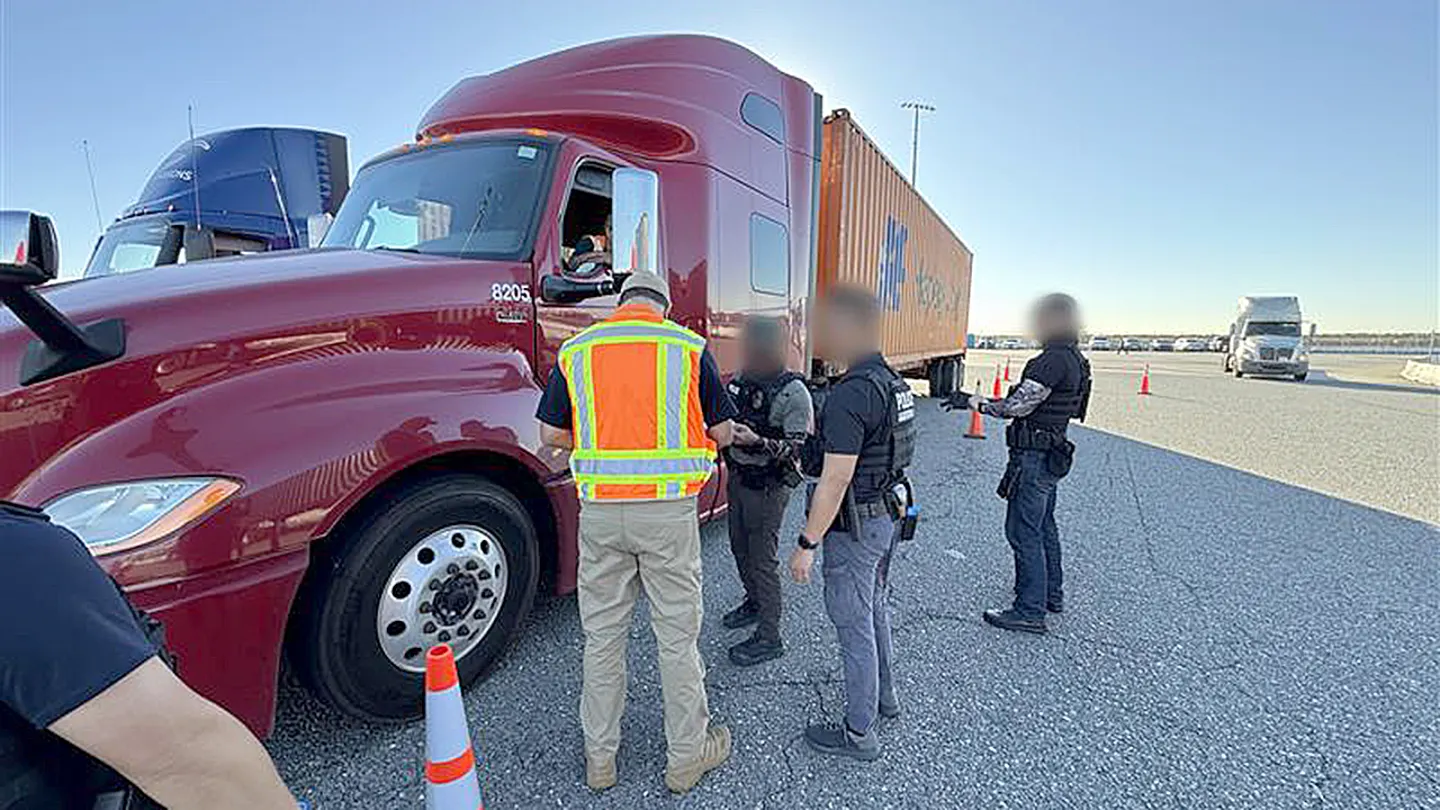
Every trucker pulled off the road for a safety violation has to be replaced by someone. That’s the detail missing from the government’s shiny new highway safety plan – a document that spends paragraphs bragging about how many truckers it removed and almost nothing on who is supposed to drive the trucks now.
On August 5, the U.S. Department of Transportation released its National Roadway Safety Strategy, the latest rewrite of federal traffic safety policy under Secretary Sean Duffy. The press release leads with a stat that sounds more impressive than it explains: 2025, it claims, produced the second-lowest traffic fatality rate in recorded history, without ever naming the actual number. A few paragraphs later, under a section called Safer People, sits one throwaway line about renewed law enforcement partnerships and cracking down on dangerous foreign truck drivers. It reads like filler. It isn’t.
Three weeks earlier, FMCSA had already spelled out what that line means in practice. In a joint operation with the Department of Homeland Security announced July 16, Duffy said the government had knocked more than 24,000 drivers off American roads for failing an English-language test, forced states to cancel over 28,000 improperly issued licenses, and purged more than 9,500 driver-training schools from the federal registry. Homeland Security Investigations is now digging into 75 more schools suspected of fraud. That is not enforcement at the margins. It is a meaningful slice of the commercial driver pipeline, removed through paperwork and license audits in about eighteen months.
Here’s what the safety strategy leaves out. Two weeks before it was published, the same administration stood in the White House with a group of veterans and launched something called the Freedom Haulers campaign. Governments don’t usually hold White House events to recruit replacement workers for an industry they insist is running fine.
Freedom Haulers expands a program called Even Exchange, which lets veterans with military heavy-vehicle experience skip both the written and driving portions of the CDL exam. Seven more states just joined, bringing the total to 34. The window for claiming that fast-tracked license was doubled, from one year after leaving the service to two. The GI Bill now covers CDL tuition, the Department of Labor is funding a training stipend, and carrier Werner has pledged to hire 1,400 more veterans in 2027. Duffy framed the swap bluntly, saying undocumented immigrants “have no business getting behind the wheel of a big rig”. One sentence later, his own department’s materials note that trucker pay is up 7.42 percent under this administration.
That wage figure is being presented as a win. It’s actually a symptom. Pay doesn’t spike that fast in trucking because business is booming – it spikes because the supply of qualified drivers shrank faster than the demand for freight capacity. Pulling 24,000 licensed drivers off the road through enforcement, on top of nearly 10,000 shuttered training schools, is exactly the kind of shock that produces a wage jump. Citing that jump as evidence of success is like pointing to a fever as proof the patient is thriving.
There’s a legitimate safety case for recruiting veterans into trucking: a clean driving record requirement, discipline, and genuine heavy-vehicle experience count for something. But skipping the CDL exam is still a trade-off, not a free win. Driving a fuel truck on a military base under convoy escort doesn’t teach hours-of-service limits, electronic logging device compliance, weigh-station procedures, or cargo securement for civilian freight. Even Exchange doesn’t test for any of that. It assumes it. The same department that spent eighteen months arguing that unverified qualifications are a safety crisis is now fast-tracking a different group of drivers past the one exam built to verify qualifications.
This isn’t only a trucking story. Long-haul trucks move the overwhelming majority of the country’s freight tonnage, including the parts, tires, and finished vehicles that stock every dealership lot in America. A driver shortage doesn’t stay contained to the trucking industry – it shows up in freight rates, and eventually in the price of the car you’re about to buy or the part your mechanic is waiting on. The Auto Wire has already covered the industry’s other labor gap, Ford’s unfilled technician jobs paying up to $120,000 a year. Trucking’s version of that shortage is the same problem in a different uniform, except this one comes attached to an 80,000-pound vehicle.
There’s a safety wrinkle in the rush to backfill seats, too. New commercial drivers, regardless of background, post disproportionately higher crash rates in their first year behind the wheel of a semi. Shortening the on-ramp – waived exams, expedited state programs, doubled eligibility windows – trades one category of risk for another. The government spent a year and a half treating unqualified drivers as the primary threat on American highways. It would be strange if the fix somehow avoided creating a fresh batch of them.
None of this makes the original crackdown baseless. Fraudulent CDL mills and unlicensed drivers who can’t read a road sign are real hazards, and shuttering nearly 10,000 driving schools is a genuine cleanup. But the National Roadway Safety Strategy wants full credit for solving a problem without mentioning that it helped create a second one. The same week regulators were rewriting equipment rules for robotaxis that don’t need a human being at all, they were also scrambling to find humans willing to drive the trucks nobody else can. Pulling thirty-thousand-odd drivers off the road proves an agency can enforce a rule. Replacing them in eighteen months without quietly lowering the bar proves whether that agency actually has a workforce strategy. So far, the arithmetic doesn’t back it up.