
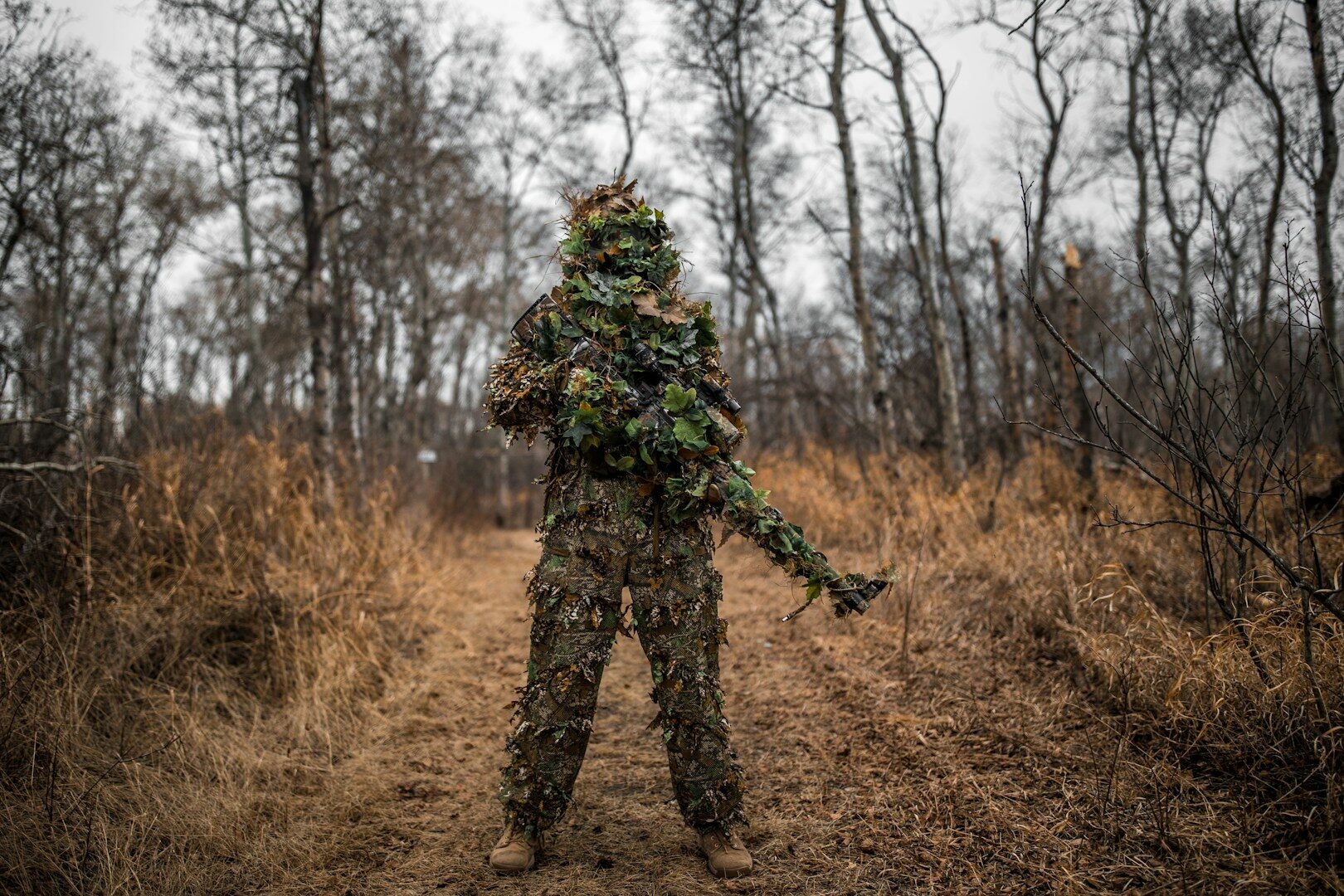
A police officer in Dunellen, New Jersey spent six hours this week standing inside a hedge, dressed as a hedge, waiting for drivers to look down at their phones instead of the road. It worked. Seventy-four people got cited in a single shift. It’s a fun local news story. It is not, however, a story about a funny costume. It’s a story about how little else has worked.
According to the Dunellen Police Department, an officer in a green camouflage suit posted himself along the town’s main road and watched traffic roll by at eye level with the shrubbery. Drivers with their attention buried in a phone screen didn’t notice him, didn’t notice the patrol car waiting up the road, and didn’t notice much of anything else, either. In six hours, the department wrote 74 distracted driving citations. That’s better than one every five minutes.
Here’s the part that should bother you more than the ghillie-suit optics: a small municipal police department felt it needed to physically disguise an officer as landscaping to enforce a law that has existed in some form since smartphones became standard equipment in nearly every car in America. Distracted driving isn’t an enforcement gap because officers don’t care. It’s an enforcement gap because the violation is nearly invisible from a moving patrol car at a normal following distance and a legal speed. A phone held low in a driver’s lap doesn’t register to an officer thirty feet away and closing at 45 mph. Hiding a cop in a bush isn’t a gimmick. It’s an admission that the standard tools don’t work.
Buyer’s guide: Best Car Phone Mounts for iPhone & Android in 2026
The stakes are not small. The National Highway Traffic Safety Administration counted 3,208 people killed in crashes involving distracted drivers in 2024, and another 315,167 injured, numbers that make an earlier report about distracted driving finally trending downward in 2023 feel like a false alarm. NHTSA’s own material on the issue includes a detail that sticks with you: reading or sending a text pulls a driver’s eyes off the road for roughly five seconds, which at 55 mph works out to driving the length of a football field blind. Even more striking, the Insurance Institute for Highway Safety admits a real blind spot behind all of this. In its own words: “There are no reliable estimates of the number of crashes caused by distracted drivers.” Regulators can tell you how many people died in crashes where distraction was present. They cannot tell you, with any real confidence, how many of those crashes distraction actually caused.
That gap between what lawmakers assume and what actually happens on the road shows up clearly in a study IIHS published in October 2025 out of Arizona, one of the last states to pass a full ban on merely holding a phone while driving. Researchers pulled anonymized data straight from insurance companies’ safe-driving apps and compared driver behavior before and after the law took effect. Handheld phone calls did drop, by roughly a quarter. But phone manipulation, IIHS’s term for scrolling, typing, and swiping, the exact behavior most likely to cause a crash, barely moved. Drivers stopped holding the phone to their ear. They kept scrolling through it in their lap.
IIHS researchers had already found something similar in an earlier study: comprehensive handheld bans were linked to fewer rear-end crashes in Oregon and Washington, but the same kind of law produced no measurable improvement in California. The law on the books isn’t the variable that changes driver behavior. Consistent, visible enforcement is. That’s exactly what eroded in Arizona during the study period. State police warnings fell by about a quarter and citations dropped by a third between 2021 and 2024, a decline researchers tie partly to pandemic-era staffing cuts that never fully reversed.
Which brings us back to the bush. Bigger, better-funded jurisdictions are already building technological workarounds for exactly this problem. Georgia sheriff’s deputies have started using drones to spot distracted drivers from above, where a phone held in a lap suddenly becomes visible instead of hidden. Minnesota has gone further, deploying AI-equipped roadside cameras that scan windshields for phones in real time and flag violators automatically, no officer required at the moment of the offense. Both approaches solve the same problem the Dunellen officer solved by standing in a hedge: they let enforcement actually see the violation instead of relying on drivers to notice a patrol car and behave. The real difference is capital. Drone units and camera networks cost real money, money plenty of small-town departments don’t have. A camouflage jumpsuit costs whatever it costs at an army surplus store. Dunellen isn’t behind the curve. It just found the cheapest version of the same idea.
It’s the same logic behind the unmarked patrol cars more departments are leaning on. Dearborn, Michigan police, for instance, started running unmarked Mustang Mach-Es in traffic specifically because drivers change their behavior the instant they spot a black-and-white in the mirror, and phone-distracted drivers weren’t spotting anything at all. A cop who looks like traffic, and a cop who looks like a hedge, are chasing the identical goal: catching the version of a driver’s behavior that only exists when they think no one is watching.
Here’s the detail that should actually change how you think about your own driving. The phone-manipulation data IIHS used to study Arizona’s law didn’t come from police radar or roadside cameras at all. It came from insurance companies’ own safe-driving apps, the accelerometer-based telematics programs plenty of drivers already run on their phones in exchange for a discount. Those apps log every pickup and every swipe above roughly 9 mph, whether or not an officer, a drone, or a bush happens to be anywhere nearby. Anyone who has opted into a usage-based insurance program to shave a few dollars off a bill that has been climbing for years should assume their phone habits are already part of the file their insurer keeps. The bush cop is optional. The app already running in your pocket usually beat him to the data.
There’s a useful precedent here. IIHS president David Harkey has pointed to it directly: seat belt use in this country didn’t climb because state legislatures wrote better-worded laws. It climbed once Click It or Ticket turned enforcement into something drivers actually believed would happen to them, backed by real citations at real scale. Distracted driving hasn’t had its Click It or Ticket moment yet. What it’s had instead is two decades of new laws paired with enforcement that keeps shrinking, especially since the pandemic thinned out traffic patrols nationwide. A guy in a ghillie suit outside a New Jersey diner isn’t a solution to that problem. He’s a symptom of how far departments have to reach, with how little money, to make drivers believe anyone is watching at all.
That’s the part worth remembering once the jokes about the bush cop fade. The costume isn’t the story. The fact that police felt they needed one is.