

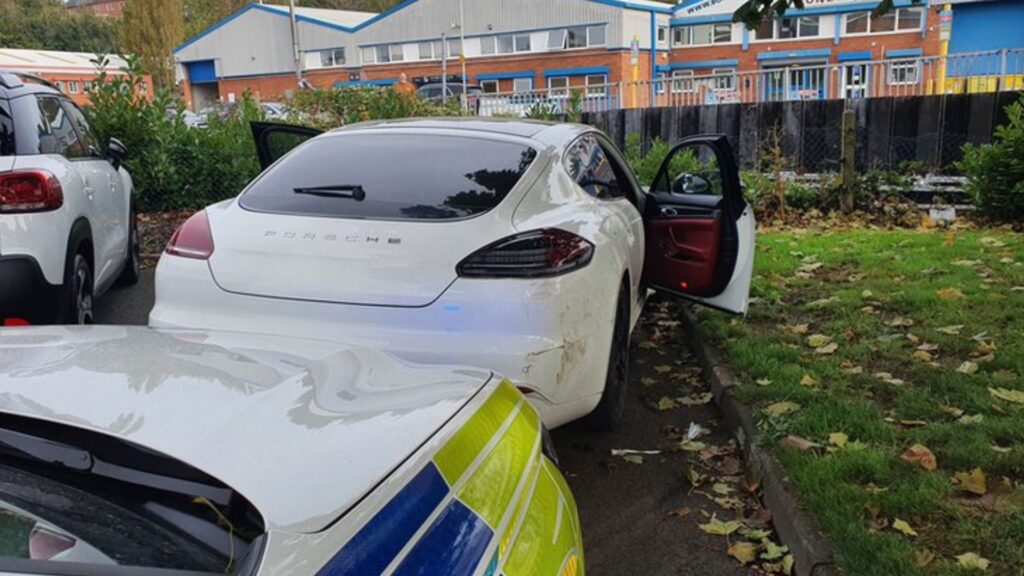
Federal prosecutors in Atlanta released a forfeiture list this week that reads like a fever dream of consumer choices: a 2019 Lamborghini Urus, a 2018 Porsche Panamera, a 2022 Tesla Model X, a Kawasaki ZX-636 sportbike, a nearly $1 million house in Smyrna, Georgia, and, wedged in between the exotics, a 2021 Dodge Durango. That is the fleet the U.S. Attorney’s Office for the Northern District of Georgia says Brittany Hudson and her partner Kayricka Wortham bought with roughly $9.4 million stolen from Amazon. Hudson was sentenced on August 26 to more than sixteen years in federal prison. Four of those vehicles look exactly like what a fraud case is supposed to buy. One does not. That mismatch is the real story, and it explains how federal forfeiture actually works better than anything else in the DOJ’s announcement.
Hudson owned a small business with a delivery contract for Amazon. Wortham worked inside Amazon’s Smyrna warehouse as an operations manager, with the authority to approve new vendors and clear their invoices for payment. From January to June 2022, the two created dozens of fake vendor profiles inside Amazon’s own vendor system, approved each other’s fabricated paperwork, and submitted more than 1,000 invoices for goods and services that never existed. Amazon’s accounts-payable system trusted the vendor file. In under six months, it wired roughly $9.4 million to accounts the pair controlled.
That would have been the whole story, except Hudson and Wortham did not stop once they were indicted that September. Out on bond, they pursued a franchise deal to open a hookah lounge in Midtown Atlanta, and when the franchisor asked about their pending fraud case, the pair emailed forged court documents claiming the charges had been dismissed, complete with the forged signature of a sitting federal judge. U.S. Attorney Theodore Hertzberg later said Hudson showed utter contempt for the law by forging that signature. The stunt got their bond revoked immediately and added a judge-forgery conviction to a case that was already a career-ender.
Here is the part worth sitting with. This case is not really about Amazon’s vendor-approval process, though that failure is real and worth Amazon’s attention. It is about why cars are a terrible place to hide stolen money, and why criminals keep buying them anyway.
Cash spends and disappears. The moment it changes hands, there is no ongoing record of where it went. A car does not work that way. A VIN is stamped into the frame, logged with the state, tied to a title, and reported to a government database every time it is registered, insured, financed, or resold. That is exactly why federal prosecutors could walk into Hudson’s garage more than three years after the fraud began and still find the Urus and the Panamera sitting there, untouched. The paperwork that makes a car legal to drive is the same paperwork that makes it impossible to make disappear.
You can launder cash. You cannot launder a Lamborghini.
That is also why the Durango matters more than the Lamborghini. An exotic SUV and a Porsche sedan are exactly what an investigator expects to find when pulling records on a sudden fraud windfall, because they announce new money on purpose, which is precisely why they get noticed early. A Dodge Durango does not announce anything. It is the kind of vehicle that shows up in a fraud case specifically because it was not bought to impress anyone; it was bought because $9.4 million buys an ordinary life too, not just a garage of toys. Forfeiture law does not care about the distinction. Once a court ties a title to fraud proceeds, the vehicle is forfeitable whether it is a Lamborghini or a minivan.
There is also a reason six-figure vehicles bought with fraud money keep sailing through dealerships without tripping any alarms. Federal cash-reporting rules exist specifically to flag transactions involving physical currency over $10,000, a holdover from decades of organized crime moving money through car lots. A wire transfer from a business bank account does not trigger that same scrutiny at the point of sale, even when the account is being actively fed by a fraud scheme. Dealers run credit checks and verify titles. They are not equipped, and are not required, to audit where a buyer’s money actually came from. That is not a scandal so much as a reminder that a system built to catch dirty cash was never built to catch dirty wires.
Once a forfeiture judgment like Hudson’s is final, the seized vehicles do not sit in an evidence lot forever. They typically move through federal asset disposition auctions, with proceeds applied toward the restitution Amazon is owed. It is one of the quieter ways an exotic car re-enters the used market at a price that looks like a bargain until you read the fine print: sold as-is, no test drive, no warranty, and a title history that reads like a court transcript.
This is not an isolated pattern for cars and financial crime. The Auto Wire has covered how the same paperwork trail makes a stolen car nearly impossible to disappear overseas, and how fraudulent paperwork can move through a dealership’s own financing contracts before anyone notices. Vehicles keep turning up at the center of these stories for the same reason they turned up in this one: they are valuable enough to launder six figures at a time, but documented enough to eventually testify against whoever bought them.
Wortham, the Amazon employee who approved the fake vendors, was sentenced back in 2023 and later given an extra year for the same judge-forgery scheme. Hudson goes away for sixteen years and three months, owes Amazon $9,469,731.45 in restitution, and has already lost the house, the bank accounts, and the garage. None of that took a forensic accountant tracing a wire through six shell companies. It just took someone running the plates.