

William Shives is 92 and his wife, Barbara, is 84. For more than 40 years they lived on 24 acres along Blythewood Road in Richland County, S.C., next to land that is now the 1,100-acre site of Scout Motors’ $2 billion assembly plant. On Aug. 7 they sued Scout and Richland County, saying the plant’s construction drove them out of the house. On Oct. 2, Scout answered that if anyone damaged their property, it was the contractors.
In that filing, Scout pulled three companies into the case as third-party defendants: Evans General Contractors, Elevate Drilling & Blasting and a firm the filing lists as Strack, the Post and Courier reported. The paper quoted the filing directly: “The damages alleged by Plaintiffs, if any, were due solely to the actions of the Third-Party Defendants and were not caused by any act or omission on the part of Defendant.”
Blaming subcontractors is a standard opening move in construction litigation, and it tells us nothing yet about who will win. What the case does show, in court papers rather than ribbon-cutting speeches, is how the risks of building a modern car plant get spread among people who will never buy one of its trucks. South Carolina paid to prepare the ground. Richland County was named alongside Scout on a state stormwater enforcement order and has already paid the $1 million penalty. Scout’s own statement on the lawsuit describes the company as having been “recruited to the Blythewood site by the State of South Carolina.” And the couple next door has two pieces of South Carolina law working for them that don’t require proving anyone was careless.
What the Shiveses say the construction did
The complaint, as described by WIS-TV and the Post and Courier, lays out three problems. The couple’s septic system had worked for more than four decades, they say, until construction changed the water table, after which it needed pumping as often as once a week. Near-daily blasting shook the house and threw rock and debris onto the property, and in 2025 debris hit a visiting guest in the eye. Faulty sediment controls sent stormwater across their land and washed out the driveway.
The suit pleads trespass, private nuisance, strict liability for blasting, negligence, gross negligence and inverse condemnation. It asks for actual, consequential and punitive damages, an order to abate the problems, and compensation for lost property value and lost enjoyment of the home, plus pre-judgment interest and attorney’s fees. “They have been driven out of the home they expected to live in for the rest of their lives, and now they have been forced to purchase a smaller house away from the place and the people they have known,” the couple’s lawyer wrote.
None of those allegations has been tested in court. Scout told WIS it could not comment on specific allegations because the case is pending, and said it had gone out of its way to keep lines of communication open with the Shives family and other neighbors.
Why a few inches of groundwater can kill a septic system
The septic complaint sounds like the least dramatic of the three. It may be the hardest to fix. A septic tank only separates solids; the treatment happens in the soil under the drain-field trenches, where bacteria break down the effluent as it seeps through dry, air-filled ground. Saturated soil can’t do that job, so the liquid has nowhere to go and backs up toward the tank.
South Carolina writes that limit into its rules. Regulation 61-56, the state’s onsite wastewater standard, requires at least six inches of vertical separation between the deepest point where effluent enters the soil and the zone of saturation for systems handling up to 1,500 gallons a day. For a conventional system, it also requires the zone of saturation to sit at least 29 inches below the natural soil surface.
Six inches is not much margin. If grading, fill or rerouted runoff next door pushes groundwater up into that gap, the drain field stops draining, and weekly pumping is the only way to keep a house livable. Whether that happened under the Shives property is a question for hydrologists and, eventually, a jury. The regulation explains why the claim isn’t far-fetched on its face, and why it can’t be cured by repairing a pipe.
South Carolina’s blasting rule doesn’t ask whether anyone was careful
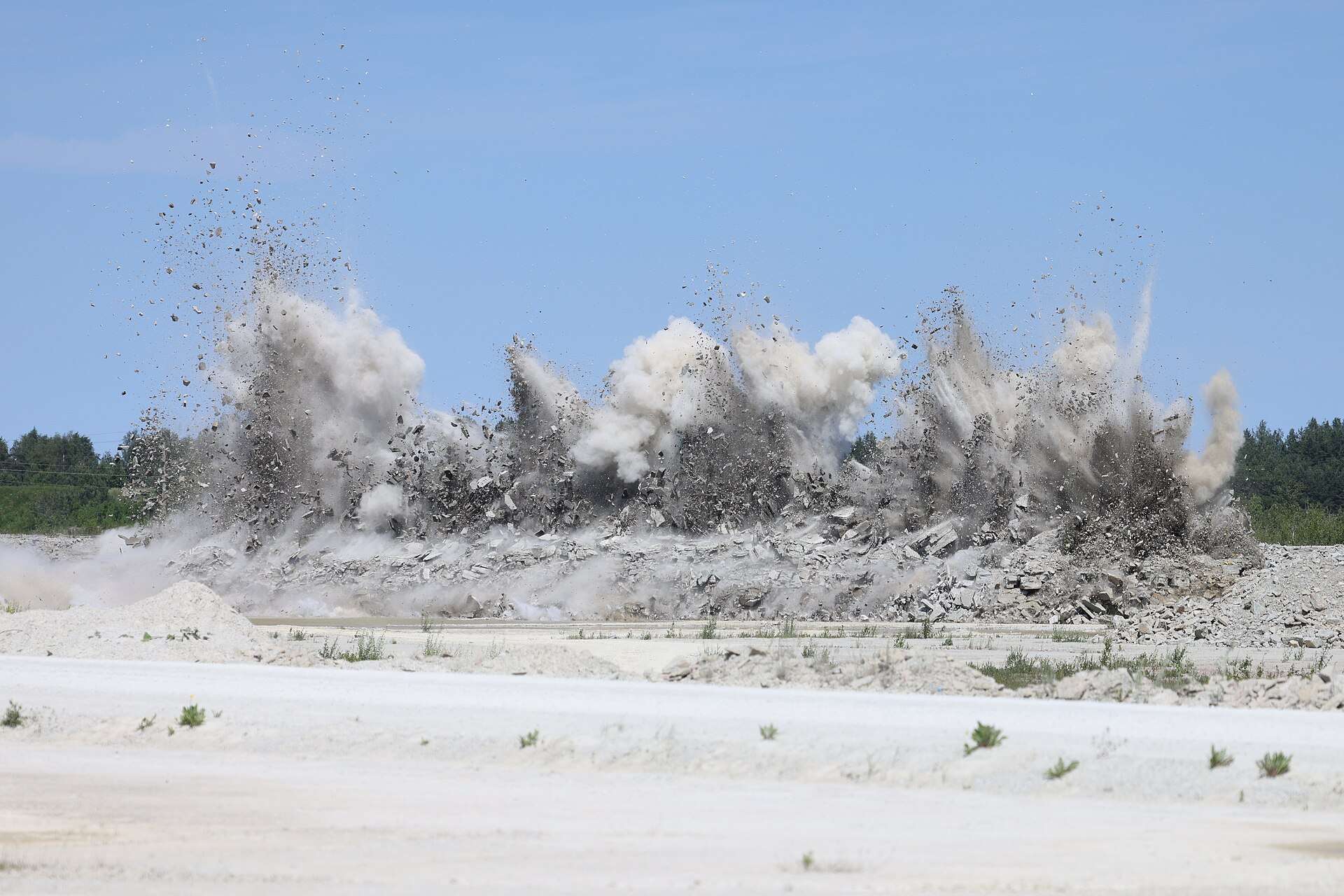
The blasting count rests on a doctrine the South Carolina Supreme Court settled in Wallace v. A. H. Guion & Co., decided Dec. 5, 1960. The court held that under the rule of strict liability, a party lawfully engaged in blasting is “liable without regard to the question of whether or not he has been negligent” for damage from concussion and vibration, and it described blasting as ultrahazardous because no one can predict exactly how far its effects will reach.
That changes what the Shiveses have to prove on that count. They don’t need to show that a blast was overloaded or poorly timed, only that blasting caused the damage. The argument then turns to causation and to who was doing the blasting, which is where Scout’s filing aims: one of the three companies it named is a drilling and blasting contractor. Whether the owner of a project can pass strict liability down to the contractor that set the charges is a separate question the court will have to sort out, and the “if any” in Scout’s filing makes clear the company isn’t conceding that any damage happened.
Why the county is a defendant, and why the claim against it is about a taking
Suing a South Carolina county in tort runs into the South Carolina Tort Claims Act. Section 15-78-120 limits recovery to $300,000 per person and $600,000 per occurrence, and bars punitive damages and interest before judgment. Section 15-78-200 makes the act the exclusive remedy for torts committed by government employees on the job. Scout, a private company, gets none of those protections.
The inverse condemnation count follows a different route. It rests on Article I, Section 13 of the state constitution, which bars taking private property for public use without just compensation. In Ray v. City of Rock Hill, decided Aug. 4, 2021, the state Supreme Court listed four elements: an affirmative, positive, aggressive act by a government agency; a taking; for public use; with some degree of permanence. In Ray, the court let a homeowner take to trial her claim that Rock Hill’s reconnection of stormwater pipes running under her lot, which she said damaged her foundation, was that kind of act. Water moved by public works onto a private lot is close to what the Shiveses allege. A takings claim seeks compensation under the constitution rather than tort damages, so the Tort Claims Act’s caps are not the obvious ceiling, though the county will have every incentive to argue the elements aren’t met.
The county is not a bystander to the site’s environmental record. A South Carolina Department of Environmental Services enforcement report lists Consent Order 25-022-W, dated May 5, 2025, with Richland County and Scout Motors Inc. as respondents. It says a July 24, 2024, inspection found the parties had discharged sediment and failed to install, operate and maintain erosion and sediment controls required by their stormwater permits. The order set a $1,000,000 civil penalty and a $2,000,000 stipulated penalty that would apply if deadlines were missed. The county paid the $1 million, with a final $65,000 installment on April 29, 2026, and expects to be reimbursed by the state and third parties, according to the Post and Courier. That order doesn’t prove anything about the Shiveses’ driveway. It is a regulator’s finding that the same site’s erosion controls failed.
The site-preparation bill is still being tallied
The lawsuit is small next to what South Carolina has already spent. The state committed about $1.3 billion in incentives to land Scout, and about $690 million had gone to site preparation, managed by the Department of Commerce, before the overrun request. Commerce then asked lawmakers for another $150 million to cover overruns, a figure since revised to $146 million, of which $47.5 million had been invoiced, the Post and Courier reported in August. Legislators froze the larger payments until the Legislative Audit Council verifies the number and its causes, with a report due in mid-December.
Commerce Secretary Harry Lightsey has blamed a five-month delay in site work, wetlands permitting problems, unusually heavy rain at the hilly site along Interstate 77 and an extremely aggressive construction schedule. The delay traces to an Army Corps of Engineers stop-work order that ran from August 2023 into early 2024; the site got 71 inches of rain in 2024 against a typical 45, according to testimony reported in April. By then crews had moved about 27 million cubic yards of dirt.
That schedule answered to a product timeline. When the governor’s office announced the plant on March 3, 2023, production was targeted to begin by the end of 2026. Scout now says initial production is targeted for 2027, and its September construction update describes test builds and conveyor trials underway in the body and paint shops. The plant is supposed to build up to 200,000 Scout Traveler SUVs and Scout Terra pickups a year, sold through a direct-sales model Scout has pushed hard for.
Moving 27 million cubic yards of earth and blasting rock on a deadline, through an unusually wet year, is the kind of job that changes how water moves across a landscape. The state’s July 2024 inspection found sediment leaving the site. The Shiveses say their septic field and driveway showed it next.
What to watch in the Richland County case
When the three contractors answer, their filings will show whether they accept Scout’s framing or point back toward the county, the state’s site program or one another. A ruling on whether the inverse condemnation count survives will indicate how much exposure the county, and through it the public, carries. The Legislative Audit Council’s December report on the overruns, which lawmakers asked to cover environmental permitting, could put more of the site’s history on the record before any trial.
For people near the next big plant site, the practical lesson is about documentation. A pre-blast survey of a house’s foundation, a record of when a septic system was last inspected and pumped, and dated photos of a driveway are the evidence that turns a neighbor’s complaint into a strict-liability or takings claim a court can measure.
When a state recruits an automaker and pays to clear the land, and the construction wrecks the house next door, who should pay the neighbors: the automaker, the contractors who did the work, or the taxpayers who made the deal?