
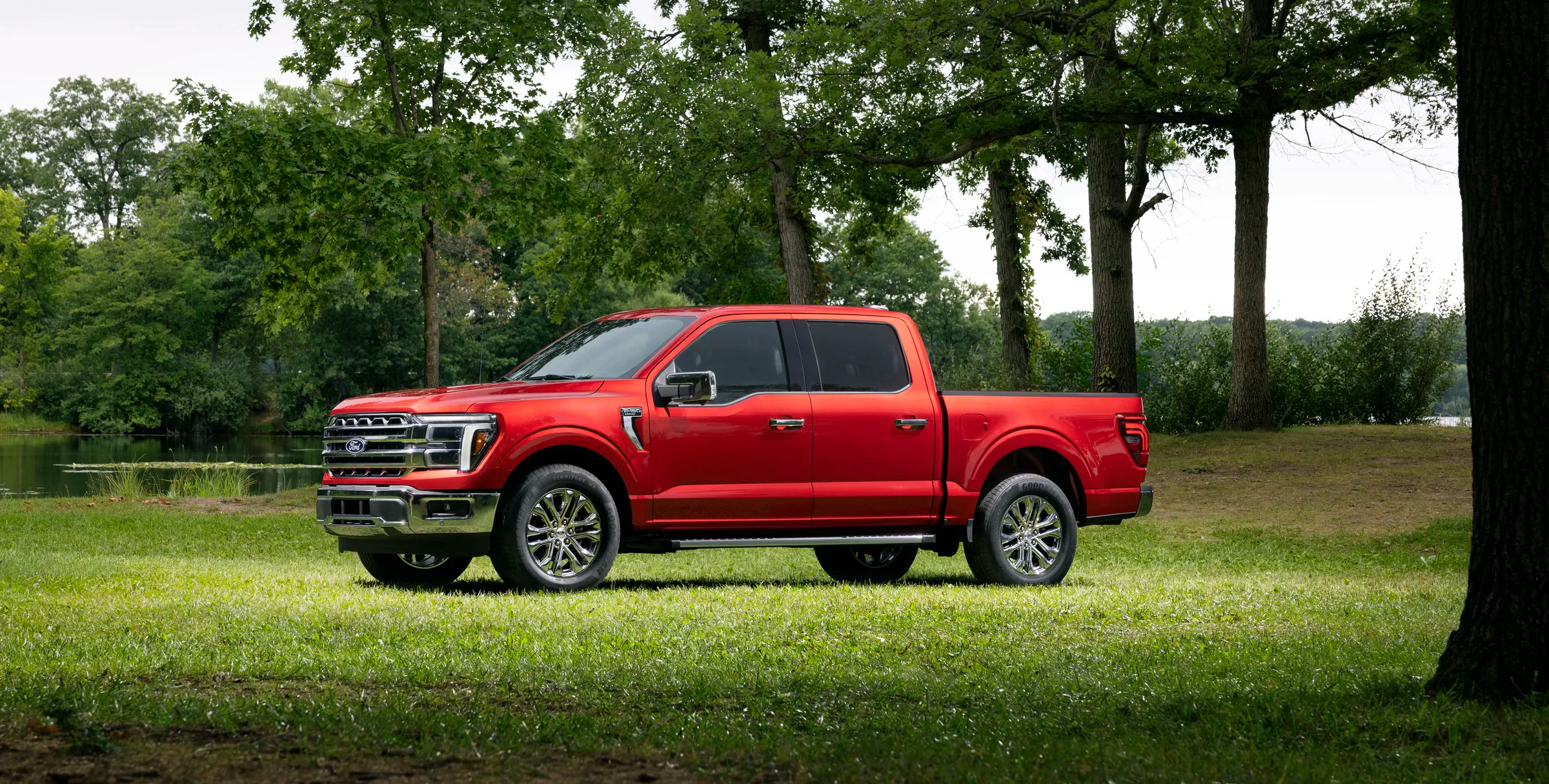
Ford’s rundown of the 2027 F-150 covers what a truck announcement usually covers. New grilles on four trims. New wheels. Hands-free highway driving that now works with a trailer hooked up. A Carhartt edition. And somewhere in the middle of that list, handled almost as housekeeping, sits the only item anyone will still be arguing about in five years.
The base engine got bigger.
Not smaller with more boost. Bigger. The 2.7-liter EcoBoost V6 that has carried the volume end of the F-150 lineup for roughly a decade is out, replaced by a 3.0-liter EcoBoost V6 that, by Ford’s own description, shares the same core architecture as the engine it displaces. At the opposite end of the order sheet, the 5.0-liter V8 comes back to King Ranch and Platinum for the first time since 2023, which means a naturally aspirated V8 is once again available across the entire F-150 range, from work-spec XL to the top trim.
Buyer’s guide: Best Accessories for Ford F-150 Owners
For more than ten years, Ford’s engine strategy argued the exact opposite case. The founding premise of EcoBoost was that you trade displacement for boost, because displacement was expensive. Not expensive to cast. Expensive to certify.
Something changed. It wasn’t the engineering.
The number that actually moved
On July 4, 2025, Public Law 119-21 was signed into law. At Section 40006, it amends 49 U.S.C. § 32912(b) — the statute that sets the civil penalty an automaker owes when its fleet misses its Corporate Average Fuel Economy target.
The statutory figure had been $5 for each tenth of a mile per gallon of shortfall, multiplied across every vehicle in the noncompliant fleet. Miss by a few tenths across a few hundred thousand trucks and the arithmetic turns unpleasant fast.
That figure is now $0.00.
The standards still exist. The testing still happens. The reporting still gets filed. The check does not get written. And the amendment reaches backward, applying to any model year for which the Secretary of Transportation hadn’t already issued a penalty notification.
That is the backdrop for every powertrain decision in the 2027 F-150. Ford’s announcement does not mention it once.
Why displacement used to be a tax
Here’s the part that rarely gets said plainly. A small-displacement turbocharged engine is, among other things, a test-cycle optimization. Federal fuel economy figures come from laboratory dynamometer cycles, and a dynamometer never asks an engine to do anything genuinely hard. Under that kind of light load, a 2.7-liter V6 behaves like a 2.7-liter V6 and sips accordingly. Under real load — a loaded bed, a grade, a trailer — it behaves like an engine with an air compressor bolted to it, burning extra fuel to manufacture boost.
You got the certification of a small engine and the consumption of a large one, but only when you worked it. And the certification was the number that counted against the fleet.
Now read Ford’s description of the new 3.0-liter carefully, because the wording is doing a lot of work. Both engines, Ford says, “share the same peak capability,” but the 3.0 delivers “roughly 10%-11% more torque where daily driving occurs.”
Peak horsepower didn’t move. Peak torque didn’t move. What moved is everything underneath the curve — the part of the rev range where anyone actually drives.
That’s the tell. Ford didn’t need a larger engine to publish a larger number. It wanted a larger engine to make the same number more easily: lower boost pressure for a given output, less heat, less thermal stress on the turbos and the exhaust side. Engineers have wanted that arrangement the entire time. It is simply the better engine for a truck that works. It just used to cost money on a federal scorecard, and that scorecard used to come with a bill attached.
The rating was never describing your truck anyway
Buried in Ford’s own footnotes is a statistic worth sitting with: more than 75% of F-150 customers use their truck to tow.
Now consider that the EPA’s estimates come from laboratory dynamometer testing, and that no towing figure is published on any window sticker in America. There is no trailer on a dynamometer. There never has been.
So the metric that shaped a decade of F-150 engine architecture has never once measured the thing three-quarters of F-150 buyers do with the truck. That gap was not a scandal. It was the design of the system, and everyone inside the industry understood it. The difference is that the gap used to be worth defending, because closing it cost real dollars in penalties.
Which brings us to the V8
The 5.0-liter returns to the two most expensive non-Raptor F-150s at 400 horsepower and 410 lb-ft. Ford frames it as answering customer demand, and that’s surely part of it. Buyers of $80,000 trucks have wanted a V8 in them for years.
But this is also the same 5.0-liter V8 at the center of a federal fraud case that a judge allowed to proceed after evidence indicated Ford’s engineers developed a fix for the engine’s oil consumption, then rolled that fix back because it hurt fuel economy numbers. The oil-burning complaints go back to 2018 and never produced a recall.
Hold those two facts next to each other for a second.
Under the old regime, a fleet-average number was valuable enough to Ford that the tradeoff between that number and an engine consuming oil was a live internal argument with real money on both sides. Under the new regime, that number is worth exactly $0.00. Whatever pressure was pushing engineering decisions toward the test cycle and away from durability simply evaporated last summer. That is good news for anyone buying a 2027. It also says something uncomfortable about what was driving those decisions before.
More Raptors, on purpose
The same logic explains the strangest item in the announcement: Ford is introducing stripped-out, lower-priced Raptor and Tremor models.
Look at what the entry-level Raptor gives up. Head-up display, fog lamps, 2kW Pro Power Onboard, the Mobile Office package, the power passenger seat, under-seat storage. The power-adjustable steering column becomes a manual tilt column. The 14-speaker B&O system becomes eight speakers. The entry Tremor, built off the STX, loses dual-zone climate, heated front seats, the power sliding rear window, and the off-road running boards.
Now look at what stays: the suspension, the track width, the hardware that makes the truck what it is. Ford didn’t make the Raptor cheaper by making it less of a Raptor. It made it cheaper by making it less of a Platinum.
And the commercial reasoning runs straight back to the statute. A Raptor is among the thirstiest vehicles Ford builds. Deliberately expanding the volume of your least efficient product used to carry a compliance cost that scaled with every single unit sold — which is precisely why halo off-road trims tend to stay expensive and stay rare. Cutting the price is the fastest way to sell more of them. As of July 2025, selling more of them no longer costs anything beyond the cost of the truck.
Everything else is downstream
The genuinely impressive engineering in this announcement is BlueCruise with Towing, which extends hands-free operation across roughly 130,000 miles of pre-qualified divided highway while pulling a trailer. Making a lane-centering system behave with an articulated mass behind the hitch is hard, and Ford says it validated the feature across thousands of miles of road testing plus simulator work covering as many trailer combinations as it could reproduce.
Note the business shape of it, though. Ford is making the feature available from XLT and Tremor on up rather than reserving it for Platinum, and it costs nothing extra for owners with an active BlueCruise subscription. Ford’s own data shows F-150 owners are the heaviest BlueCruise users in the lineup, logging 118 million hands-free miles in 2025, more than double the prior year. Attaching a subscription product to the one activity three-quarters of your customers already perform is the single most effective renewal strategy available. It is also, as with every driver-assist system, a feature operating in a regulatory space that is still being sorted out. Ford’s fine print is explicit that not all BlueCruise functions work while towing, and that trailer type, size, and weight all limit availability.
The F-150 Carhartt, meanwhile, is a $4,195 package on a 4×4 XLT Crew Cab that lands at $62,660 before destination. It buys unique 20-inch wheels, a cowl hood, fender vents, badging, rocker and tailgate graphics, a branded spray-in bedliner, two-tone seat covers, accent stitching, and floor mats. It is a well-executed trim package attached to a multi-year licensing relationship between two Detroit institutions, and it will sell. It is not the news.
What to actually take away
Two cautions. First, the regulatory ground is still moving. NHTSA issued an interpretive rule in June 2025 concluding it had improperly counted electric vehicles when setting earlier targets, conceding it “would not have proposed or adopted standards as stringent” otherwise, and it has since proposed loosening the standards themselves for model years 2022 through 2031. That proposal has not been finalized. More to the point, a statute amended by one Congress can be amended right back by another, and engines outlive Congresses. Ford is tooling a powertrain lineup for a decade against a penalty rate that could change in two years.
Second, none of this makes a 2027 F-150 a finished product. Ford is already recalling 2027 model year F-150s over fuel tanks that can detach. New displacement does not fix assembly.
But if you’re cross-shopping full-size trucks this year, the practical point is straightforward: the 2027 base engine is a better engine for what most people do with an F-150. More torque low in the range, at lower boost, with less heat. That’s real, and it’s worth having.
It just isn’t what Ford leads with, and it isn’t why the engine arrived now.
Ford did not suddenly discover that a bigger engine tows better. It has known that the entire time. What changed last July is that knowing it stopped being expensive.