
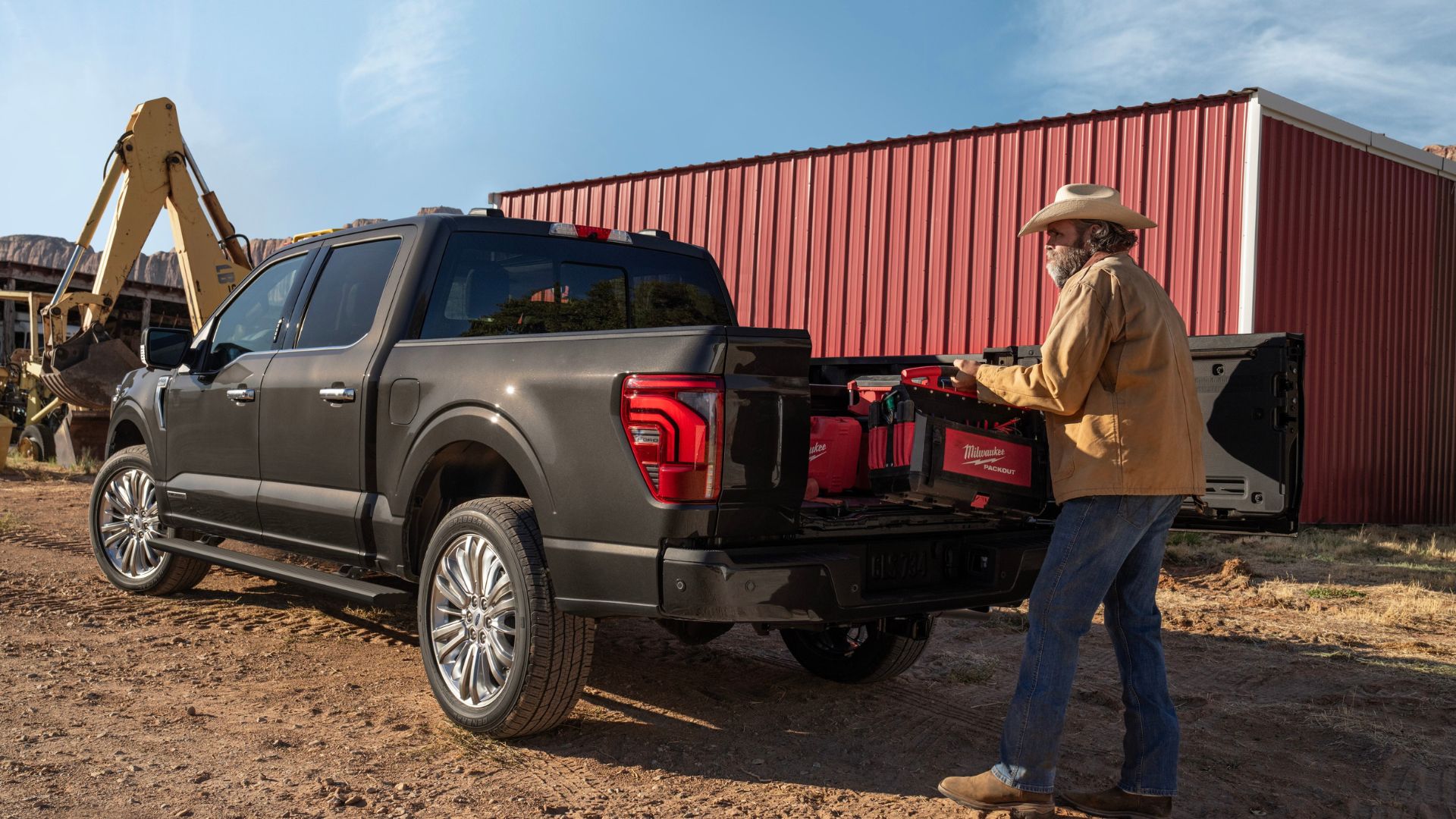
Every recall has a number that matters more than the one in the headline. In Ford’s F-150 fuel tank recall, it isn’t 223,472. It’s five — as in five consecutive model years of F-150 pickups that may have left the factory with a fuel tank that isn’t properly strapped to the frame.
Ford’s filing covers 2023 through 2027 trucks. Some have been on the road for three winters. Others are still coming off the line. A defect that stretches across that much of a nameplate’s life isn’t a bad batch of parts. It’s a process that ran wrong the whole time, unnoticed.
What Ford Told Regulators
Ford notified the National Highway Traffic Safety Administration on September 9 that 223,472 F-150s may have a fuel tank that, in the agency’s words, “may be improperly secured and leak fuel, or detach from the vehicle while driving.” NHTSA logged it as campaign 26V578000. Ford’s own number for it is 26S69. The component named in the filing isn’t the fuel tank. It’s the tank assembly mounting.
Buyer’s guide: Best Accessories for Ford F-150 Owners
Two different failure modes ride in the same campaign. A tank that separates from a moving truck becomes a road hazard for everyone behind it. A tank that merely leaks can stall the engine or feed a fire.
The remedy is an inspection. Dealers “will inspect and replace the fuel tank straps, as necessary, free of charge.” Ford plans to mail owner letters on September 21, and affected VINs became searchable on NHTSA’s site on September 14.
What the filing leaves out is worth noticing too. The public entry names no root cause, no supplier and no build window. NHTSA’s park-it and park-outside flags — the ones the agency sets when a vehicle shouldn’t be driven at all, or shouldn’t sit in a garage — both read false, on a campaign whose own consequence statement mentions fire. That is a deliberate call. It tells you Ford expects very few of these trucks to actually have a loose tank.
“As Necessary” Is Doing Most of the Work
Those two words reshape the entire campaign. Replacing straps on 223,472 trucks outright would mean dropping a quarter-million fuel tanks that are, in the overwhelming majority of cases, exactly where they belong. Inspecting instead is cheaper by an order of magnitude, and it is the only version of this recall a dealer network could absorb without collapsing its service schedule.
For owners, it means something less satisfying. Most of you will book an appointment, hand over the truck for part of a day, and get it back with nothing replaced and no visible evidence that anything happened. That isn’t a brush-off. That is what containment looks like from the customer’s chair.
It does move the decision, though. The factory had five model years of process control and missed this. The catch is now a single pass-fail judgment made by a technician on a flat-rate clock, on a truck that gives no outward sign of the problem. A recall that hinges on inspection quality is only as good as the least careful service lane in the network.
The Federal Standard That Doesn’t Cover This
American fuel system rules are genuinely demanding. FMVSS 301, the federal fuel system integrity standard, fills a vehicle’s tank to 90 to 95 percent of capacity, drives it into a fixed barrier at up to 48 km/h, lets a moving barrier strike it from behind at 80 km/h with 70 percent overlap, hits it in the side at 53 km/h, then rotates the whole thing through a static rollover sequence.
The allowable leakage is minuscule. The rule states that “fuel spillage in any fixed or moving barrier crash test shall not exceed 28 g from impact until motion of the vehicle has ceased, and shall not exceed a total of 142 g in the 5-minute period following cessation of motion.”
Twenty-eight grams is about an ounce. One hundred forty-two grams is about five. After a 50-mph rear-end collision, federal law measures escaped gasoline in quantities you would normally use for baking.
And yet no federal performance test anywhere asks whether the tank is still attached to the truck on an ordinary Tuesday. FMVSS 301 governs what the fuel system does in a crash. Nothing governs whether the line torqued the strap.
That gap isn’t an oversight so much as a limit on what regulation can do. You can write a performance test for crashworthiness because you can crash a vehicle. You cannot write a performance test for “was it assembled correctly,” because the answer changes truck by truck and shift by shift. The only instrument the system has for build quality is the one Ford just reached for: watch the warranty data, find the pattern, file the report. Which makes detection speed a direct function of how hard the manufacturer is looking.
What a Loose Tank Does to Everyone Else
The road-hazard half of this recall gets underrated. Research from the AAA Foundation for Traffic Safety counted an estimated 319,724 crashes involving road debris in the United States between 2018 and 2023, along with 32,802 injuries and 433 deaths. Vehicle parts were the single largest identified category of that debris at 28.8 percent — mostly tires, but also wheels, bumpers and engine components.
The finding that should stay with you is this one: roughly a quarter of the injuries and nearly half of the deaths happened to people who crashed while trying to avoid debris rather than while striking it. The hazard isn’t only the object in the lane. It’s the reflex it triggers in everyone around it.
So an F-150 owner whose tank lets go has a very bad day. The driver one lane over who jerks the wheel has, statistically, a worse one.
There is also a great deal of tank to avoid. Ford’s own 2026 F-150 specification sheet lists a 36.0-gallon fuel tank across most of the lineup. Only short-wheelbase 2.7-liter EcoBoost and 5.0-liter V8 trucks carry the 23.0-gallon tank, and the PowerBoost hybrid runs 30.6 gallons.
Now Look at the Rest of the F-150’s Recall Record
Set this campaign beside the others and it stops looking like a fuel system story at all.
In December 2023, Ford recalled 112,965 F-150s from the 2021 through 2023 model years because a rear axle hub bolt could fatigue and break. In August 2025 it recalled 103,174 more trucks for the same defect, with the filing stating plainly that the action “expands previous NHTSA recall number 23V896.” In July 2026 it recalled 86,543 Mustang Mach-Es because improperly secured rear quarter window trim could detach. On August 25 of this year it recalled 23 trucks — 2026 Maverick, F-150 and Bronco Sport — because “certain vehicle joints may be improperly tightened.” Last week it recalled 10,001 vehicles over cracked pistons.
Four of those campaigns describe the same underlying failure in different vocabulary: something that was supposed to stay fastened didn’t.
The 23-vehicle recall is the most instructive of the group. It is Ford’s containment system working exactly as designed — a narrow build window identified quickly, two dozen trucks affected, problem closed. Put that next to a fuel tank issue spanning five model years and 223,472 trucks and the shape of the weakness comes into focus. Ford catches a bad shift well. It catches a process that was quietly wrong the entire time very slowly.
The Part That Should Worry Dearborn
In October 2025, Ford announced it would add a third crew of 1,200 workers at Dearborn Truck Plant and build more than 45,000 additional F-150s during 2026. Every truck in this recall predates that ramp, so no causal link connects the two, and it would be careless to draw one.
Sequencing still matters. An assembly operation that let a fastener problem run for five model years now has to build meaningfully more trucks per year, and the verification process that missed it has to keep pace with a faster line.
Ford’s own annual report doesn’t soften the exposure: “The cost of recall and customer satisfaction actions to remedy defects in vehicles that have been sold could be substantial, particularly if the actions relate to global platforms.” No single nameplate carries more of Ford’s volume than the F-150.
What F-150 Owners Should Do Now
Run your VIN through NHTSA’s recall lookup; affected VINs became searchable on September 14. Ford begins mailing letters September 21. Ford’s customer service line is 1-866-436-7332, and the number to quote is recall 26S69.
Don’t wait for the envelope if you smell raw fuel around the truck, notice fuel disappearing faster than the trip computer says it should, or find a wet patch under the bed. Those are reasons to see a dealer whether or not a recall exists.
And if your truck comes back with nothing replaced, that is the expected outcome rather than a dodge. Keep the paperwork anyway. Recall records follow the VIN, and the next owner will want to see it.
A fuel tank doesn’t have to be defective to be dangerous. It only has to be loose. Ford will replace straps on the trucks that need them, and for almost everyone this ends as a wasted morning in a dealership waiting room. But the thing that actually failed here was never the strap. It was the step that was supposed to confirm the strap was tight — and the five model years during which nobody noticed that step wasn’t working.
Related: Ford Just Made the F-150’s Base Engine Bigger. Thank a Federal Fine That’s Worth Exactly Nothing.
Top photo: Ford.