

Gasoline costs 31.8% more than it did a year ago. That is the kind of move that is supposed to end arguments about powertrains.
It ended nothing.
AAA published its 2026 Your Driving Costs study on Tuesday, and the figure that will travel is $12,863 — the average annual cost to own a new car and operate it, or $1,071.92 a month. The more useful finding is buried in the category tables. In a year when pump prices climbed hard enough to make fuel efficiency look like the whole argument, the vehicles that cut fuel spending by roughly two-thirds mostly lost anyway.
That is not a knock on electric cars. It is a statement about where the money in a modern vehicle actually goes.
AAA reshaped the study this year, folding selected electric and hybrid models into the same categories as their gasoline equivalents instead of treating them as a separate exhibit. “By looking at EVs, hybrids and traditional gas-powered vehicles within the same categories, consumers can better understand how total ownership costs vary by powertrain,” said Greg Brannon, AAA’s director of automotive engineering. The comparison that produces is the most direct one the organization has published. It also does not say what fifteen years of window-sticker marketing trained buyers to expect.
Fuel is the small argument
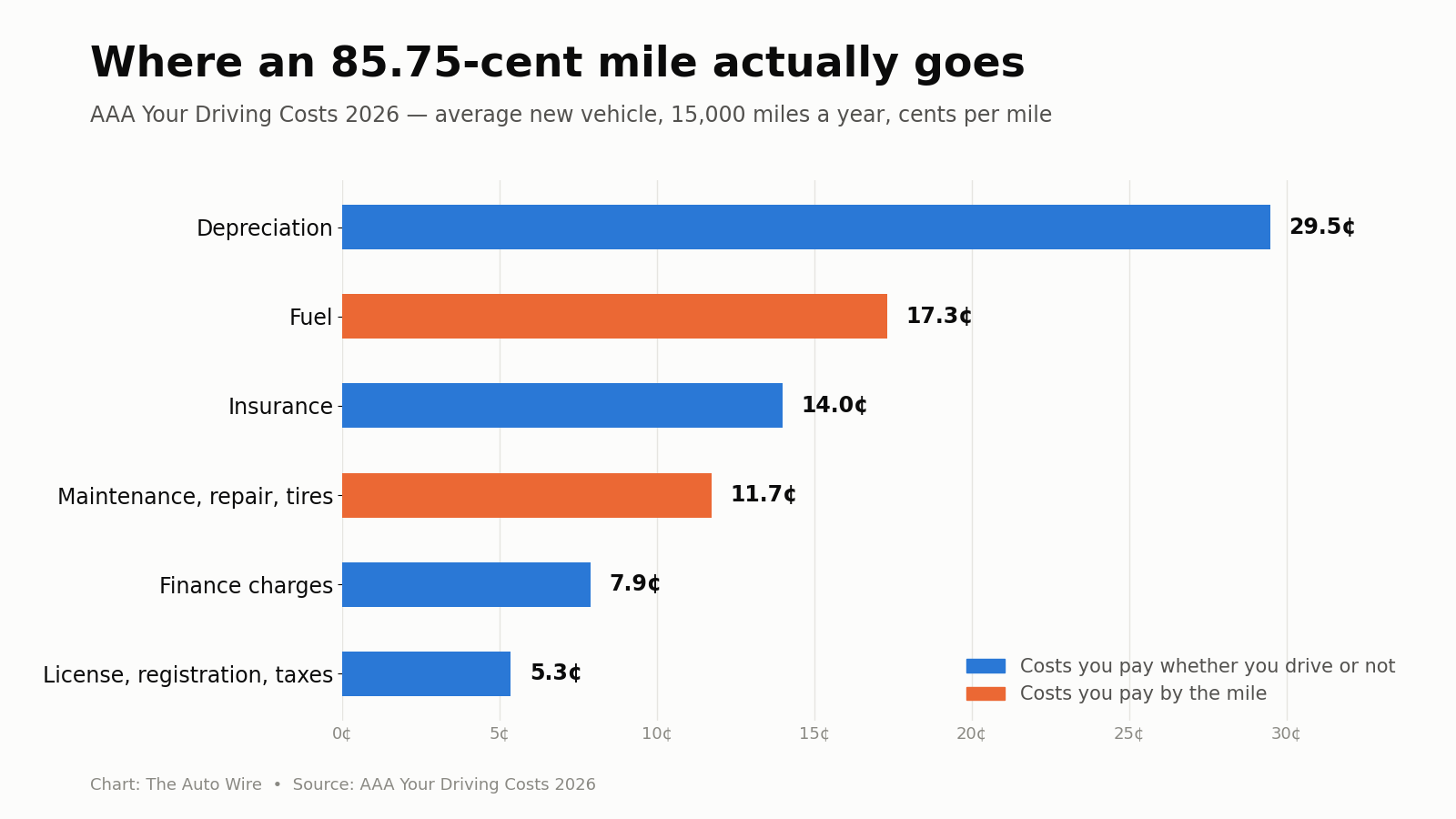
Run the numbers the way AAA runs them — buy new, keep the vehicle five years and 75,000 miles, trade it in — and the average new vehicle costs 85.75 cents a mile.
Fuel is 17.32 cents of that. Maintenance, repair and tires add 11.73 cents. Everything else — $8,506 a year, or 56.71 cents a mile — accumulates whether the car ever leaves the driveway.
Depreciation alone runs $4,422 a year, more than a third of the total and by a wide margin the biggest line in the study. Insurance is $2,098. Finance charges are $1,184. License, registration and taxes are $802. The sales-weighted average sticker across the 34 models AAA studied was $39,376, though what buyers actually sign for depends on incentives and rebates.
Roughly two-thirds of what a new vehicle costs you is settled by the paperwork, not the pedal. Depreciation is the strangest part of that, because it is the one bill you never actually receive. Nobody invoices you for $4,422. You pay it once, quietly, on the day you trade the car in and learn what five years did to it.
What happened in the medium sedan
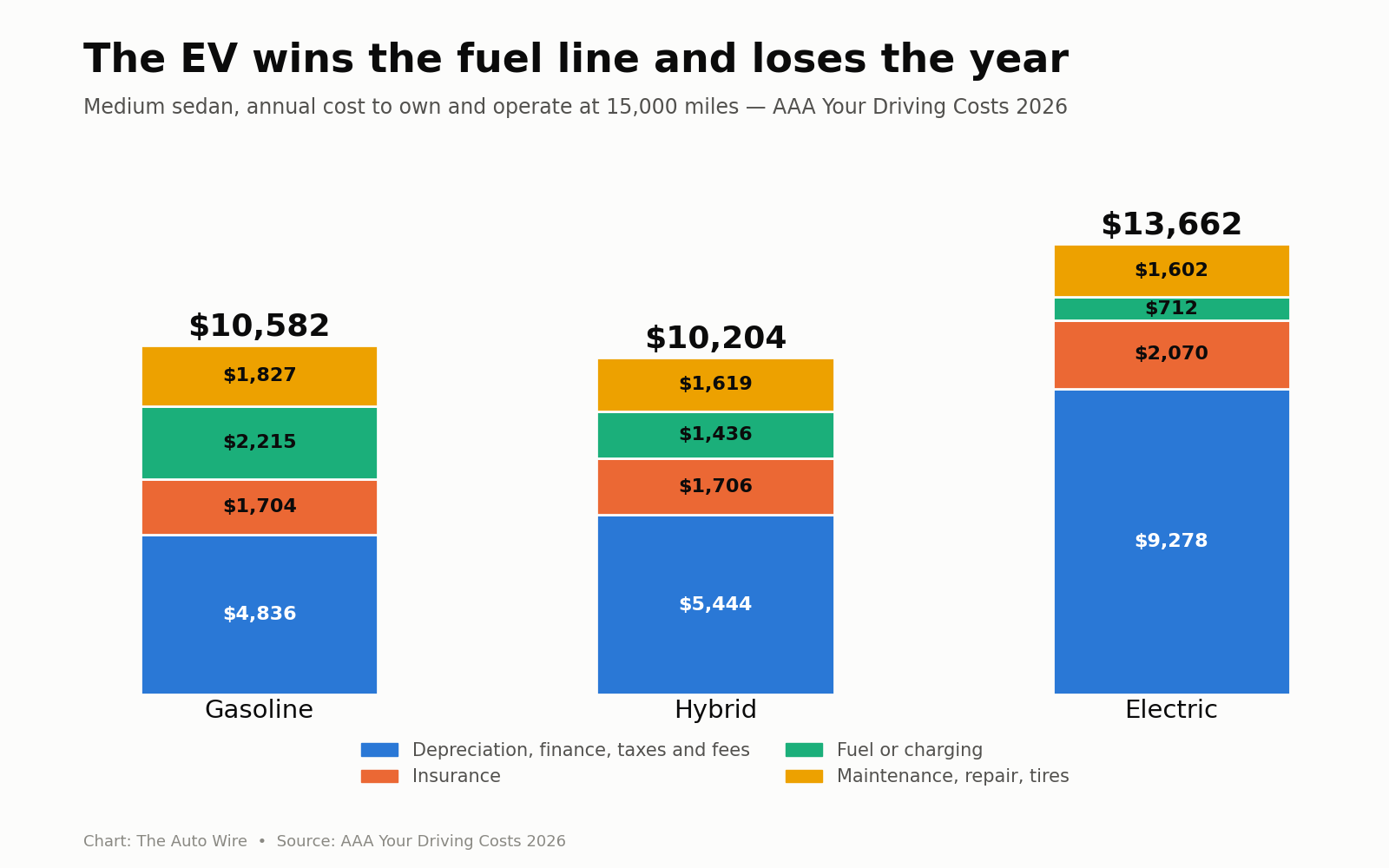
The medium sedan is where the study’s logic is easiest to see.
A gasoline medium sedan costs $10,582 a year to own and operate. The comparable electric one costs $13,662 — $3,080 more, or 29.1% higher.
The EV wins the energy line and it is not close. Charging runs $712.50 a year against $2,215 for gasoline. Across the four categories AAA compared, EV energy costs landed 66% to 70% below their gasoline counterparts.
Then depreciation arrives. The electric sedan gives up $6,786 a year in value against $3,330 for the gas car — roughly double. The $1,502 saved at the plug is handed back more than twice over at trade-in.
Now put that depreciation figure next to the gasoline car’s entire annual fuel bill. The electric sedan loses more than three times as much value per year as the gas sedan spends on gasoline. Resale value is not a footnote in this study. It is the study.
The sticker price gets billed three times
Here is the mechanism behind every number above, and most buyers never think about it.
Depreciation, finance charges, and license, registration and taxes are all functions of what you paid. Most states assess registration fees and ad valorem taxes against vehicle value. Interest is charged on the amount financed. Depreciation is a percentage of the starting price. A dollar of transaction price does not cost you a dollar. It gets billed to you three separate times across five years.
The medium-sedan tables show it plainly. The electric car’s license, registration and taxes come to $1,051 against $609 for the gas model — about 73% higher, for a car that uses the same roads and takes up the same parking space. Its finance charges are $1,441 against $897. Neither figure has anything to do with batteries, electricity or efficiency. Both are what happens when a bigger number goes on line one of the contract.
Timing matters here too. The federal credit that spent three years knocking as much as $7,500 off that line is finished: the IRS says the new clean vehicle credit under section 30D applies only to vehicles acquired on or before September 30, 2025. AAA builds depreciation and finance costs from the actual purchase price. Take the subsidy away and the price-linked cascade runs at full strength.
Hybrids quietly won everything
Hybrids beat gasoline in all four categories AAA compared: medium sedans, compact SUVs, medium SUVs and pickups.
The hybrid medium sedan is the cheapest powertrain in its class at $10,204 a year. The hybrid compact SUV runs $11,201 against $11,656 for gas. The hybrid medium SUV is $13,698 against $14,431.
The pickup result is the one worth sitting with. The hybrid truck’s fuel bill is $3,153 against $3,598 for gasoline — a saving of about 12%, which is thin. It still wins the year, $16,117 against $16,626, because it gives up slightly less to depreciation and costs less to maintain.
A hybrid pickup with an unremarkable fuel advantage beats a gas pickup on total cost. That is how little the fuel line is doing.
Electric vehicles won exactly one of the four categories: medium SUVs, by $99 a year. That is a rounding error. The hybrid in that category beat both of them by $733.
The cheapest miles belong to people who drive the most
One more thing hiding in the fact sheet, and it inverts the usual advice.
A half-ton pickup driven 10,000 miles a year costs $1.4152 per mile. A small sedan driven 20,000 miles a year costs 54.22 cents. The truck owner pays about 2.6 times as much per mile — and a large part of that gap has nothing to do with the truck.
Because most of the cost is fixed, driving more spreads it thinner. That same pickup at 20,000 miles a year falls to 94.13 cents per mile. Nothing about the vehicle changed. The denominator did.
The practical version: a lightly driven vehicle is the most expensive way to own transportation. Buy a truck you will drive 8,000 miles a year and you pay full freight on depreciation, insurance, registration and interest, then divide it by almost nothing. It is one more reason Americans are holding onto vehicles longer — the back half of a long ownership run is where the math finally turns friendly.
One number worth distrusting
The comparison everyone will reach for this week is $12,863 against last year’s $11,577, an 11% jump. AAA says not to make it. The organization states plainly that methodology updates make this year’s results not directly comparable with last year’s estimate, which is a polite way of saying the study changed underneath the number.
That year-over-year figure is the weakest thing in the release. The internal comparisons — powertrain against powertrain, category against category, all computed the same way in the same year — are the strong part, and almost nobody will quote them.
For scale, AAA has run this study since 1950, when driving cost 9 cents a mile and gasoline sold for 27 cents a gallon. In unadjusted dollars, the fuel line by itself in 2026 is nearly twice the entire cost of a 1950 mile.
What to actually do with this
AAA’s advice is sound and boring: budget for ownership costs before you shop, keep the vehicle price, the financing rate and the trade-in value as three separate negotiations, and get pre-approved by a bank or credit union before a finance manager quotes you a monthly payment. The organization’s cost calculator will run your own category, powertrain and mileage.
Add one more. Read the window sticker as a five-year obligation rather than a price, because that is how the math treats it. Every thousand dollars added to the transaction reappears in depreciation, again in interest, and in most states again in taxes and registration.
One caveat on the insurance figure as well. AAA’s $2,098 assumes full coverage for a driver under 65 with more than six years of experience, no accidents and a $500 deductible. That is the best-case customer. If there is a teenager on the policy or a claim in the last three years, that line is not your line.
The cheapest mile is not the one that burns the least fuel. It is the one attached to the smallest number on the window sticker.
Which line on your own ownership bill surprised you most the last time you added it all up — depreciation, insurance or interest?
Does this math change how you think about going electric? Share your take in the comments.