
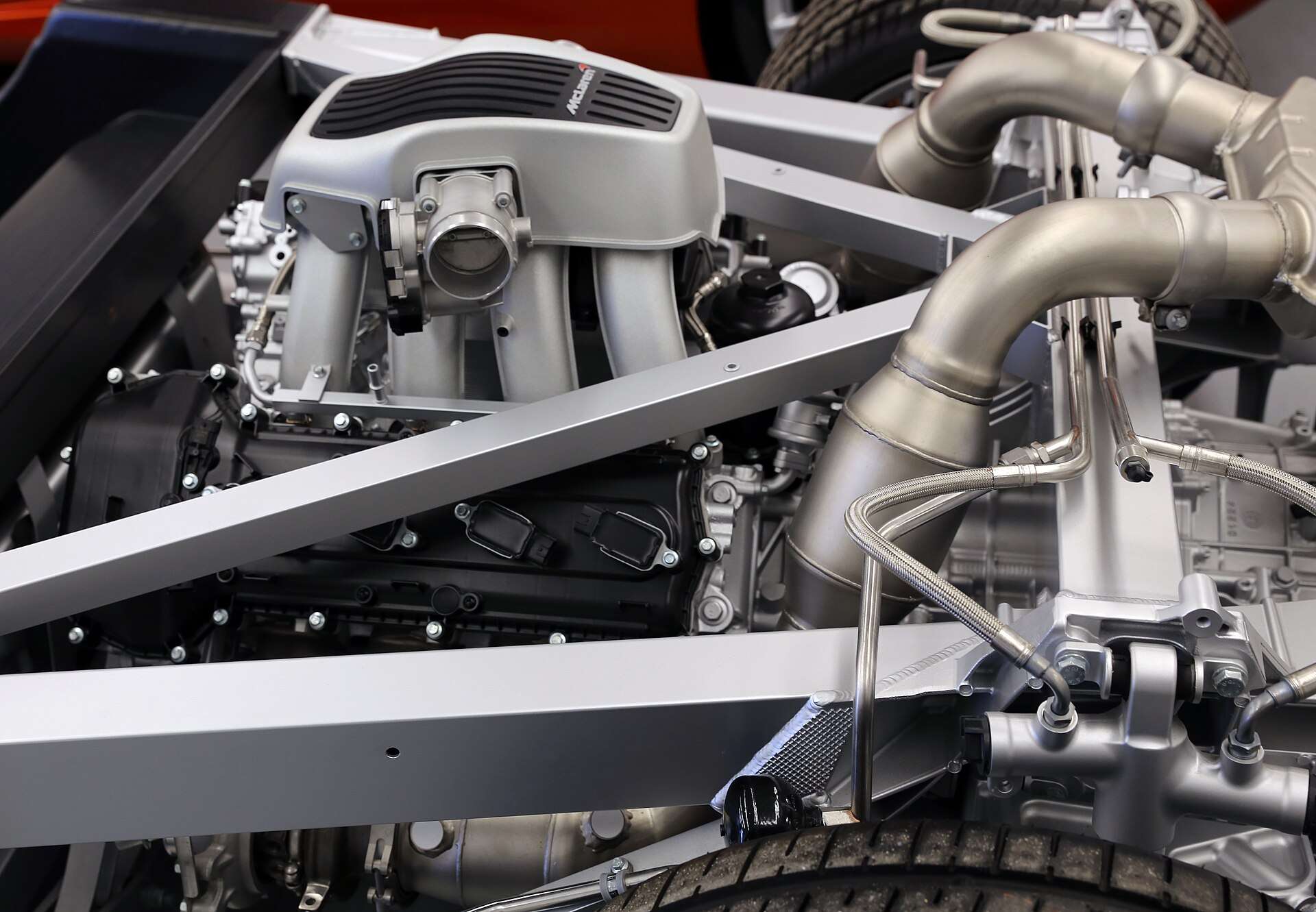
For 15 years, the heart of every modern McLaren road car has been bolted together about 50 miles from Woking, in a building McLaren does not own.
That detail explains the supercar maker’s new £500 million UK expansion better than anything else. The announcement has been sold as a jobs story and an SUV story, and it is both. But the most important line sits in the middle of the UK government’s announcement: McLaren plans to manufacture its future engines in-house for the first time.
A company that built its reputation as a complete British supercar maker is about to become one in a way it never fully was. And the reason it is doing so now says a lot about what McLaren’s owners think it has to become to survive, and what Britain’s shrinking car industry can realistically hope to be.
What McLaren actually committed to
The actual commitments are fairly specific. McLaren Automotive will invest around £500 million to expand its R&D and production site in South Yorkshire and open a new vehicle production facility somewhere in the UK. The government has not named where. The company says it will add 1,000 jobs by 2032, and ministers expect up to 3,000 more across the wider sector. The product plan adds a performance SUV and in-house engine production.
Prime Minister Andy Burnham said McLaren is “doubling down on Britain.” Business Secretary Jonathan Reynolds and First Secretary of State Louise Haigh visited the McLaren Technology Centre in Woking on Sept. 16 to mark the news. The Society of Motor Manufacturers and Traders called it “a major boost.”
Our earlier reporting tracked the signals in McLaren’s hiring before the plan was official, and what the SUV confirmation does and doesn’t tell us. The engine decision deserves its own look, because it is the part most likely to still matter in 2035.
The McLaren engine that McLaren didn’t build
Since the MP4-12C arrived in 2011, McLaren’s own powertrain team has designed its V8 and V6 engines, but engineering firm Ricardo has manufactured them at its plant in Shoreham-by-Sea on the south coast. By May 2023, Ricardo said it had built and delivered roughly 34,000 McLaren powertrains, with more than 100 engineers and technicians dedicated to the work.

That arrangement made sense. Building a few thousand high-performance engines a year is expensive in all the ways a small carmaker hates: dedicated machining and assembly lines, test cells, quality-control systems, trained staff, and the fixed overhead to keep all of it running whether sales are up or down. Handing that to a specialist let McLaren spend its money on carbon fiber, design, and product.
There’s a wrinkle. In 2023, McLaren and Ricardo extended their partnership “into the next decade” for a new generation of hybrid V8s and said both would make significant investment in Shoreham. Three years later, the stated plan is in-house production. The government’s announcement does not say when McLaren’s own engine line starts, which engines it will build, or what happens to the Ricardo arrangement in the meantime. Those details remain unconfirmed, and owners of current cars should not read anything into this announcement about parts or service support for existing engines.
Why bring the engine home now
The timing points to the owners. CYVN Holdings completed its acquisition of McLaren Automotive in April 2025 and folded it together with Forseven, a British luxury startup, installing Forseven’s Nick Collins as chief executive of the combined group. From the start, the stated goal was to push McLaren into new product categories. The investor quoted in this month’s announcement, Jassem Al Zaabi of L’IMAD, framed the money as backing McLaren “through its next chapter.”
Owners who plan to stay and scale think differently from owners who are simply keeping a famous badge alive. Once you intend to add a higher-volume model like an SUV, the math on outsourcing starts to flip. The engine is where emissions compliance, hybrid integration, durability testing, and warranty exposure all meet. Controlling the line that builds it means controlling cost, timing, and quality on the single most complex component in the car. It also means the margin on that work stays inside the company.
McLaren has made this move once already. In 2018, it opened a £50 million composites technology centre at the Advanced Manufacturing Park in Rotherham, its first production facility outside Woking, to build the carbon fiber tubs at the core of its cars. That is the South Yorkshire site now being expanded. McLaren is steadily pulling the defining parts of its cars under its own roof.
A supercar maker that doesn’t build its own engines is a brilliant design studio with an expensive supply chain. McLaren has decided to become a manufacturer.
How small McLaren really is
McLaren feels enormous because its name is everywhere, from Formula 1 to the poster on a teenager’s wall. Its road-car business is not.
Those 34,000 Ricardo-built powertrains covered roughly 12 years, an average of fewer than 3,000 a year. The UK built 717,371 cars in 2025, about 13,800 a week. So more than a decade of McLaren engine output equals about two and a half weeks of British car production.
Compare that with Lamborghini, which delivered 10,747 cars in 2025 with a lineup that includes the Urus SUV. That gap explains the SUV, and the SUV explains the engine plant. At McLaren’s historic volumes, owning an engine line is hard to justify. At meaningfully higher volumes, renting one gets harder to justify.
Good news for Britain, at the right scale
The British industry badly needed a positive headline. SMMT called 2025 “the toughest year in a generation” for UK vehicle manufacturing: total output fell 15.5% to 764,715 vehicles and commercial vehicle production collapsed 62.3%, hit by a cyber incident at the country’s largest automotive employer, new transatlantic tariffs, and the consolidation of two van plants into one. In January, the trade group projected growth of more than 10% in 2026.
That recovery has not arrived. First-half 2026 output fell another 7.5% to 385,979 vehicles, and the independent forecast SMMT cited in July put full-year production at 740,000, below even 2025’s weak total. The sector employs about 188,000 people in manufacturing.
Set against that, 1,000 jobs by 2032 is about half a percent of the manufacturing workforce. It will not rescue British car production. For readers tracking how global carmakers are reshuffling factories around tariffs, the scale matters: volume plants decide national production totals, and McLaren is not a volume plant.
But the type of work matters too. Engine machining and assembly, carbon composites, and vehicle development are skills-heavy jobs that are hard to move and hard to replace once lost. The government says the investment builds on £4 billion of public automotive sector investment committed through 2035, though its announcement does not specify whether any public money goes directly to McLaren. Either way, Britain is getting an employer that is adding capability rather than simply adding shifts.
Building the part that defines the car
The SUV will get the attention when it arrives, and the jobs figure will get the political speeches. The more lasting change is quieter. For the first time since McLaren returned to making road cars at scale, the company intends to build the part that defines them.
That is what a carmaker does when its owners expect it to be around, and bigger, a decade from now. Britain’s car industry won’t be saved by supercars. But its most durable jobs may look a lot more like McLaren’s than like the assembly lines it has been losing.
Does it change how you see a McLaren to know its engines were built by an outside firm for 15 years, or does design matter more than who turns the wrenches on the assembly line?