
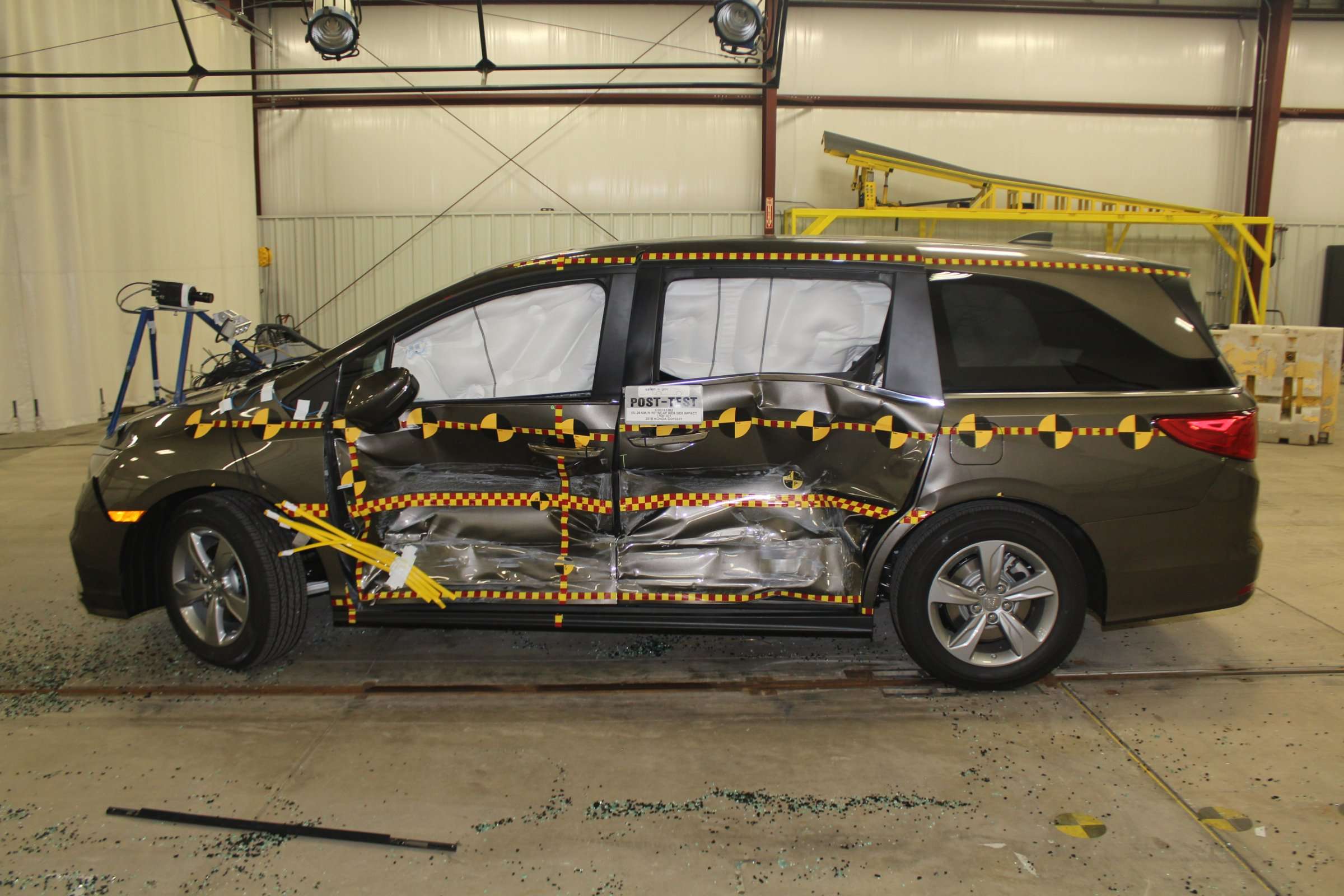
The rollover star on the window sticker of your next new car is about to be decided almost entirely by the vehicle’s shape.
It won’t depend on what the car does when a driver panics and throws the wheel over, or how fast its stability control catches the slide. It comes from a ratio: half the track width, divided by the height of the center of gravity. Measure it once and you have the answer before the car has turned a wheel in anger.
That is the practical result of a request for comments the National Highway Traffic Safety Administration published on August 17, signed by Administrator Jonathan Morrison. The agency wants to pull two long-running procedures out of the New Car Assessment Program, the federal program behind the 5-Star Safety Ratings: the dynamic rollover Fishhook maneuver, and side air bag out-of-position testing. Comments close October 16 under docket NHTSA-2026-1651.
On their own, the removals look like housekeeping. The third section of the notice, which rewrites NCAP’s ten-year roadmap, changes the picture.
NHTSA is banking savings now to pay for upgrades that, in the very same filing, just slid another two years to the right. The cuts land with model year 2027. The replacements start arriving in late 2029, assuming nothing moves again. That gap is what matters.
What the NCAP rollover test was supposed to catch
Congress ordered a dynamic rollover consumer test in the TREAD Act of 2000, the law written in the wreckage of the Ford Explorer and Firestone tire failures. NHTSA added the Static Stability Factor to NCAP in 2001 and the Fishhook maneuver in 2003. Since 2007, because the 2005 highway bill told the agency to do it, the resulting rollover risk has appeared as a star rating on the Monroney label stuck to every new car’s window. That same 2005 law deliberately wrote 12- and 15-passenger vans into the program, because loaded vans were rolling and killing people.
The Fishhook is a steering flick. A hard input one way, then a violent correction back, meant to imitate a driver overcooking an evasive maneuver. If both inside wheels lift two inches off the pavement at the same moment, the vehicle has tipped up.
Then stability control became the law. FMVSS No. 126 began phasing in during September 2008 and covered essentially the entire light-vehicle fleet by September 2011, policed by a nastier maneuver called sine-with-dwell. NHTSA’s own research puts electronic stability control at roughly 50 percent effective against single-vehicle fatal crashes and about 70 percent effective against first-event rollovers.
No vehicle has tipped up in NCAP testing in fifteen years.
What NHTSA’s own math shows
Even back when vehicles did tip up, the dynamic test barely moved the rating. Run NHTSA’s own two regression equations and a tip-up shifts the calculated rollover risk by somewhere between 1.6 and 4.8 percentage points, depending on the vehicle’s geometry. The tape measure was always doing the heavy lifting. The stunt driving was a rounding error with a steering robot attached.
So the agency’s reasoning holds: a test that passes everyone tells buyers nothing.
The conclusion is the part I’d argue with.
NCAP has existed since 1978 for exactly one reason: to be harder than the law. Its entire value is the daylight between the federal minimum and the rating. When a consumer test stops separating the good from the merely adequate, that is usually evidence the test needs to get meaner, not that it needs to be deleted. Once the Fishhook is gone, nothing in the rollover rating gives an engineer credit for tuning stability control past the FMVSS No. 126 floor. Roll stability control with a dedicated roll-rate sensor? No credit. Rollover-triggered curtain air bags? Not in the rating. What remains rewards one thing: being low and wide.
That’s a windfall for electric vehicles. Bolt several hundred kilograms of battery into the floor and you have purchased a low center of gravity, and therefore a healthy Static Stability Factor, before the chassis team does anything clever.
The vans are the harder case. Static Stability Factor is one number, measured once. A 15-passenger van’s center of gravity is not a fixed property of the vehicle; it climbs with every occupant and every bag lashed to the roof, which is the failure mode Congress had in mind. NHTSA’s answer is that these vans all carry stability control now, frequently with roll stability control layered on top, and that it knows of exactly one 2026 model heavy enough to fall outside the program’s 10,000-pound ceiling anyway: the Ford Transit T-350 HD 15-passenger with dual rear wheels. That is a defensible answer. It is not the answer the statute contemplated.
The air bag test that could never be enforced
The second removal is stranger, and considerably more candid.
Side air bag out-of-position testing joined NCAP in 2003, when nobody was entirely sure whether a bag firing out of a seatback would protect a child leaning against the door or break them. The procedure places a fifth-percentile female dummy and Hybrid III three- and six-year-old child dummies hard against the bag, then fires it with the car standing still, and compares the readings to injury thresholds borrowed from the frontal air bag rules.
NHTSA’s retrospective on its own program is blunt. The agency sees roughly two failures a year. In more than two decades it has never tied one of those failures to a real-world injury in that model. It has, however, found a real-world crash in which a side air bag injured an occupant of a vehicle that passed every single position.
And it could never have done anything about a failure regardless. Because the protocol lets technicians shuffle the dummy around hunting for a worst case, the results do not reproduce, so the agency has never been able to open a recall proceeding off one. NHTSA goes so far as to suggest the testing may have handed consumers a false sense of security.
Credit where it’s due: regulators almost never publish a document conceding that one of their own programs did not work.
Still, there is no federal motor vehicle safety standard governing how hard a side air bag is allowed to hit an out-of-position child. The out-of-position requirements in FMVSS No. 208 apply to frontal air bags. The side air bag procedure was written in the late 1990s by an industry working group, the automaker trade associations plus the restraint suppliers’ council and the Insurance Institute for Highway Safety, and NCAP was the only mechanism checking the homework. Starting with model year 2026, manufacturers already only have to attest that they passed and supply a report number. Remove the spot-checks and the voluntary commitment is running on the honor system.
That may well turn out fine. A 2026 curtain bag is not a 2001 thorax bag. Still, a category of occupant protection that was never federally regulated is about to stop being federally audited. If that sounds unlikely, it is not even the only example this month. Nobody ever wrote a standard requiring panoramic sunroofs not to shatter, either.
What the savings are supposed to buy
NHTSA frames both removals as a way to free up resources. The same notice lists where those resources are supposed to go:
- The THOR-50M frontal dummy, plus the small-female HIII-05F in the driver’s seat: implementation slips two years, to the fourth quarter of 2029.
- The new frontal oblique crash test, the one that finally reflects how cars actually hit each other: also 2029.
- WorldSID-50M in side impact: dropped out of the mid-term list entirely, now 2031.
- THOR-05F, the advanced small-female frontal dummy: 2031.
- WorldSID-05F, its side-impact counterpart: 2033.
- Updated ratings for crashworthiness, vulnerable road users and overall safety, and the Monroney label rulemaking that would actually show them to buyers: 2029.
The dummies are late because the government has not finished legally defining them. In the U.S., a crash test dummy is a regulation as much as a piece of equipment, specified in 49 CFR Part 572 down to the engineering drawings. NHTSA cannot build a rating around a dummy it has not yet written into the Code of Federal Regulations. That proceeding is now in its third round and currently occupied with which lumbar spine to specify and whether a slab of memory foam in the dummy’s face can be swapped for a 3D-printed one, as we reported this week. The original 2023 proposal noted that Europe’s NCAP had already adopted THOR and was rating cars with it.
Then there is the thing all of this is nominally funding. Congress told NHTSA to build a rating system for driver assistance technology in the FAST Act in 2015. It told the agency again in the 2021 infrastructure law. NCAP still does not have one. The revised roadmap targets 2028, thirteen years after the first instruction. Anyone who followed our reporting on rear automatic braking getting a gold star instead of a mandate will recognize the rhythm.
Who gains, and who waits
Automakers gain a modest administrative break. The out-of-position protocol asked them to submit data for as many as 30 dummy positions per vehicle, and NHTSA spot-checked roughly a third to 40 percent of crash-tested models. That paperwork disappears.
NHTSA’s test labs gain something more valuable: capacity. Crash test slots and staff hours are the real currency of this program, and there are not many of either.
Churches, schools, shuttle operators and anyone else shopping for a 15-passenger van lose the only dynamic test ever applied to the vehicle class Congress specifically legislated into the program.
And the occupants who wait longest are, once again, the smallest ones. In its 2023 filing, NHTSA said it expected to finish the research supporting a small-female THOR rulemaking that year. Three years later, that dummy’s NCAP debut sits in 2031, and its side-impact equivalent in 2033. The tools built to measure what happens to a 108-pound adult in a crash are the ones furthest out on the calendar, and they have moved before.
The gap is the product
A safety rating is only worth the distance between it and the law. That gap is the product. It tells a buyer whether a vehicle is merely legal or actually good, and it is the reason a star on a window sticker ever changed an engineering decision. We made much the same point about Honda’s new five-star road safety score: a rating is worth what the test behind it demands.
Everything in this notice narrows that gap. Two tests come out with model year 2027. The tests that would widen it again, sharper dummies, an oblique impact, a crash-avoidance rating Congress has now ordered twice, arrive in 2029, 2031 and 2033, and every one of them has already been postponed at least once.
NHTSA is right that the Fishhook stopped telling anyone anything useful. It is right that a test it can never enforce is worse than no test at all. But deleting a procedure that no longer fails anybody is the easy half of the job. Writing one that does is the hard half, and that half keeps sliding.
Comments on both removals and on the revised roadmap are due October 16, 2026, under docket NHTSA-2026-1651.
Do you check the rollover star on a window sticker when you shop, and would you trust it more or less knowing it now comes down mostly to a car’s shape?