
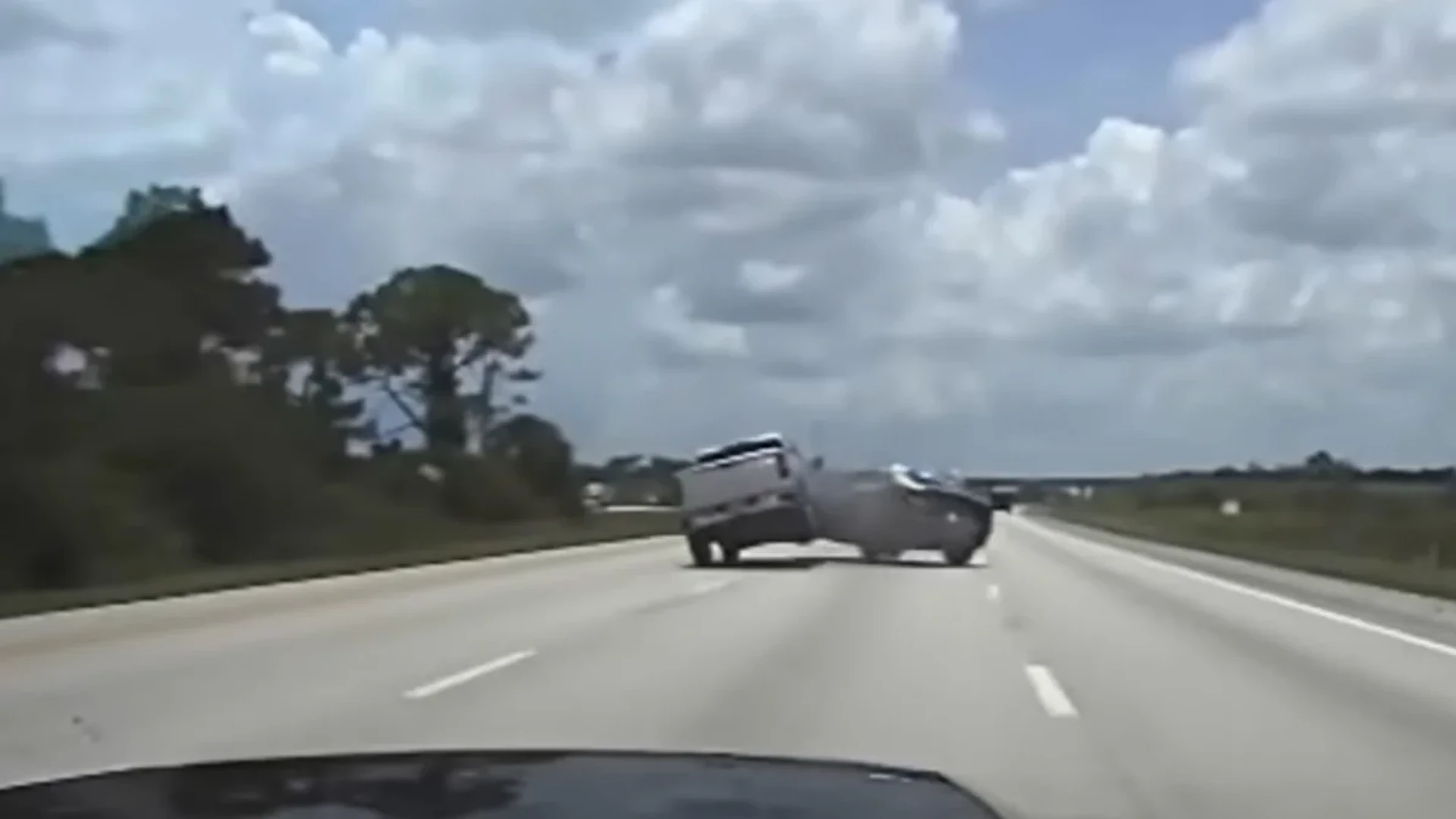
Florida Highway Patrol troopers say a 36-year-old Fort Myers man ran from them on Interstate 75 on July 8, 2025, in a 2020 Chevrolet Silverado 1500 and twice steered the pickup into a patrol car before they stopped him at Tuckers Grade in Charlotte County. Thirteen days later, the state filed a court case against the truck.
The dashcam footage has circulated online ever since, and Auto Wire covered the chase clip in February. The court file adds what the clip can’t show. On July 21, 2025, the Florida Department of Highway Safety and Motor Vehicles, the department that runs FHP, asked a Charlotte County circuit judge to find probable cause to forfeit the Silverado under the Florida Contraband Forfeiture Act, according to the case docket. The case, No. 25000953CA, is assigned to Circuit Judge Russell T. Kirshy. The truck has two registered owners, and only one of them was behind the wheel.
What Troopers Say Happened Between Lee County and Tuckers Grade
FHP told Fox 4 in Fort Myers that troopers tried to stop a pickup doing 100 mph near the Charlotte County line, that they believe the driver intentionally hit a trooper’s car and forced it into the shoulder, and that the truck kept going on a disabled right front tire until backup troopers caught it at Tuckers Grade.
The forfeiture application, which is built on affidavits from three troopers, gives the longer version. It says the chase began on I-75 in Lee County with the Silverado weaving through traffic at about 100 mph in a 70-mph zone. When Trooper Benson Prosper moved in, the application says, the driver rammed Prosper’s patrol car twice. Trooper Sean Reilly ended the chase with a PIT maneuver, and troopers made a felony stop. The application says Prosper suffered a concussion and a neck strain. FHP described the trooper’s injuries to Fox 4 as minor.
The application also lists what troopers say they found in the cab: six empty and four full liquor shooters, three burnt marijuana cigarettes weighing 1.5 grams together, marijuana paraphernalia, and prescription medication in the driver’s name. It says hospital testing put his blood alcohol level at 0.152, almost twice Florida’s 0.08 limit.
FHP identified the driver as Kevin Reardon. The Charlotte Sun’s police beat lists Kevin Donald Reardon, 36, of Fort Myers, as arrested on charges of reckless driving, drug paraphernalia, DUI with property damage, two counts of aggravated battery on an officer or firefighter, and aggravated fleeing to elude, with no bond. Those are arrest charges, not findings of guilt, and I could not confirm from online court records how his criminal case or the forfeiture case stands today.


Why Florida Law Can Treat a Pickup as Contraband
Florida’s definition of a contraband article covers any “vehicle of any kind” used “as an instrumentality in the commission of” any felony, whether or not the vehicle is an element of the crime. The state’s application cites two felonies: aggravated fleeing under section 316.1935 and aggravated battery on a law enforcement officer under section 784.07. The law doesn’t require drugs or money. A pickup driven into a patrol car fits the definition the same way a smuggler’s boat does.
The law also sets limits on how the state gets the truck. Under section 932.703, an agency can seize property only if the owner is arrested for the crime that makes it contraband, with a handful of exceptions. The agency then has 10 business days to ask a judge for a probable cause finding. The Silverado was seized on Tuesday, July 8, and the application was filed Monday, July 21, the ninth business day. Owners must be sent notice by certified mail within 5 working days of the seizure, and they have 15 days after receiving it to demand an adversarial preliminary hearing. If a judge finds no probable cause at that hearing, section 932.704 says the court “shall award” the owner attorney’s fees and costs of up to $2,000.
To take title, the state has to go further. It must file a forfeiture complaint, pay a filing fee of at least $1,000, and deposit a $1,500 bond that goes to the owner if the owner wins. The owner is entitled to a jury unless they waive it, and the court can order forfeiture only on proof beyond a reasonable doubt that the property was used in violation of the act. That is the same standard a prosecutor has to meet. Neither section 932.703 nor section 932.704 makes a criminal conviction a condition of forfeiture, though. The arrest opens the civil case, and the civil case runs on its own track.
The Second Owner’s Name on the Silverado’s Title
The docket names two registered owners of the Silverado, the driver and a second person, and says the application gave both notice of their right to request a hearing. Nothing in the records I reviewed places the second owner in the truck or shows that person was charged.
Florida law gives that second owner separate protection. Section 932.703(7)(a) bars forfeiture unless the state shows by a preponderance of the evidence that the owner “knew, or should have known after a reasonable inquiry,” that the property was being used, or was likely to be used, in criminal activity. Subsection (7)(c) applies the same knowledge test to a vehicle titled jointly by a husband and wife. Subsection (8) covers every other co-owner and adds a buyout. When a culpable co-owner’s share is forfeited, the remaining co-owner gets the chance to buy that share from the agency. If they don’t, the agency may hold the property in co-ownership, sell or liquidate its interest, or dispose of it “in any other reasonable manner.” The statute doesn’t set a price.
The records I reviewed don’t say how the two owners are related, which decides whether (7)(c) or (8) applies. The test is the same under both: the state has to prove what the second owner knew or should have known. If the state wins the driver’s share and can’t prove the co-owner knew, subsection (8) allows an outcome where the government owns part of a 2020 Silverado. For anyone who shares a title with a spouse, a partner or a grown kid, the same rules cover their truck, and the 15-day window to demand a hearing starts when the certified letter arrives.
Florida Agencies Seized $15.8 Million in Vehicles, Vessels and Aircraft in One Year
Florida agencies report forfeiture activity to the Florida Department of Law Enforcement. FDLE’s annual report for fiscal year 2023-24, the most recent one it has posted, puts statewide seizures at $56,078,315.04. Of that, $15,791,526.59 fell in the conveyance category, which covers vehicles, vessels and aircraft. That’s about 28 percent of the total. Sheriffs reported $7,905,812.50 in conveyance seizures, police departments $7,002,172.09 and state agencies $882,196.
Section 932.704 says agencies may use forfeiture proceeds as “supplemental funding,” and the same subsection says the potential for revenue “must not override fundamental considerations such as public safety, the safety of law enforcement officers, or the investigation and prosecution of criminal activity.” Other states keep arguing over how far to go. In Kentucky, a bill to crush street racers’ cars has died again. Florida already has a working tool for taking a vehicle, and a chase like this one is the kind of case it covers.
What the Fleeing and Battery Charges Carry on Conviction
If prosecutors pursue the charges as booked, the penalties are heavy. Under section 316.1935(3)(a), fleeing a marked patrol car with lights and siren on while driving at high speed, or with wanton disregard for safety, is a second-degree felony. It becomes a first-degree felony if the driver causes serious bodily injury to another person, and the statute names pursuing officers among those people. A conviction under the fleeing statute brings a mandatory license revocation of 1 to 5 years. Subsection (6) also bars judges from withholding adjudication, so a guilty or no-contest plea still ends in a formal conviction. Under section 784.07, aggravated battery on a law enforcement officer moves up from a second-degree to a first-degree felony and carries a 5-year minimum prison term on conviction.
What Happens Next in Charlotte County
The forfeiture docket I reviewed lists filings from July 21, 2025: the application, a notice of filing, a civil cover sheet and the court’s standing order in civil cases. The next steps set out in the statute are a probable cause ruling, a hearing if either owner requested one within the 15-day window, and a complaint with the $1,000 fee and $1,500 bond if the state goes for title. Charlotte County’s clerk keeps both the civil and criminal files in its online court search. Reardon has not been convicted of the charges in the records I reviewed, and the truck’s fate depends on two cases that don’t have to end the same way.
Florida can seize a vehicle after an arrest and win it in civil court without a criminal conviction, as long as it proves beyond a reasonable doubt how the vehicle was used. Should forfeiture of a car or truck wait until the driver is convicted, or is an arrest plus proof in civil court enough?
Image via Scooper/YouTube – See the full video here.